
Pulp Fiction, 1917 · page 20 of 228
Adventure, February 1917 — page 20: what you’re looking at
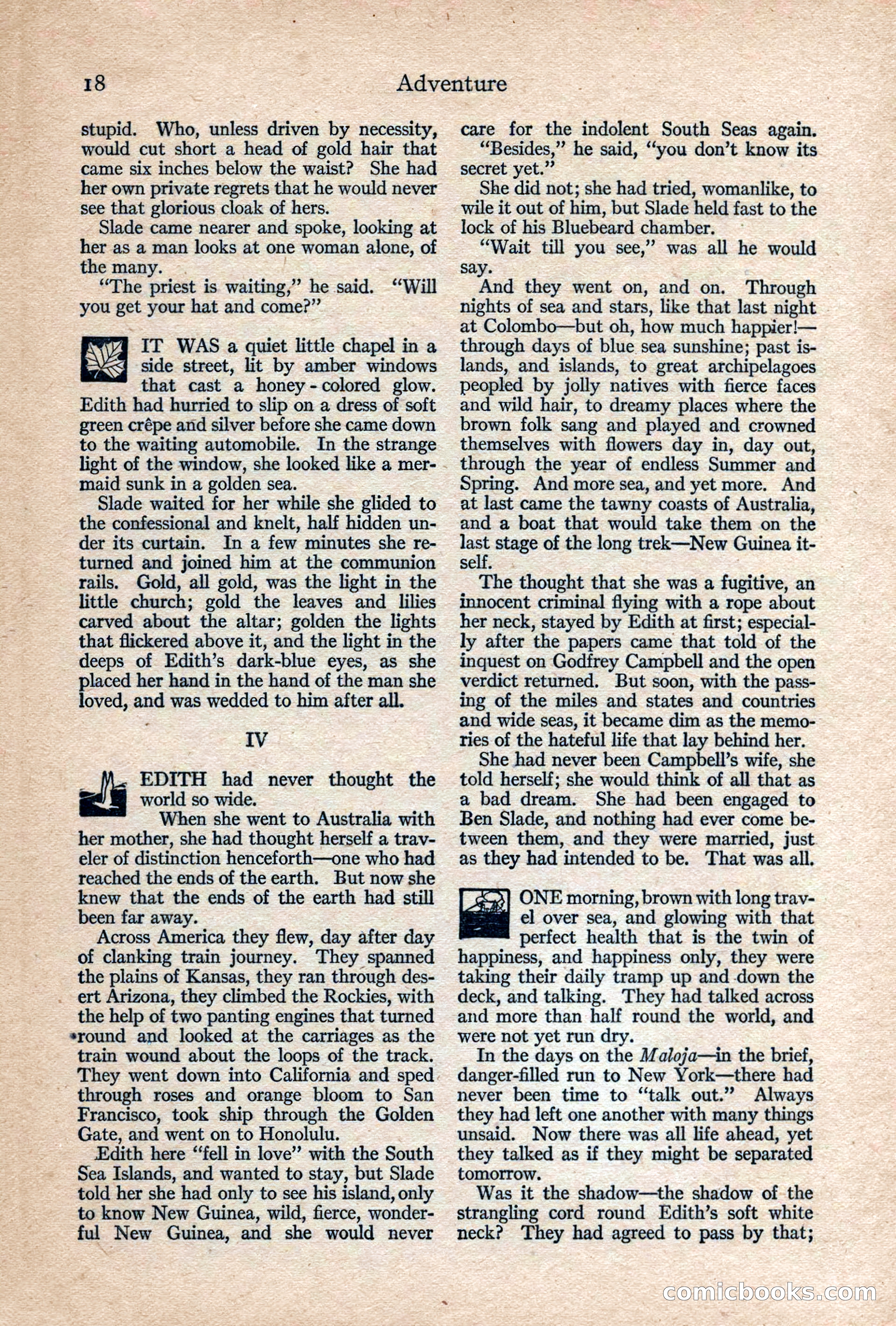
A restored page from Pulp Fiction, 1917. Page through the whole issue in the reader above.
📄 Transcribed text from this page (OCR, searchable)
Machine-transcribed from the original scan — historical spelling and the odd misread are preserved.
18 stupid. Who, unless driven by necessity, would cut short a head of gold hair that came six inches below the waist? She had - her own private regrets that he would never see that glorious cloak of hers. sr Slade came nearer and spoke, looking at her as a man looks at one woman alone, of the many. | “The priest is waiting,” he said. “Will you get your hat and come?” wy IT WAS a quiet little chapel in a <i side street, lit by amber windows that cast a honey-colored glow. Edith had hurried to slip on a dress of soft green crépe and silver before she came down to the waiting automobile. In the strange light of the window, she looked like a mer- - maid sunk in a golden sea. : Slade waited for her while she glided to the confessional and knelt, half hidden un- der its curtain. In a few minutes she re- turned and joined him at the communion rails. Gold, all gold, was the light in the little church; gold the leaves and lilies carved about the altar; golden the lights that flickered above it, and the light in the deeps of Edith’s dark-blue eyes, as she placed her hand in the hand of the man she loved, and was wedded to him after all. IV EDITH had never thought the world so wide. When she went to Australia with her mother, she had thought herself a trav- eler of distinction henceforth—one who had reached the ends of the earth. But now she knew that the ends of the earth had still been far away. Across America they flew, day after day of clanking train journey. They spanned the plains of Kansas, they ran through des- . ert Arizona, they climbed the Rockies, with the help of two panting engines that turned sround and looked at the carriages as the train wound about the loops of the track. al _ They went down into California and sped. through roses and orange bloom to San Francisco, took ship through the Golden Gate, and went on to Honolulu. — Edith here “fell in love” with the South Sea Islands, and wanted to stay, but Slade told her she had only to see his island, only to know New Guinea, wild, fierce, wonder- ful New Guinea, and she would never Adventure care for the indolent South Seas again. “Besides,” he said, “you don’t know its secret yet.” She did not; she had tried, womanlike, to wile it out of him, but Slade held fast to the lock of his Bluebeard chamber. “Wait till you see,” was all he would say. And they went on, and on. Through nights of sea and stars, like that last night - at Colombo—but oh, how much happier!— through days of blue sea sunshine; past is- lands, and islands, to great archipelagoes peopled by jolly natives with fierce faces and wild hair, to dreamy places where the brown folk sang and played and crowned themselves with flowers day in, day out, through the year of endless Summer and Spring. And more sea, and yet more. And at last came the tawny coasts of Australia, and a boat that would take them on the last stage of the long trek—New Guinea it- self. =; The thought that she was a fugitive, an innocent criminal flying with a rope about her neck, stayed by Edith at first; especial- ly after the papers came that told of the inquest on Godfrey Campbell and the open verdict returned. But soon, with the pass- ing of the miles and states and countries and wide seas, it became dim as the memo- ries of the hateful life that lay behind her. She had never been Campbell’s wife, she told herself; she would think of all that as a bad dream. She had been engaged to Ben Slade, and nothing had ever come be- tween them, and they were married, just as they had intended to be. That was all, $99] ONE morning, brown with long trav- jem el over sea, and glowing with that perfect health that is the twin of happiness, and happiness only, they were taking their daily tramp up and -down the deck, and talking. They had talked across and more than half round the world, and were not yet run dry. In the days on the Maloja—in the brief, danger-filled run to New York—there had never been time to “talk out.” Always they had left one another with many things unsaid. Now there was all life ahead, yet they talked as if they might be separated tomorrow. Was it the shadow—the shadow of the strangling cord round Edith’s soft white neck? They had agreed to pass by that; Gomicbooks (C@