
Pulp Fiction, 1917 · page 170 of 228
Adventure, February 1917 — page 170: what you’re looking at
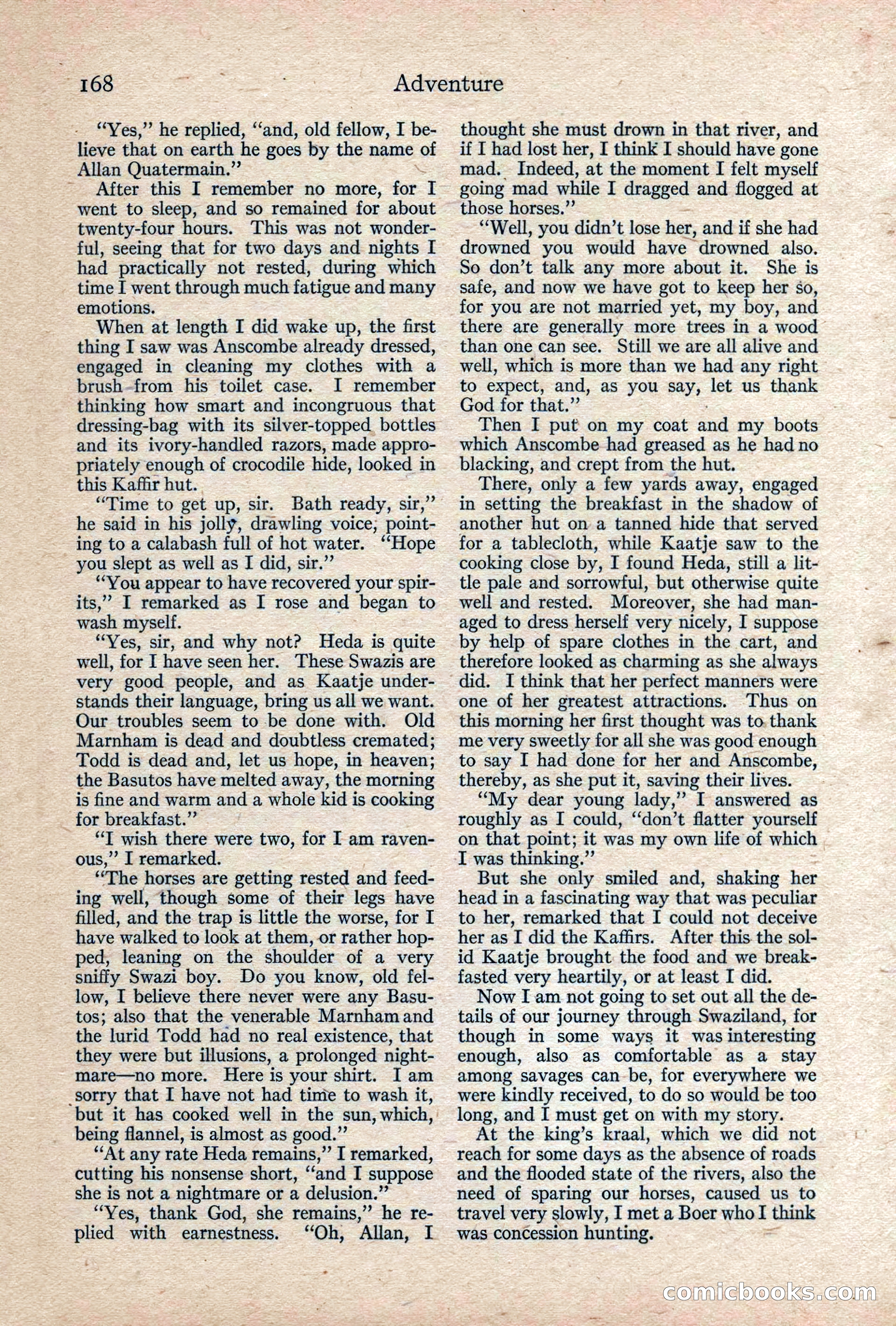
A restored page from Pulp Fiction, 1917. Page through the whole issue in the reader above.
📄 Transcribed text from this page (OCR, searchable)
Machine-transcribed from the original scan — historical spelling and the odd misread are preserved.
168 “Ves,” he replied, “‘and, old fellow, I be- lieve that on earth he goes by the name of Allan Quatermain,.”’ After this I remember no more, far T went to sleep, and so remained for about twenty-four hours. This was not wonder- ful, seeing that for two days and nights I had practically not rested, during which time I went through much fatigue and many emotions. When at length I did wake up, the first thing I saw was Anscombe already dressed, engaged in cleaning my clothes with a brush-from his toilet case. I remember thinking how smart and incongruous that dressing-bag with its silver-topped. bottles and its ivory-handled razors, made appro- priately enough of crocodile hide, looked in this Kaffir hut. “Time to get up, sir. Bath ready, sir,” he said in his jolly, drawling voice; point- ing to a calabash full of hot water. “Hope _ you slept as well as I did, sir.” “You appear to have recovered your spir- its,’ I remarked as I rose and began to wash myself. “Ves, sir, and why not? Heda is quite well, for I have seen her. These Swazis are very good people, and as Kaatje under- stands their language, bring us all we want. Our troubles seem to be done with. Old Marnham is dead and doubtless cremated; Todd is dead and, let us hope, in heaven; the Basutos have melted away, the morning is fine and warm and a whole kid is cooking for breakfast.” “T wish there were two, for I am raven- ous,” I remarked. “‘The horses are getting rested and feed- ing well, though some of their legs have filled, and the trap is little the worse, for I have walked to look at them, or rather hop- ped, leaning on the shoulder of a very sniffy Swazi boy. Do you know, old fel- low, I believe there never were any Basu- tos; also that the venerable Marnham and the lurid Todd had no real existence, that they were but illusions, a prolonged night- mare—no more. Here is your shirt. I am _sorry that I have not had tinie to wash it, but it has cooked well in the sun, which, being flannel, is almost as good.” ““At any rate Heda remains,” I remarked, cutting his nonsense short, ‘‘and I suppose she is not a nightmare or a delusion.” “Yes, thank God, she remains,” he re- plied with earnestness. “Oh, Allan, I Adventure thought she must drown in that river, and if I had lost her, I think I should have gone mad. Indeed, at the moment I felt myself going mad while I ceepeed and flogged at those horses.” “Well, you didn’t lose her, and if she had drowned you would have drowned also. So don’t talk any more about it. She is safe, and now we have got to keep her so, for you are not married yet, my boy, and there are generally more trees in a wood than one can see. Still we are all alive and well, which is more than we had any right to expect, and, as you say, let us thank God for that.” Then I put on my coat and my boots which Anscombe had greased as he had no blacking, and crept from the hut. There, only a few yards away, engaged in setting the breakfast in the shadow of another hut on a tanned hide that served for a tablecloth, while Kaatje saw to the cooking close by, I found Heda, still a lit- tle pale and sorrowful, but otherwise quite well and rested. Moreover, she had man- aged to dress herself very nicely, I suppose by help of spare clothes in the cart, and therefore looked as charming as she always did. I think that her perfect manners were one of her greatest attractions. Thus on this morning her first thought was to. thank me very sweetly for all she was good enough to say I had done for her and Anscombe, thereby, as she put it, saving their lives. “My dear young lady,” I answered as roughly as I could, “don’t flatter yourself on that point; it was my own life of which I was thinking.”’ But she only smiled and, shaking her head in a fascinating way that was peculiar to her, remarked that I could not deceive her as I did the Kaffirs. After this the sol- id Kaatje brought the food and we break- fasted very heartily, or at least I did. Now I am not going to set out all the de- tails of our journey through Swaziland, for though in some ways it was interesting enough, also as comfortable as a stay among savages can-be, for everywhere we were kindly received, to do so would be too long, and I must get on with my story. At the king’s kraal, which we did not reach for some days as the absence of roads and the flooded state of the rivers, also the need of sparing our horses, caused us to travel very slowly, I met a Boer who I think was concession hunting. CO) Gomicbook