
Pulp Fiction, 1917 · page 169 of 228
Adventure, February 1917 — page 169: what you’re looking at
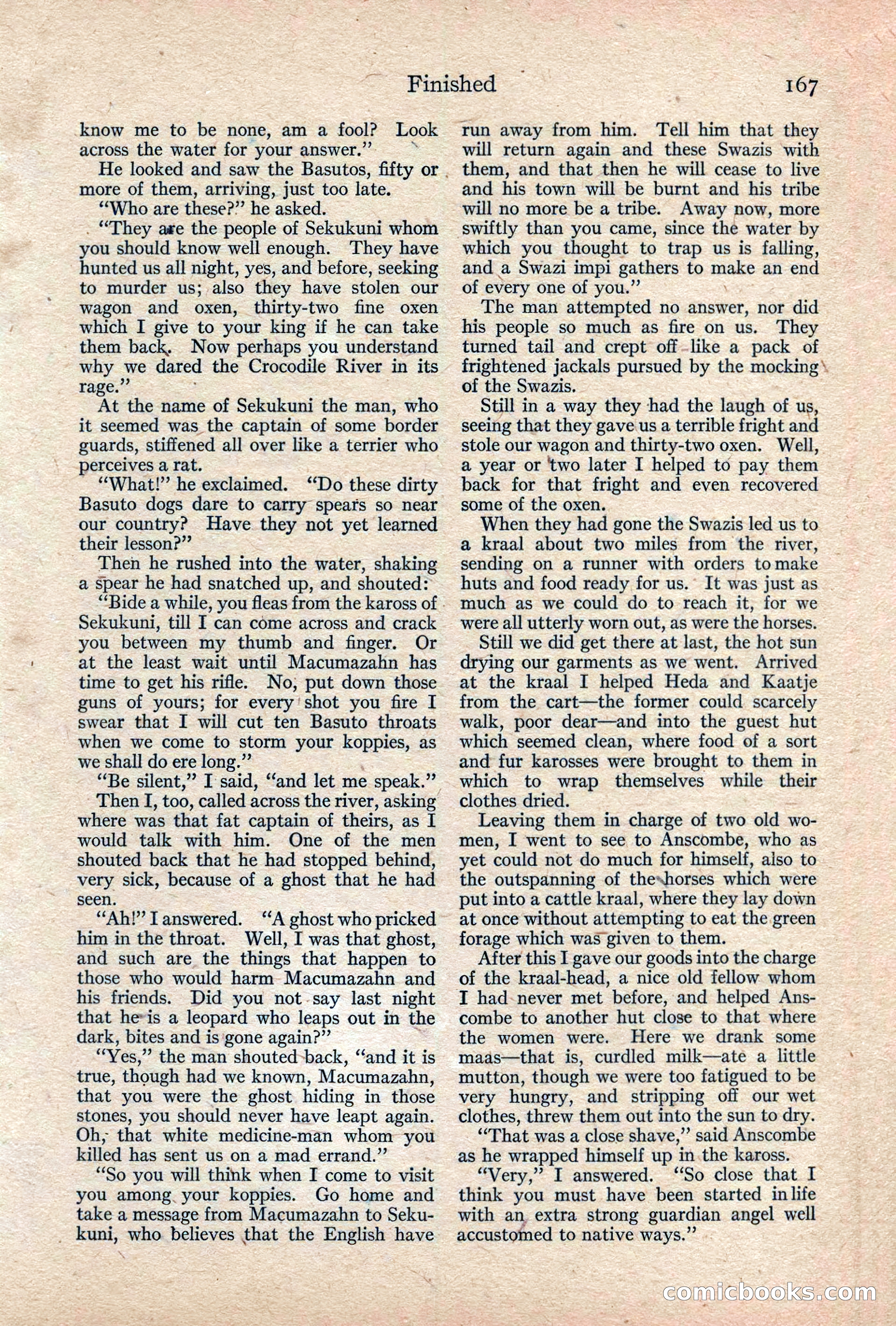
A restored page from Pulp Fiction, 1917. Page through the whole issue in the reader above.
📄 Transcribed text from this page (OCR, searchable)
Machine-transcribed from the original scan — historical spelling and the odd misread are preserved.
Finished know me to be none, am a fool? Look across the water for your answer.”’ : He looked and saw the Basutos, fifty or . more of them, arriving, just too late. “Who are these?” he asked. “They ate the people of Sekukuni whom you should know well enough. They have hunted us all night, yes, and before, seeking to murder us; also they have stolen our wagon and oxen, thirty-two fine oxen which I give to your king if he can take - them back. Now perhaps you understand why we dared the Crocodile River in its rage.” At the name of Sekukuni the man, who it seemed was the captain of some border guards, stiffened all over like a terrier who perceives a rat. “What!” he exclaimed. “Do these dirty Basuto dogs dare to carry spears so near our country? Have they not yet learned their lesson?” 7 _ Then he rushed into the water, shaking a Spear he had snatched up, and shouted: “Bide a while, you fleas from the kaross of - Sekukuni, till I can come across and crack you between my thumb and finger. Or at the least wait until Macumazahn has time to get his rifle. No; put down those guns of yours; for every'shot you fire I swear that I will cut ten Basuto throats when we come to storm your koppies, as we shall do ere long.” “Be silent,” I said, “and let me speak.” Then I, too, called across the river, asking where was that fat captain of theirs, as I would talk with him. One of the men shouted back that he had stopped behind, very sick, because of a ghost that he had seen. “Ah!” Tanswered. ‘A ghost who pricked him in the throat. Well, I was that ghost, and such are the things that happen to those who would harm Macumazahn and his friends. Did you not-say last night that hevis a leopard who leaps out in the dark, bites and is gone again?” “Yes,” the man shouted-back, “and it is ‘true, though had we known, Macumazahn, that you were the ghost hiding in those stones, you should never have leapt again. Oh, that white medicine-man whom you killed has sent us on a mad errand.” ‘So you will think when I come to visit you among. your koppies. Go home and take a message from Macumazahn to Seku- _ kuni, who believes that the English have run away from him. 167 Tell him that they will return again and these Swazis with them, and that then he will cease to live and his town will be burnt and his tribe will no more be a tribe. Away now, more swiftly than you came, since the water by which you thought to trap us is falling, and a Swazi impi gathers to make an end of every one of you.’ The man attempted no answer, nor did his people so much as fire on us. They turned tail and crept off-like a pack of frightened jackals pursued by the mocking of the Swazis. Still in a way they had the laugh of us, seeing that they gave us a terrible fright and stole our wagon and thirty-two oxen. Well, a year or ‘two later I helped to pay them back for that fright and even recovered some of the oxen. When they had gone the Swazis led us to a kraal about two miles from the river, sending on a runner with orders tomake huts and food ready for us. much as we could do to reach it, for we were all utterly worn out, as were the horses. Still we did get there at last, the hot sun drying our garments as we went. Arrived at the kraal I helped Heda and Kaatje from the cart—the former could scarcely walk, poor dear—and into the guest hut which seemed clean, where food of a sort and fur karosses were brought to them in which to wrap themselves while their clothes dried. Leaving them in charge of two old wo- men, I went to see to Anscombe, who as ’ It was just as _. yet could not do much for himself, also to the outspanning of theshorses which were put into a cattle kraal, where they lay down at once without attempting to eat the green forage which was given to them. After this I gave our goods into the charge of the kraal-head, a nice old fellow whom IT had-never met before, and helped Ans- combe to another hut close to that where the women were. Here we drank some madas—that is, curdled milk—ate a little mutton, though we were too fatigued to be very hungry, and stripping off our wet clothes, threw them out into the sun to dry. “That was a close shave,’’ said Anscombe as he wrapped himself up ‘in the kaross. “Very,” I answered. “So close that I think you must have been started in life with an extra strong guardian angel well accustomed to native ways.’ ook (E©) (E©)