
Pulp Fiction, 1916 · page 167 of 228
Adventure Magazine, March 1916 — page 167: what you’re looking at
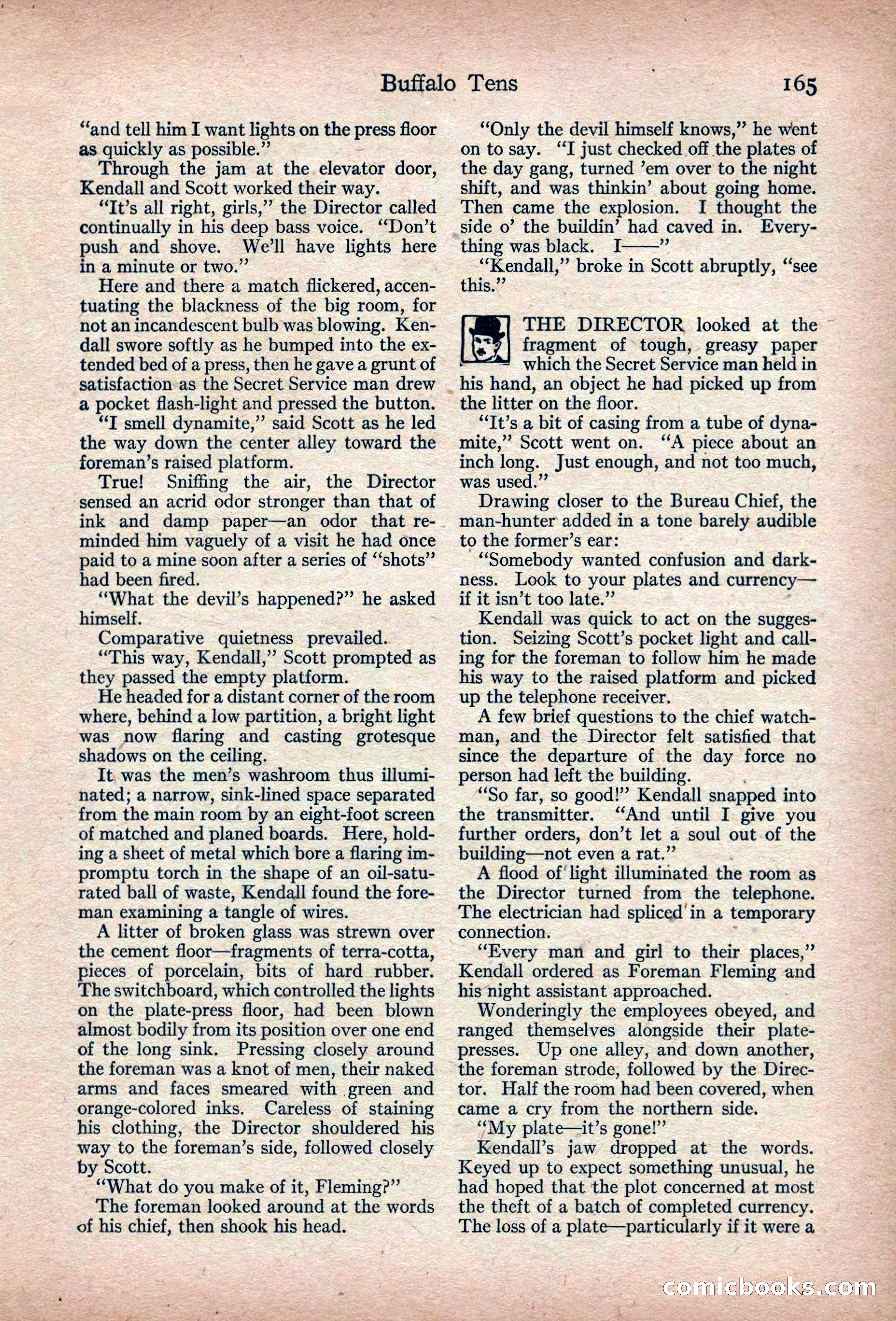
A restored page from Pulp Fiction, 1916. Page through the whole issue in the reader above.
📄 Transcribed text from this page (OCR, searchable)
Machine-transcribed from the original scan — historical spelling and the odd misread are preserved.
Buffalo Tens “and tell him I want lights on the press floor as quickly as possible.”’ Through the jam at the elevator door, Kendall and Scott worked their way. “Tt’s all right, girls,’’ the Director called continually in his deep bass voice. ‘Don’t push and shove. We'll have lights here in a minute or two.” Here and there a match flickered, accen- tuating the blackness of the big room, for not an incandescent bulb was blowing. Ken- dall swore softly as he bumped into the ex- tended bed of a press, then he gave a grunt of satisfaction as the Secret Service man drew a pocket flash-light and pressed the button. “T smell dynamite,” said Scott as he led the way down the center alley toward the foreman’s raised platform. True! Sniffing the air, the Director ‘sensed an acrid odor stronger than that of ink and damp paper—an odor that re-. minded him vaguely of a visit he had once paid to a mine soon after a series of ‘“‘shots” had been fired. “What the devil’s happened?” he asked himself. Comparative quietness prevailed. “This way, Kendall,’ Scott prompted as they passed the empty platform. He headed for a distant corner of the room where, behind a low partition, a bright light was now flaring and casting grotesque shadows on the ceiling. It. was the men’s washroom thus illumi- nated; a narrow, sink-lined space separated from the main room by an eight-foot screen of matched and planed boards. Here, hold- ing a sheet of metal which bore a flaring im- promptu torch in the shape of an oil-satu- rated ball of waste, Kendall found the fore- man examining a tangle of wires. A litter of broken glass was strewn over the cement floor—fragments of terra-cotta, pieces of porcelain, bits of hard rubber. The switchboard, which controlled the lights on the plate-press floor, had been blown almost bodily from its position over one end of the long sink. Pressing closely around the foreman was a knot of men, their naked arms and faces smeared with green and orange-colored inks. Careless of staining his clothing, the Director shouldered his way to the foreman’s side, followed closely by Scott. “What do you make of it, Fleming?” The foreman looked around at the words of his chief, then shook his head. 165 “Only the devil himself knows,”’ he went on to say. “I just checked off the plates of the day gang, turned ’em over to the night shift, and was thinkin’ about going home. Then came the explosion. I thought the side o’ the buildin’ had caved in. Every- thing was black. J-——” “Kendall,” broke in Scott abruptly, “‘see this. 3) fragment of tough, greasy paper which the Secret Service man held in : his hand, an object he had picked up from the litter on the floor. THE DIRECTOR looked at the ~ “It’s a bit of casing from a tube of dyna- ~ mite,’ Scott went on. “A piece about an inch long. Just enough, and not too much, was used.” Drawing closer to the Bureau Chief, the man-hunter added in a tone barely audible to the former’s ear: “Somebody wanted confusion and dark- ness. Look to your plates and currency— if it isn’t too late.” Kendall was quick to act on the sugges- tion. Seizing Scott’s pocket light and call- ing for the foreman to follow him he made his way to the raised platform and picked up the telephone receiver. A few brief questions to the chief watch- man, and the Director felt satisfied that since the departure of the day force no person had left the building. “So far, so good!”’ Kendall snapped into the transmitter. “And until I give you further orders, don’t let a soul out of the building—not even a rat.” A flood of‘light illuminated the room as the Director turned from the telephone. The electrician had spliced’in a temporary connection. “Every man and girl to their places,” Kendall ordered as Foreman Fleming and his night assistant approached. Wonderingly the employees obeyed, and ranged themselves alongside their plate- presses. Up one alley, and down another, the foreman strode, followed by the Direc- tor. Half the room had been covered, when came a cry from the northern side. “My plate—it’s gone!” Kendall’s jaw dropped at the words. Keyed up to expect something unusual, he had hoped that the plot concerned at most the theft of a batch of completed currency. The loss of a plate—particularly if it were a Gomichbooks (ECO)