
Pulp Fiction, 1916 · page 165 of 228
Adventure Magazine, March 1916 — page 165: what you’re looking at
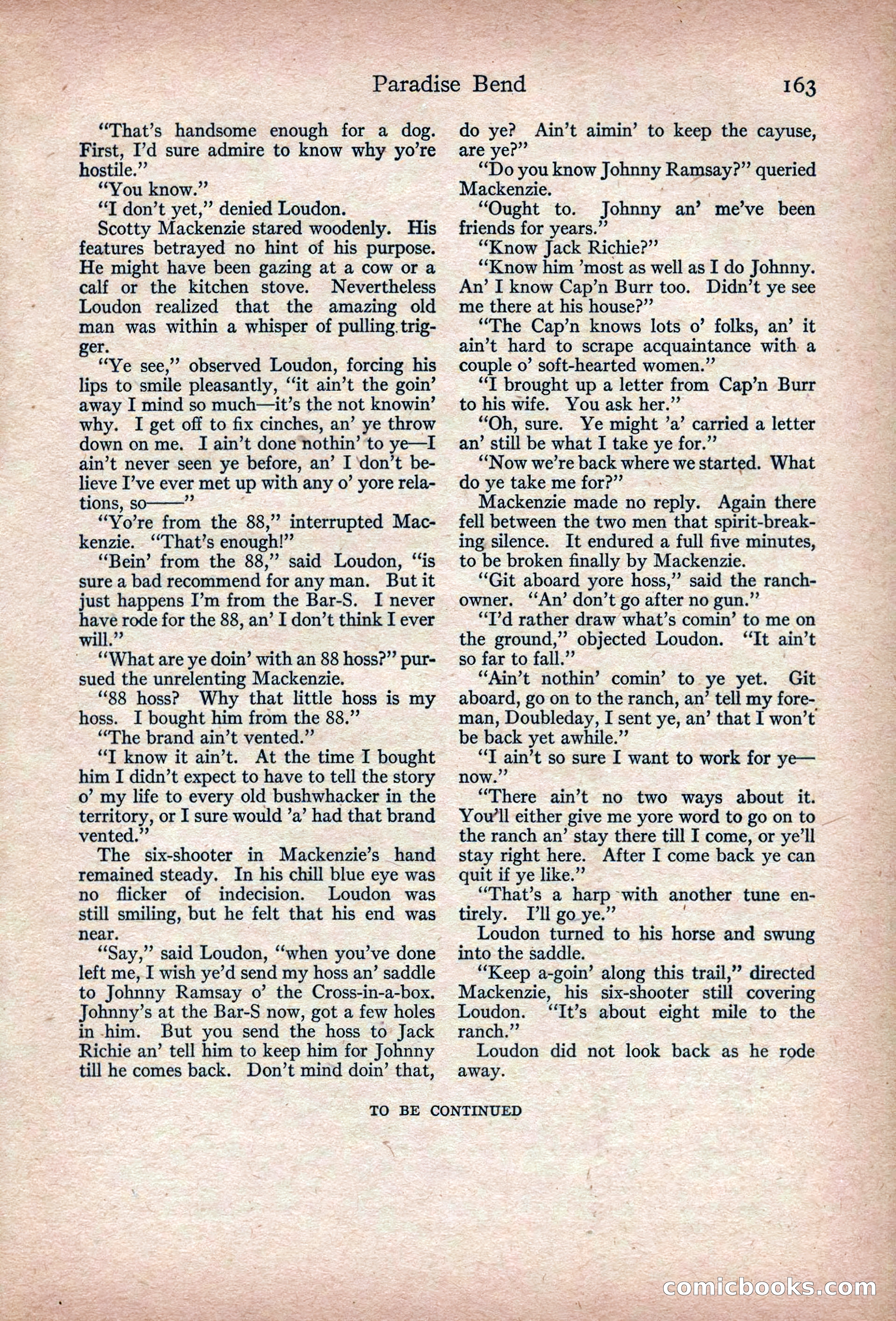
A restored page from Pulp Fiction, 1916. Page through the whole issue in the reader above.
📄 Transcribed text from this page (OCR, searchable)
Machine-transcribed from the original scan — historical spelling and the odd misread are preserved.
Paradise Bend “That’s handsome enough for a dog. First, I’d sure admire to know why yo’re hostile.”’ “You know.” “T don’t yet,” denied Loudon. Scotty Mackenzie stared woodenly. His features betrayed no hint of his purpose. He might have been gazing at a cow or a calf or the kitchen stove. Nevertheless Loudon realized that the amazing old man was within a whisper of pulling trig- er. : “Ve see,’ observed Loudon, forcing his lips to smile pleasantly, “it ain’t the goin’ away I mind so much—it’s the not knowin’ why. I get off to fix cinches, an’ ye throw down on me. JI ain’t done nothin’ to ye—I ain’t never seen ye before, an’ i ‘don’t be- lieve I’ve ever met up with any 0’ yore rela- tions, so——”’ “VYo’re from the 88,” interrupted Mac- kenzie. ‘““That’s enough!” ‘Bein’ from the 88,” said Loudon, ‘“‘is sure a bad recommend for any man. But it just happens I’m from the Bar-S. I never have rode for the 88, an’ I don’t think I ever | will.” ‘What are ye doin’ with an 88 hoss?” pur- sued the unrelenting Mackenzie. “88 hossP Why that little hoss is my hoss. I bought him from the 83.” “The brand ain’t vented.” “T know it ain’t. At the time I bought him I didn’t expect to have to tell the story o’ my life to every old bushwhacker i in the territory, or I sure would ’a’ had that brand vented.” The six-shooter in Mackenzie’s hand remained steady. In his chill blue eye was no flicker of indecision. Loudon was still smiling, but he felt that his end was near. “Say,” said Loudon, ‘“‘when you’ve done left me, I wish ye’d send my hoss an’ saddle to Johnny Ramsay o’ the Cross-in-a-box. Johnny’s at the Bar-S now, got a few holes in -him. But you send the hoss to Jack Richie an’ tell him to keep him for Johnny till he comes back. Don’t mind doin’ that, 163 do ye? Ain’t aimin’ to keep the cayuse, are ye?” “Do you know Johnny wes ec queried Mackenzie. “Ought to. Johnny an’ me’ve been friends for years.” “Know Jack Richie?”’ “Know him ’most as well as I do Johnny. An’ I know Cap’n Burr too. Didn’t ye see me there at his house?” “The Cap’n knows lots o’ folks, an’ it ain’t hard to scrape acquaintance with a couple o’ soft-hearted women.” “T brought up a letter from Cap’n Burr to his wife. You ask her.” Ob, sure. Ye might ’a’ carried a letter an’ still be what I take ye for.” “Now we're back where we started. What do ye take me for?” Mackenzie made no reply. Again there fell between the two men that spirit-break- ing silence. It endured a full five minutes, to be broken finally by Mackenzie. “Git aboard yore hoss,” said the ranch- owner. ‘‘An’ don’t go after no gun.” “T’d rather draw what’s comin’ to me on the ground,” objected Loudon. “It ain’t so far to fall.” “Ain’t nothin’ comin’ to ye yet. Git aboard, go on to the ranch, an’ tell my fore- man, Doubleday, I sent ye, an’ that I won’t be back yet awhile.” “T ain’t so sure I want to work for ye— now.” “There ain’t no two ways about it. Yow’ll either give me yore word to go on to © the ranch an’ stay there till I come, or ye’ll stay right here. After I come back ye can quit if ye like.” “Thats a harp with another tune en- tirely. Tl go ye.” Loudon ned to his horse and swung into the saddle. “Keep a-goin’ along this trail,” directed Mackenzie, his six-shooter still covering Loudon. “It’s about eight mile to the ranch.” Loudon did not look back as he rode away. TO BE CONTINUED comichbook (E()