
Pulp Fiction, 1928 · page 163 of 200
Adventure, July 1, 1928 — page 163: what you’re looking at
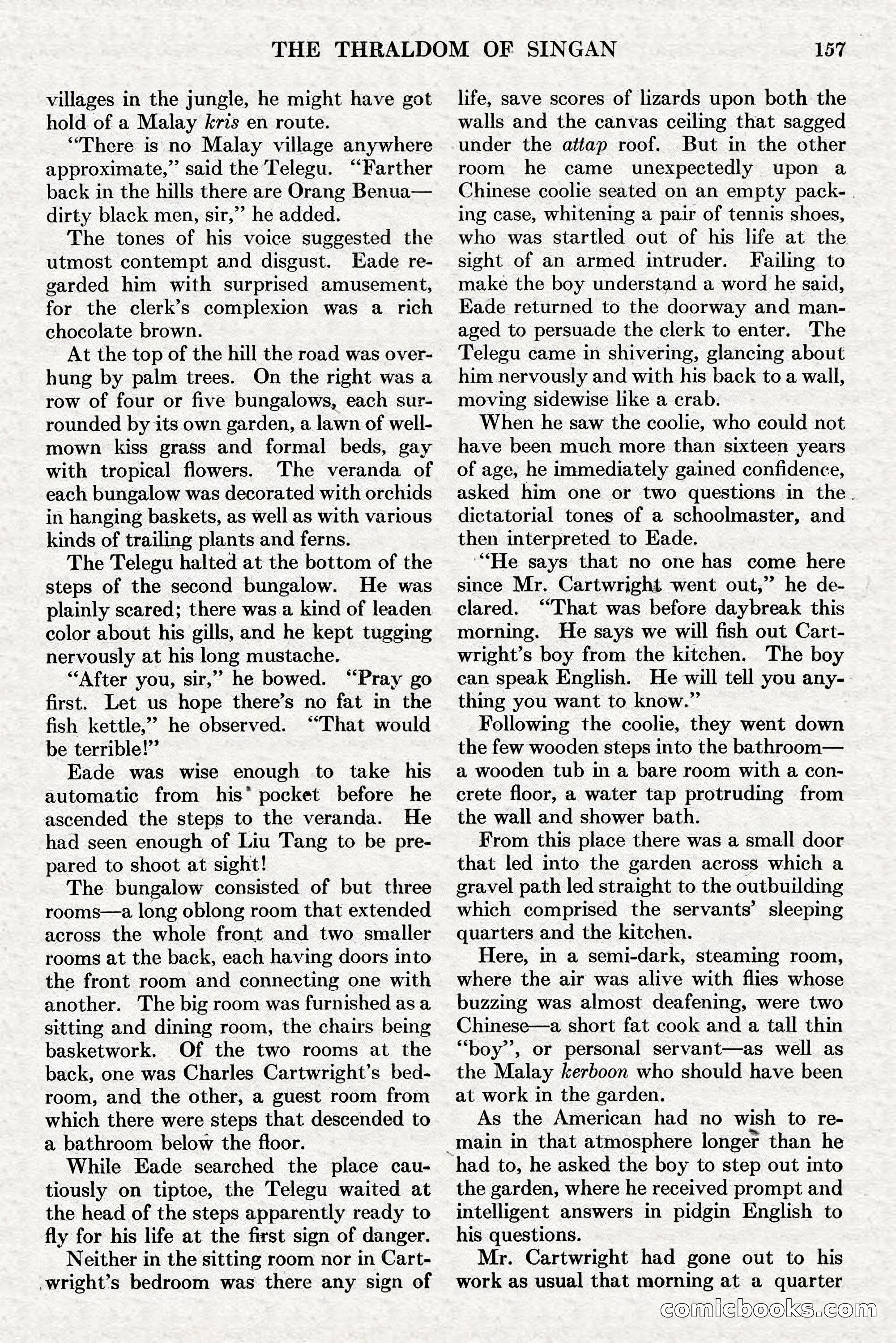
A restored page from Pulp Fiction, 1928. Page through the whole issue in the reader above.
📄 Transcribed text from this page (OCR, searchable)
Machine-transcribed from the original scan — historical spelling and the odd misread are preserved.
THE THRALDOM OF SINGAN villages in the jungle, he might have got hold of a Malay kris en route. “There is no Malay village anywhere approximate,”’ said the Telegu. “Farther back in the hills there are Orang Benua— dirty black men, sir,”’ he added. The tones of his voice suggested the utmost contempt and disgust. Eade re- garded him with surprised amusement, for the clerk’s complexion was a rich chocolate brown. At the top of the hill the road was over- hung by palm trees. On the right was a row of four or five bungalows, each sur- rounded by its own garden, a lawn of well- mown kiss grass and formal beds, gay with tropical flowers. The veranda of each bungalow was decorated with orchids in hanging baskets, as well as with various kinds of trailing plants and ferns. The Telegu halted at the bottom of the steps of the second bungalow. He was plainly scared; there was a kind of leaden color about his gills, and he kept tugging nervously at his long mustache. “After you, sir,” he bowed. “Pray go first. Let us hope there’s no fat in the fish kettle,”’ he observed. “That would be terrible!” Eade was wise enough to take his automatic from his* pocket before he ascended the steps to the veranda. He had seen enough of Liu Tang to be pre- pared to shoot at sight! The bungalow consisted of but three rooms—a long oblong room that extended across the whole front and two smaller rooms at the back, each having doors into the front room and connecting one with another. The big room was furnished as a sitting and dining room, the chairs being basketwork. Of the two rooms at the back, one was Charles Cartwright’s bed- room, and the other, a guest room from which there were steps that descended to a bathroom below the floor. While Eade searched the place cau- tiously on tiptoe, the Telegu waited at the head of the steps apparently ready to fly for his life at the first sign of danger. Neither in the sitting room nor in Cart- _wright’s bedroom was there any sign of 157 life, save scores of lizards upon both the walls and the canvas ceiling that sagged under the attap roof. But in the other room he came unexpectedly upon a Chinese coolie seated on an empty pack- . ing case, whitening a pair of tennis shoes, who was startled out of his life at the sight of an armed intruder. Failing to make the boy understand a word he said, Eade returned to the doorway and man- aged to persuade the clerk to enter. The Telegu came in shivering, glancing about him nervously and with his back to a wall, moving sidewise like a crab. When he saw the coolie, who could not have been much more than sixteen years of age, he immediately gained confidence, asked him one or two questions in the. dictatorial tones of a schoolmaster, and then interpreted to Eade. “He says that no one has come here since Mr. Cartwright went out,” he de- clared. ‘That was before daybreak this morning. He says we will fish out Cart- wright’s boy from the kitchen. The boy can speak English. He will tell you any- thing you want to know.” Following the coolie, they went down the few wooden steps into the bathroom— a wooden tub in a bare room with a con- crete floor, a water tap protruding from the wall and shower bath. From this place there was a small door that led into the garden across which a gravel path led straight to the outbuilding which comprised the servants’ sleeping quarters and the kitchen. Here, in a semi-dark, steaming room, where the air was alive with flies whose buzzing was almost deafening, were two Chinese—a short fat cook and a tall thin “boy”, or personal servant—as well as the Malay kerboon who should have been at work in the garden. As the American had no wish to re- main in that atmosphere longer than he : P. 4 had to, he asked the boy to step out into the garden, where he received prompt and intelligent answers in pidgin English to his questions. Mr. Cartwright had gone out to his work as usual that morning at a quarter comicloooks.com