
Pulp Fiction, 1928 · page 162 of 200
Adventure, July 1, 1928 — page 162: what you’re looking at
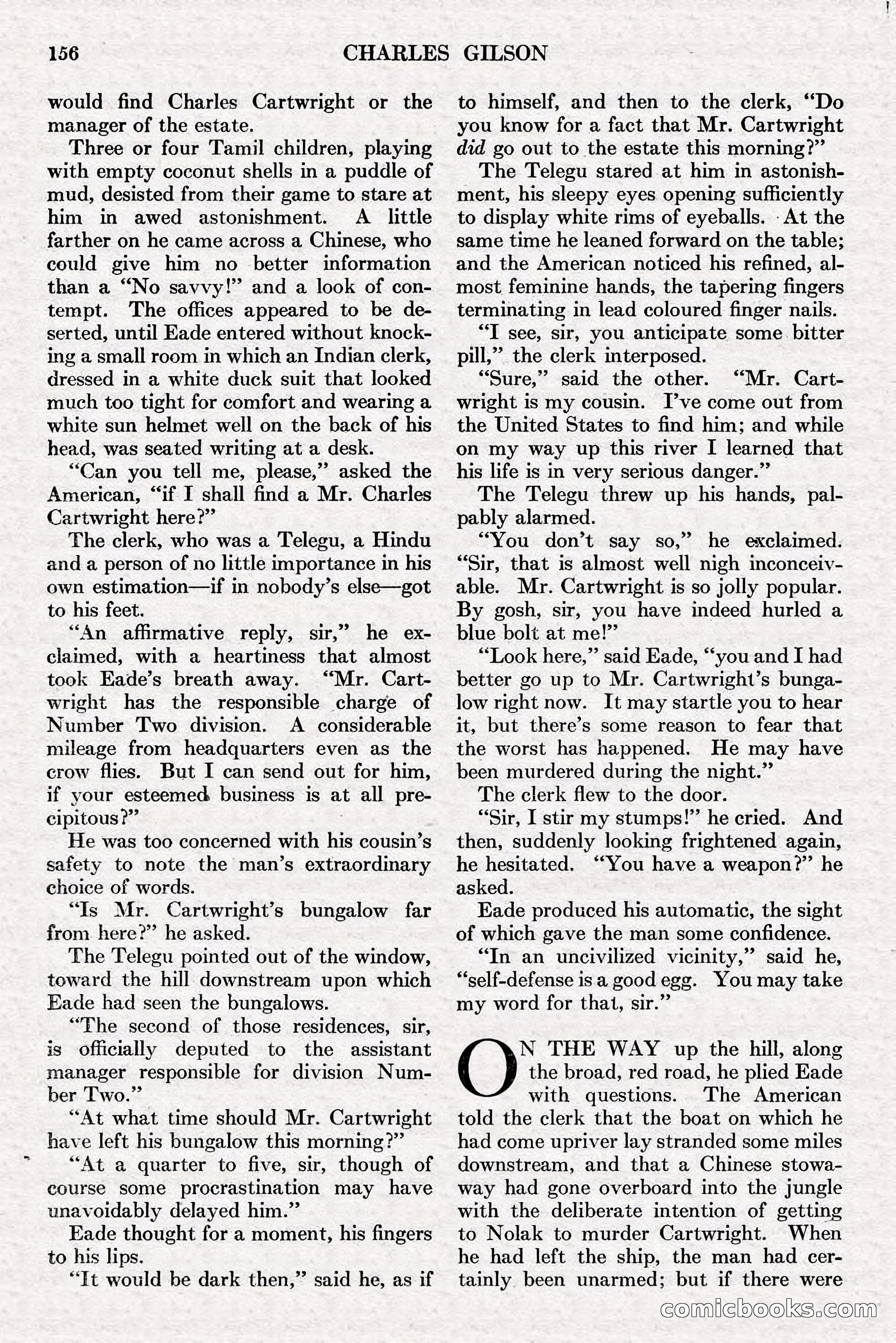
A restored page from Pulp Fiction, 1928. Page through the whole issue in the reader above.
📄 Transcribed text from this page (OCR, searchable)
Machine-transcribed from the original scan — historical spelling and the odd misread are preserved.
156 would find Charles Cartwright or the manager of the estate. Three or four Tamil children, playing with empty coconut shells in a puddle of mud, desisted from their game to stare at him in awed astonishment. A little farther on he came across a Chinese, who could give him no better information than a “No savvy!” and a look of con- tempt. The offices appeared to be de- serted, until Eade entered without knock- ing a small room in which an Indian clerk, dressed in a white duck suit that looked much too tight for comfort and wearing a white sun helmet well on the back of his head, was seated writing at a desk. “Can you tell me, please,” asked the American, “if I shall find a Mr. Charles Cartwright here?’ The clerk, who was a Telegu, a Hindu and a person of no little importance in his own estimation—if in nobody’s else—got to his feet. “An affirmative reply, sir,” he ex- claimed, with a heartiness that almost took Eade’s breath away. “Mr. Cart- wright has the responsible charge of Number Two division. A considerable mileage from headquarters even as the crow flies. But I can send out for him, if your esteemed business is at all pre- cipitous?” ; He was too concerned with his cousin’s safety to note the man’s extraordinary choice of words. “Is Mr. Cartwright’s bungalow far from here?’’ he asked. The Telegu pointed out of the window, toward the hill downstream upon which Eade had seen the bungalows. “The second of those residences, sir, is officially deputed to the assistant manager responsible for division Num- ber Two.” “At what time should Mr. Cartwright have left his bungalow this morning?” “At a quarter to five, sir, though of course some procrastination may have unavoidably delayed him.” Eade thought for a moment, his fingers to his lips. “Tt would be dark then,” said he, as if CHARLES GILSON to himself, and then to the clerk, “Do you know for a fact that Mr. Cartwright did go out to the estate this morning?” The Telegu stared at him in astonish- ment, his sleepy eyes opening sufficiently to display white rims of eyeballs. -At the same time he leaned forward on the table; and the American noticed his refined, al- most feminine hands, the tapering fingers terminating in lead coloured finger nails. “I see, sir, you anticipate some bitter pill,” the clerk interposed. ‘Sure,’ said the other. “Mr. Cart- wright is my cousin. I’ve come out from the United States to find him; and while on my way up this river I learned that his life is in very serious danger.” The Telegu threw up his hands, pal- pably alarmed. “You don’t say so,” he exclaimed. “Sir, that is almost well nigh inconceiv- able. Mr. Cartwright is so jolly popular. By gosh, sir, you have indeed hurled a blue bolt at me!” “Look here,” said Eade, “you and I had better go up to Mr. Cartwright’s bunga- low right now. It may startle you to hear it, but there’s some reason to fear that the worst has happened. He may have been murdered during the night.” The clerk flew to the door. “Sir, I stir my stumps!” he cried. And then, suddenly looking frightened again, he hesitated. “You have a weapon?” he asked. Eade produced his automatic, the sight of which gave the man some confidence. “In an uncivilized vicinity,” said he, “self-defense isa good egg. You may take my word for that, sir.” N THE WAY up the hill, along the broad, red road, he plied Eade with questions. The American told the clerk that the boat on which he had come upriver lay stranded some miles downstream, and that a Chinese stowa- way had gone overboard into the jungle with the deliberate intention of getting to Nolak to murder Cartwright. When he had left the ship, the man had cer- tainly been unarmed; but if there were comicloooks.com