
Pulp Fiction, 1919 · page 92 of 204
Adventure, August 3, 1919 — page 92: what you’re looking at
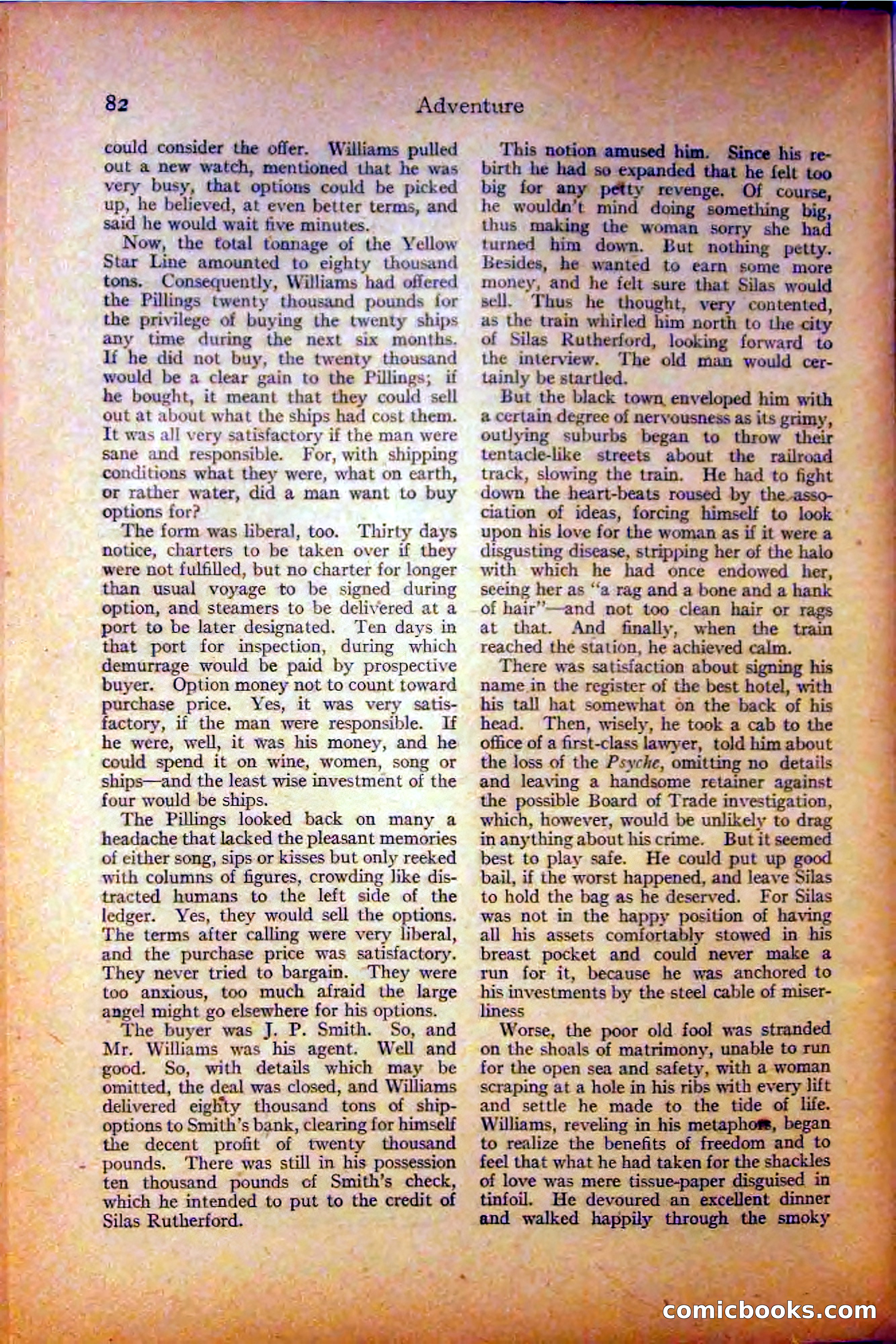
A restored page from Pulp Fiction, 1919. Page through the whole issue in the reader above.
📄 Transcribed text from this page (OCR, searchable)
Machine-transcribed from the original scan — historical spelling and the odd misread are preserved.
82 Adventure could consider the offer. Williams pulled out a new watch, mentioned that he was very busy, that options could be picked up, he believed, at even better terms, and said he would wait five minutes. Now, the fotal tonnage of the Yellow Star Line amounted to eighty thousand tons. Consequently, Williams had offered the Pillings twenty thousand pounds for the privilege of buying the twenty ships any time during the next six months. If he did not buy, the twenty thousand would be a clear gain to the Pillings; if he bought, it meant that they could sell out at about what the ships had cost them. It was all very satisfactory if the man were sane and responsible. For, with shipping conditions what they were, what on earth, or rather water, did a man want to buy options for? The form was liberal, too. Thirty days notice, charters to be taken over if they were not fulfilled, but no charter for longer than usual voyage to be signed during option, and steamers to be delivered at a port to be later designated. Ten days in that port for inspection, during which demurrage would be paid by prospective buyer. Option money not to count toward purchase price. Yes, it was very satis- factory, if the man were responsible. If he were, well, it was his money, and he could spend it on wine, women, song or ships—and the least wise investment of the four would be ships. The Pillings looked back on many a headache that lacked the pleasant memories of either song, sips or kisses but only reeked with columns of figures, crowding like dis- tracted humans to the left side of the ledger. Yes, they would sell the options. The terms after calling were very liberal, and the purchase price was satisfactory. They never tried to bargain. "They were too anxious, too much afraid the large angel might go elsewhere for his options. The buyer was J. P. Smith. So, and Mr. Williams was his agent. Well and good. So, with details which may be omitted, the deal was closed, and Williams delivered eiglity thousand tons of ship- options to Smith’s bank, clearing for himself the decent profit of twenty thousand pounds. ‘There was still in his possession ten thousand pounds of Smith’s check, which he intended to put to the credit of Silas Rutherford. & revenge. Of course, he woulde’t. min doing something big, thus making the woman sorry she had Besides, he to earn some more money, and he felt sure that Silas would sell. Thus he thought, very contented, as the train whirled him north to the city of Silas Rutherford, looking forward to the interview. The old man would cer- tainly be startled, But the black town enveloped him with a certain degree of nervousness as its grimy, outlying suburbs began to throw their tentacle-like streets about the railroad track, slowing the train. He had to fight down the heart-beats roused by theasso- ciation of ideas, forcing himself to look upon his love for the woman as if it were a disgusting disease, stripping her of the halo with which he had once endowed her, seeing her as “a rag and a bone and a hank of hair’ —and not too clean hair or rags at that. And finally, when the train reached the station, he achieved calm. There was satisfaction about signing his name in the register of the best hotel, with his tall hat somewhat on the back of his head. Then, wisely, he took a cab to the office of a first-class lawyer, told him about the loss of the Psyche, omitting no details and leaving a handsome retainer against the possible Board of Trade investigation, which, however, would be unlikely to drag in anything about hiscrime. But it seemed best to play safe. He could put up good bail, if the worst happened, and leave Silas to hold the bag as he deserved. For Silas was not in the happy position of having all his assets comfortably stowed in his breast pocket and could never make a run for it, because he was anchored to his investments by the steel cable of miser- liness Worse, the poor old fool was stranded on the shoals of matrimony, unable to run for the open sea and safety, with a woman scraping at a hole in his ribs with every lift and settle he made to the tide of life. Williams, reveling in his metaphows, to realize the benefits of freedom and to pag ee what he had taken for the shackles ve was mere tissue-paper disguised in tinfoil. He devoured an excellent dinner and walked happily through the smoky comicbooks.com— ;