
Pulp Fiction, 1919 · page 91 of 204
Adventure, August 3, 1919 — page 91: what you’re looking at
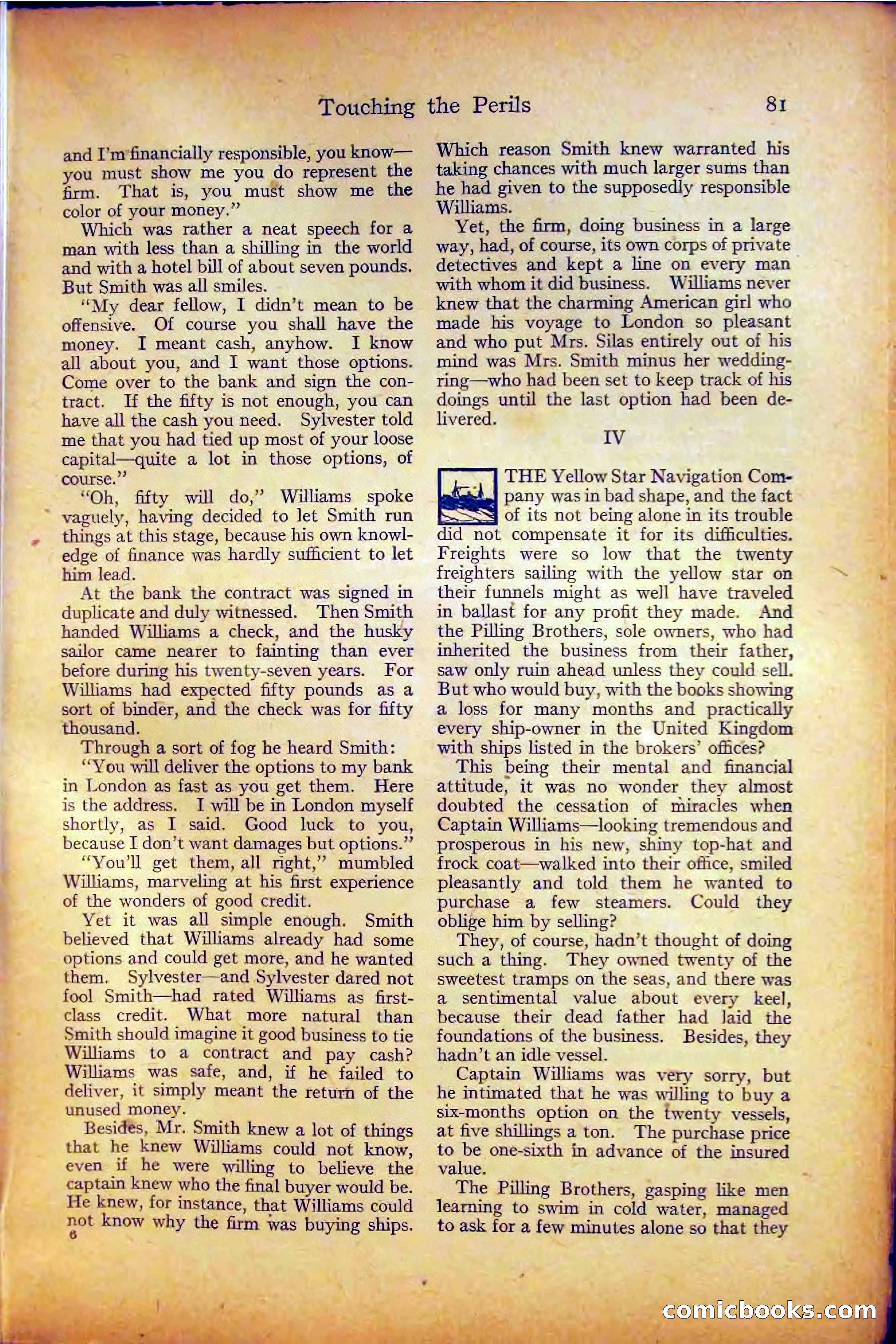
A restored page from Pulp Fiction, 1919. Page through the whole issue in the reader above.
📄 Transcribed text from this page (OCR, searchable)
Machine-transcribed from the original scan — historical spelling and the odd misread are preserved.
and I’m’financially responsible, you know— you must show me you do represent the firm. That is, you must show me the color of your money.” Which was rather a neat speech for a man with less than a shilling in the world and with a hotel bill of about seven pounds, But Smith was all smiles. ‘My dear fellow, I didn’t mean to be offensive. Of course you shall have the money. I meant cash, anyhow. I know all about you, and I want those options. Come over to the bank and sign the con- tract. If the fifty is not enough, you can have all the cash you need. Sylvester told me that you had tied up most of your loose capital—quite a lot in those options, of course.” “Oh, fifty will do,” Williams spoke vaguely, having decided to let Smith run things at this stage, because his own knowl- edge of finance was hardly sufficient to let him lead. At the bank the contract was signed in duplicate and duly witnessed. Then Smith handed Williams a check, and the husky sailor came nearer to fainting than ever before during his twenty-seven years. For Williams had expected fifty pounds as a sort of binder, and the check was for fifty thousand. © Through a sort of fog he heard Smith: “You will deliver the options to my bank in London as fast as you get them. Here is the address, I will be in London myself shortly, as I said. Good luck to you, because I don’t want damages but options.” “You'll get them, all mght,’” mumbled Williams, marveling at his first experience of the wonders of good credit. Yet it was all simple enough. Smith believed that Williams already had some options and could get more, and he wanted them. Sylvester—and Sylvester dared not fool Smith—had rated Williams as first- _ class credit. What more natural than _ Smith should imagine it good business to tie _ Williams to a contract and pay cash? _ Williams was safe, and, if he failed to _ deliver, it simply meant the return of the - unused money. Besides, Mr. Smith knew a lot of things that he knew Williams could not know, re captain knew who the final buyer would be. _ Hekn ew, for instance, that Williams could _ not know why the firm was buying ships. Png _- “Ss *n, a 7 ‘ . 1 4 ‘ i d “., a «* - ‘ti Us 4 acy =< as = : } a *. j ” . even if he were willing to believe the ay ing the Perils Which reason Smith knew warranted his taking chances with much larger sums than he had given to the supposedly responsible Williams Yet, the firm, doing business in a large way, had, of course, its own corps of private detectives and kept a line on every man with whom it did business. Williams never knew that the charming American girl who made his voyage to London so pleasant and who put Mrs. Silas entirely out of his mind was Mrs. Smith minus her wedding- ring—who had been set to keep track of his doings until the last option had been de- livered. IV Pay THE Yellow Star Navigation Com- Natt} pany was in bad shape, and the fact SS of its not being alone in its trouble did not compensate it for its difficulties. Freights were so low that the twenty freighters sailing with the yellow star on their funnels might as well have traveled in ballast for any profit they made. And the Pilling Brothers, sole owners, who had inherited the business from their father, saw only ruin ahead unless they could sell. But who would buy, with the books showing a loss for many months and practically every ship-owner in the United Kingdom with ships listed in the brokers’ offices? This being their mental and financial attitude, it was no wonder they almost doubted the cessation of miracles when Captain Williams—looking tremendous and prosperous in his new, shiny top-hat and frock coat—walked into their office, smiled pleasantly and told them he wanted to purchase a few steamers. Could they oblige him by selling? They, of course, hadn’t thought of doing such a thing. They owned twenty of the sweetest tramps on the seas, and there was a sentimental value about every keel, because their dead father had laid the foundations of the business. Besides, they hadn’t an idle vessel. _ Captain Williams was very sorry, but he intimated that he was willing to buy a six-months option on the twenty vessels, at five shillings a ton. The purchase price to be one-sixth in advance of the insured value. The Pilling Brothers, gasping like men learning to swim in cold water, managed to ask for a few minutes alone so that they — =F y — a aa a ~ r=. a re _ = me * Eomicbooks.com am! _.,*