
Pulp Fiction, 1919 · page 86 of 204
Adventure, August 3, 1919 — page 86: what you’re looking at
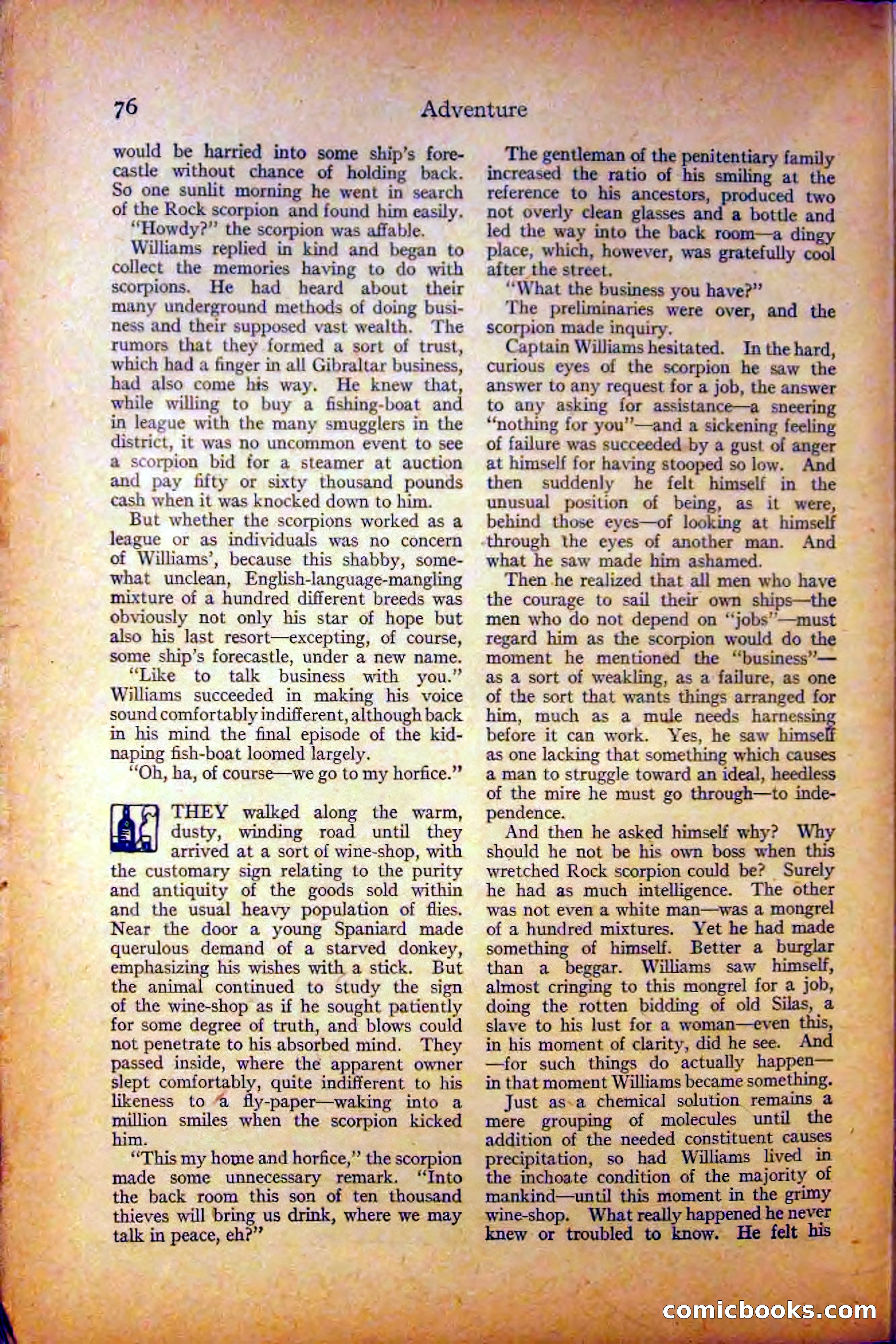
A restored page from Pulp Fiction, 1919. Page through the whole issue in the reader above.
📄 Transcribed text from this page (OCR, searchable)
Machine-transcribed from the original scan — historical spelling and the odd misread are preserved.
76 would be harried into some ship's fore- castle without chance of holding back. So one sunlit morning he went in search of the Rock scorpion and found him easily. “Howdy?” the scorpion was affable. Williams replied in kind and began to collect the memories having to do with scorpions. He had heard about their many underground methods of doing busi- ness and their supposed vast wealth. The rumors that they formed a sort of trust, which had a finger in all Gibraltar business, had also come his way. He knew that, while willing to buy a fishing-boat and in league with the many smugglers in the district, it was no uncommon event to see a scorpion bid for a steamer at auction and pay fifty or sixty thousand pounds cash when it was knocked down to him. But whether the scorpions worked as a league or as individuals was no concern of Williams’, because this shabby, some- what unclean, English-language-mangling mixture of a hundred different breeds was obviously not only his star of hope but also his last resort—excepting, of course, some ship’s forecastle, under a new name. “Like to talk business with you.” Williams succeeded in making his voice sound comfortably indifferent, although back in his mind the final episode of the kid- naping fish-boat loomed largely. “Oh, ha, of course—we go to my horfice.” p (4 THEY walked along the warm, ty: dusty, winding road until they arrived at a sort of wine-shop, with the customary sign relating to the purity and antiquity of the goods sold within and the usual heavy population of flies. Near the door a young Spaniard made querulous demand of a starved donkey, emphasizing his wishes with a stick, But the animal continued to study the sign of the wine-shop as if he sought patiently for some degree of truth, and blows could not penetrate to his absorbed mind. They passed inside, where the apparent owner slept comfortably, quite indifferent to his likeness to “a fly-paper—waking into a million smiles when the scorpion kicked him. “This my home and horfice,” the scorpion made some unnecessary remark. “Into the back room this son of ten thousand thieves will bring us drink, where we may talk in peace, eh?” Adventure reference to his ances roduced two not overly clean glasses led the way into the back room—a dingy place, which, however, was gratefully cool after the street, ‘What the business you have?’ The preliminaries were over, and the — scorpion made inquiry, Captain Williams hesitated. In the hard, curious eyes of the scorpion he saw the answer to any request for a job, the answ to any asking for assistance—a sneering “nothing for you"’—and a sickening feeling of failure was succeeded by a gust of anger at himself for having stooped so low. And then suddenly he felt himself in the unusual position of being, as it were, behind those eyes—of looking at himself -through the eyes of another man. And what he saw made him ashamed. Then he realized that all men who have the courage to sail their own shi men who do not depend on “jobs” —must regard him as the scorpion would do the moment he mentioned the “business”— as a sort of weakling, as a failure, as one of the sort that wants things arranged for him, much as a mule needs nance before it can work. Yes, he saw hi as one lacking that something which causes a man to struggle toward an ideal, heedless of the mire he must go through—to inde- pendence. And then he asked himself why? Why should he not be his own boss when this wretched Rock scorpion could be? Surely he had as much intelligence. The other was not even a white man—was a mongrel of a hundred mixtures. Yet he had made something of himself. Better a burglar than a beggar. Williams saw himself, almost cringing to this mongrel for a job, doing the rotten bidding of old Silas, a slave to his lust for a woman—even in his moment of clarity, did he see. And —for such things do actually happen— in that moment Williams became something. Just as-a chemical solution remains a mere grouping of molecules until the addition of the needed constituent causes the inchoate condition of the majority of mankind—until this moment in the grimy 1appene a bottle and mh