
Pulp Fiction, 1919 · page 85 of 204
Adventure, August 3, 1919 — page 85: what you’re looking at
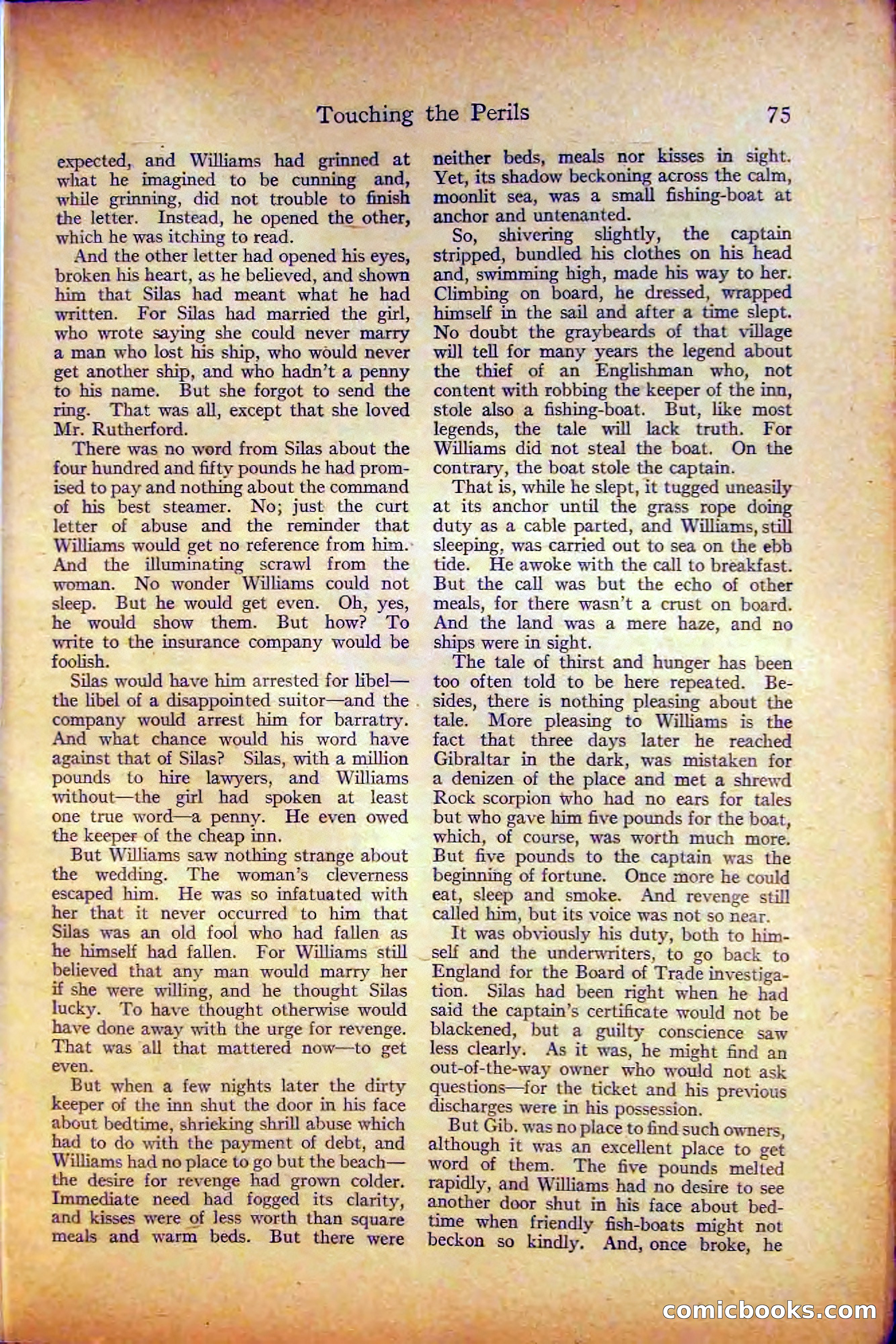
A restored page from Pulp Fiction, 1919. Page through the whole issue in the reader above.
📄 Transcribed text from this page (OCR, searchable)
Machine-transcribed from the original scan — historical spelling and the odd misread are preserved.
Se expected, and Williams had grinned at what he imagined to be cunning and, while grinning, did not trouble to finish the letter. Instead, he opened the other, which he was itching to read. And the other letter had opened his eyes, broken his heart, as he believed, and shown him that Silas had meant what he had written. For Silas had married the girl, who wrote saying she could never marry a man who lost his ship, who would never get another ship, and who hadn’t a penny to his name. But she forgot to send the ring. That was all, except that she loved Mr. Rutherford. There was no word from Silas about the . four hundred and fifty pounds he had prom- ised to pay and nothing about the command of his best steamer. No; just the curt letter of abuse and the reminder that _ Williams would get no reference from him.: And the illuminating scrawl from the woman. No wonder Williams could not sleep. But he would get even. Oh, yes, he would show them. But how? To - write to the insurance company would be foolish. Silas would have him arrested for libel— the libel of a disappointed suitor—and the . company would arrest him for barratry. And what chance would his word have against that of Silas? Silas, with a million pounds to hire lawyers, and Williams without—the girl had spoken at least one true word—a penny. He even owed the keeper of the cheap inn. But Williams saw nothing strange about the wedding. The woman’s cleverness escaped him. He was so infatuated with her that it never occurred to him that _ Silas was an old fool who had fallen as he himself had fallen. For Williams still _ _ believed that any man would marry her if she were willing, and he thought Silas lucky. To have thought otherwise would have done away with the urge for revenge. That was all that mattered now—to get __ But when a few nights later the dirty _keeper of the inn shut the door in his face _ about bedtime, shrieking shrill abuse which had to do with the payment of debt, and _ Williams had no place to go but the beach— the desire for revenge had grown colder. nediate need had fogged its clarity, were of Jess worth than square ~ | ; and warm beds. But there were 73 y - : & ff ; Te 4 Ya j 7 ie, = id “— eed J i . « Sa? - - ; neither beds, meals nor kisses in sight. | Yet, its shadow beckoning across the calm, moonlit sea, was a fishing-boat at anchor and untenanted. ‘ ‘ So, shivering slightly, the captain stripped, bundled his clothes on his head and, swimming high, made his way to her. Climbing on board, he dressed, wrapped himself in the sail and after a time slept. No doubt the graybeards of that village will tell for many years the legend about the thief of an Englishman who, not content with robbing the keeper of the inn, stole also a fishing-boat. But, like most legends, the tale will lack truth. For Williams did not steal the boat. On the contrary, the boat stole the captain. That is, while he slept, it tugged uneasily at its anchor until the grass rope doing duty as a cable parted, and Williams, still sleeping, was carried out to sea on the ebb tide. He awoke with the call to breakfast. But the call was but the echo of other meals, for there wasn’t a crust on board. And the land was a mere haze, and no ships were in sight. The tale of thirst and hunger has been too often told to be here repeated. Be- sides, there is nothing pleasing about the tale. More pleasing to Williams is the fact that three days later he reached Gibraltar in the dark, was mistaken for a denizen of the place and met a shrewd Rock scorpion who had no ears for tales but who gave him five pounds for the boat, which, of course, was worth much more. But five pounds to the captain was the beginning of fortune. Once more he could eat, sleep and smoke. And revenge still called him, but its voice was not so near. . It was obviously his duty, both to him- od self and the underwriters, to go back to England for the Board of Trade investiga- = tion. Silas had been right when he had 5 said the captain’s certificate would not be : blackened, but a guilty conscience saw less clearly. As it was, he might find an out-of-the-way owner who would not ask questions—for the ticket and his previous discharges were in his possession. But Gib. was no place to find such owners, although it was an excellent place to get word of them. The five pounds melted a rapidly, and Williams had no desire to see a another door shut in his face about bed- time when friendly fish-boats might not a beckon so kindly. And, once broke, he . “i oe he i. a. he ae: = : : oe ae Ma ooks-com