
Pulp Fiction, 1919 · page 71 of 204
Adventure, August 3, 1919 — page 71: what you’re looking at
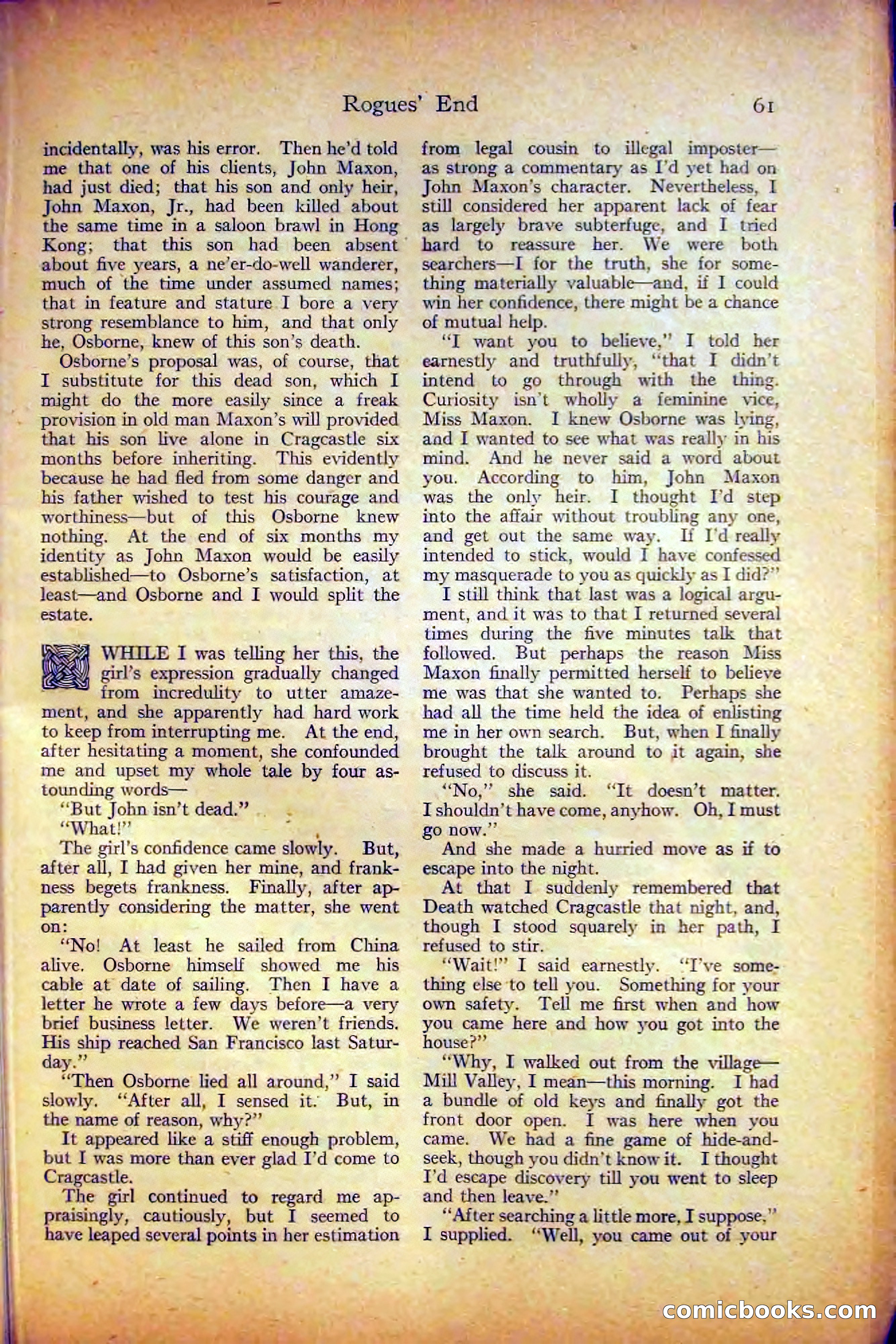
A restored page from Pulp Fiction, 1919. Page through the whole issue in the reader above.
📄 Transcribed text from this page (OCR, searchable)
Machine-transcribed from the original scan — historical spelling and the odd misread are preserved.
ts tek aay his error. Then he'd told hat one of his clients, John Maxon, ust died; that his son and only heir, n Maxon, Jr., had been killed about ihe same time in a saloon brawl in Hong about five years, a ne’er-do-well wanderer, ich of the time under assumed names; that in feature and stature I bore a very 3 strong resemblance to him, and that only he, Osborne, knew of this son ’s death. | “Osborne’s proposal was, of course, that I substitute for this dead son, which I might do the more easily since a freak . provision in old man Maxon’s will provided that his son live alone in Cragcastle six months before inheriting. This. evidently because he had fled from some danger and his father wished to test his courage and worthiness—but of this Osborne knew nothing. At the end of six months my identity as John Maxon would be easily established—to Osborne’s satisfaction, at _ Jeast—and Osborne and I would split the | estate. Sy WHILE I was telling her this, the @ YY girl’s expression gradually changed ~~ irom incredulity to utter amaze- ment, and she apparently had hard work to keep from interrupting me. At the end, after hesitating a moment, she confounded me and upset my whole tale by four as- tounding words— “But John isn’t dead.” _ “What!” : The girl’s confidence came 16: alae, But, after all, I had given her mine, and frank- mess begets frankness. Finally, after ap- ig considering the matter, she went "No! At least he sailed from China alive. Osborne himself showed me _ his cable at date of sailing. Then I have a letter he wrote a few days before—a very _ brief business letter. We weren’t friends. ) ae ship reached San Francisco last Satur- a) “Then Osborne lied all around,” I said slowly. “After all, I sensed it. But, in | the name of reason, why?” | __ It appeared like a stiff enough problem, t but I was more than ever glad I’d come to Cragcas _ The he girl continued to regard me ap- ie pa ingly, pe etl but I seemed to hay e lk pa pai ss her estimation c Rogues’ End Seng: that this son had been absent from legal cousin to illegal imposter— as strong a commentary as I’d yet had on John Maxon’s character. Nevertheless, I still considered her apparent lack of fear as largely brave subterfuge, and I tried hard to reassure her. We were both searchers—I for the truth, she for some- thing materially valuable—and, if I could win her confidence, there might be a chance of mutual help. “T want you to believe,” I told her earnestly and truthfully, “that I didn’t intend to go through with the thing. Curiosity isn’t wholly a feminine vice, Miss Maxon. I knew Osborne was lying, and I wanted to see what was really in his mind. And he never said a word about you. According to him, John Maxon was the only heir. I thought Id step into the affair without troubling any one, and get out the same way. If I'd really intended to stick, would I have confessed my masquerade to you as quickly as I did?” T still think that last was a logical argu- ment, and it was to that I returned several times during the five minutes talk that followed. But perhaps the reason Miss Maxon finally permitted herself to believe me was that she wanted to. Perhaps she had all the time held the idea of enlisting me in her own search. But, when I finally brought the talk around to it again, she refused to discuss it. “No,” she said. “It doesn’t matter. Tshouldn’t have come, anyhow. Oh, I must go now.” ; And she made a hurried move as if to escape into the night. At that I suddenly remembered that Death watched Cragcastle that night, and, though I stood squarely in her path, I refused to stir. ‘Wait!’ I said earnestly. “I’ve some- thing else ‘to tell you. Something for your own safety. Tell me first when and how you came here and how you got into the house?” “Why, I walked out from the village— Mill Valley, I mean—this morning. I had a bundle of old keys and finally got the front door open. I was here when you came. We had a fine game of hide-and- seek, though you didn’t knowit. I thought I'd escape discovery till you went to sleep and then leave.” iter searching a little more, I suppose,” I Kennels “sel ay out sag) te | *, x _ ee >. “ on ae amilichoaks. com