
Pulp Fiction, 1919 · page 70 of 204
Adventure, August 3, 1919 — page 70: what you’re looking at
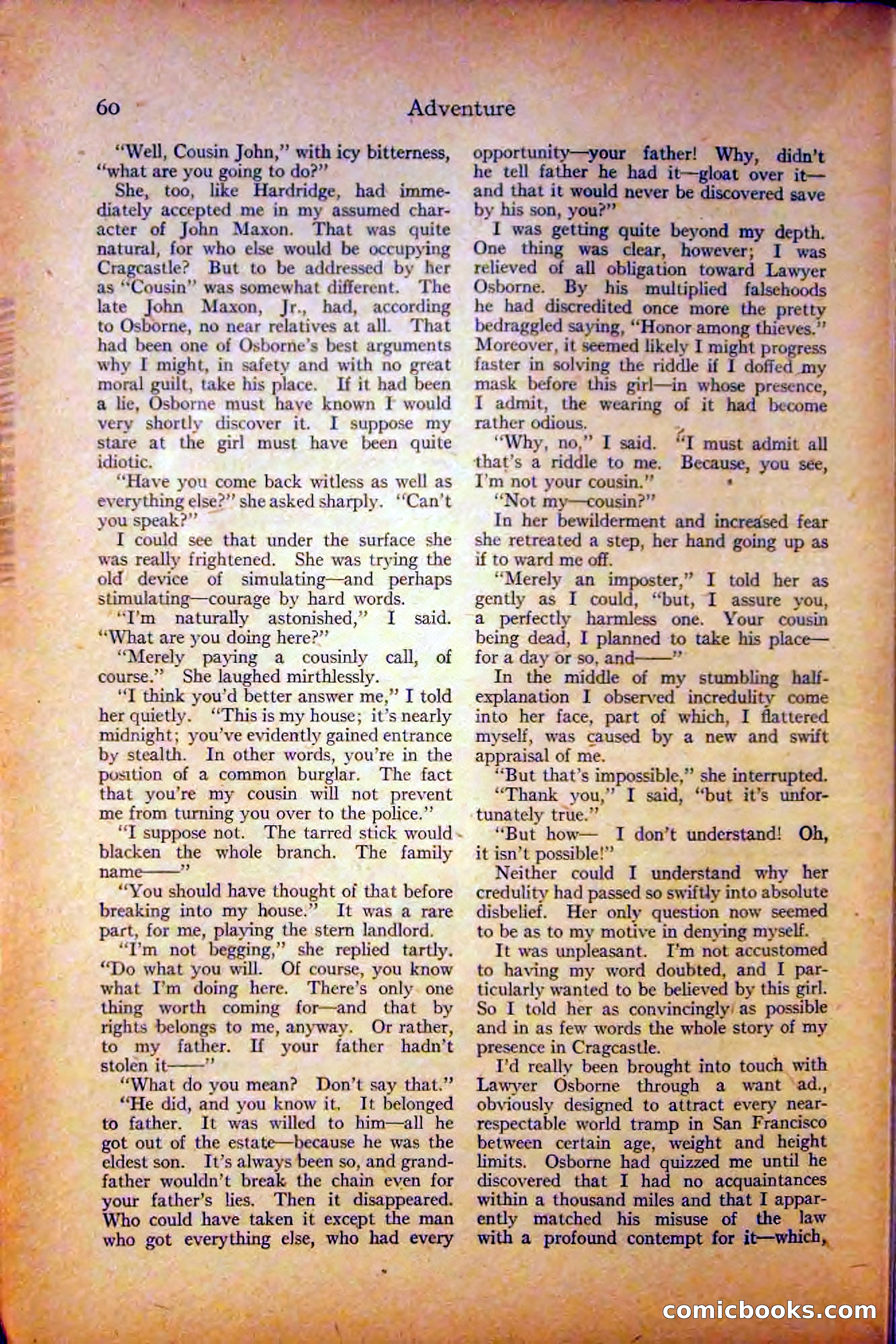
A restored page from Pulp Fiction, 1919. Page through the whole issue in the reader above.
📄 Transcribed text from this page (OCR, searchable)
Machine-transcribed from the original scan — historical spelling and the odd misread are preserved.
ee ee 60 “Well, Cousin John,” with icy bitterness, “what are you going to do?” She, too, like Hardridge, had imme- diately accepted me in my assumed char- acter of John Maxon. That was quite natural, for who else would be occupying Crageastle? But to be addressed by her as “Cousin” was somewhat different. The late John Maxon, Jr., had, according to Osborne, no near relatives at all. That had been one of Osborne’s best arguments why I might, in safety and with no great moral guilt, take his place. If it had been a lie, Osborne must haye known IT would very shortly discover it. I suppose my stare at the girl must have been quite idiotic. “Have you come back witless as well as everything else?’’ she asked sharply. ‘‘Can’t you speak?” I could see that under the surface she was really frightened. She was trying the old device of simulating—and perhaps stimulating—courage by hard words. “I’m naturally astonished,” I said. “What are you doing here?” “Merely paying a cousinly call, of course.”” She laughed mirthlessly. “T think you'd better answer me,” I told her quietly. “This is my house; it’s nearly midnight; you’ve evidently gained entrance by stealth. In other words, you’re in the position ef a common burglar. The fact that you’re my cousin will not prevent me from turning you over to the police.”’ “T suppose not. blacken the whole branch. The family name——” “You should have thought of that before breaking into my house.” It was a rare part, for me, playing the stern landlord. “T’m not begging,” she replied tartly. “Do what you will. Of course, you know what I’m doing here. There’s only. one thing worth coming for—and that by rights belongs to me, anyway. Or rather, to my father. If your father hadn't stolen it——” “What do you mean? Don’t say that.” “He did, and you know it, It belonged to father. It was willed to him—all he got out of the estate—because he was the eldest son. It’s always been so, and grand- father wouldn’t break the chain even for your father’s lies, Then it disappeared. Who could have taken it except the man who got everything else, who had every The tarred stick would ~ Adventure opportunity—your father! Why, he tell father he had it—gloat over it— and that it would never be discovered save by his son, you?” ‘ I was getting quite beyond th. One thing was clear, ree gto relieved of all obligation toward Lawyer Osborne. By his multiplied falsehoods he had discredited once more the pretty bedraggled saying, “Honor among thieves.” Moreover, it seemed likely I might progress faster in solving the riddle if I doffed my mask before this girl—in whose presence, I admit, the wearing of it had become rather odious. ., “Why, no,” I said. “I must admit all that’s a riddle to me. Because, you sée, I’m not your cousin.” : ‘“‘Not my—cousin?” In her bewilderment and incredsed fear she retreated a step, her hand going up as if to ward me off. ‘Merely an imposter,” I told her as gently as I could, “but, I assure you, a perfectly harmless one. Your cousin being dead, I planned to take his place— for a day or so, and——” In the middle of my stumbling half- explanation I observed incredulity come into her face, part of which, I flattered myself, was caused by a new and swift appraisal of me. “But that’s impossible,” she interrupted. “Thank you,” I said, “but it’s unfor- tunately true.” “But how— I don’t understand! Oh, it isn’t possible!” Neither could I understand why her credulity had passed so swiftly into absolute disbelief. Her only question now seemed to be as to my motive in denying myself. It was unpleasant. I’m not accustomed to having my word doubted, and I par- ticularly wanted to be believed by this girl. So I told her as convincingly) as possible and in as few words the whole story of my presence in Cragcastle. I'd really been brought into touch with Lawyer Osborne through a want ‘ad., obviously designed to attract every near- respectable world tramp in San Francisco between certain age, weight and height limits. Osborne had quizzed me until he discovered that I had no acquaintances within a thousand miles and that I appar- ently matched his misuse of the law with a profound contempt for it—which, comicbooks.co oil a —_ z ee. ih m ——_ |