
Pulp Fiction, 1919 · page 42 of 204
Adventure, August 3, 1919 — page 42: what you’re looking at
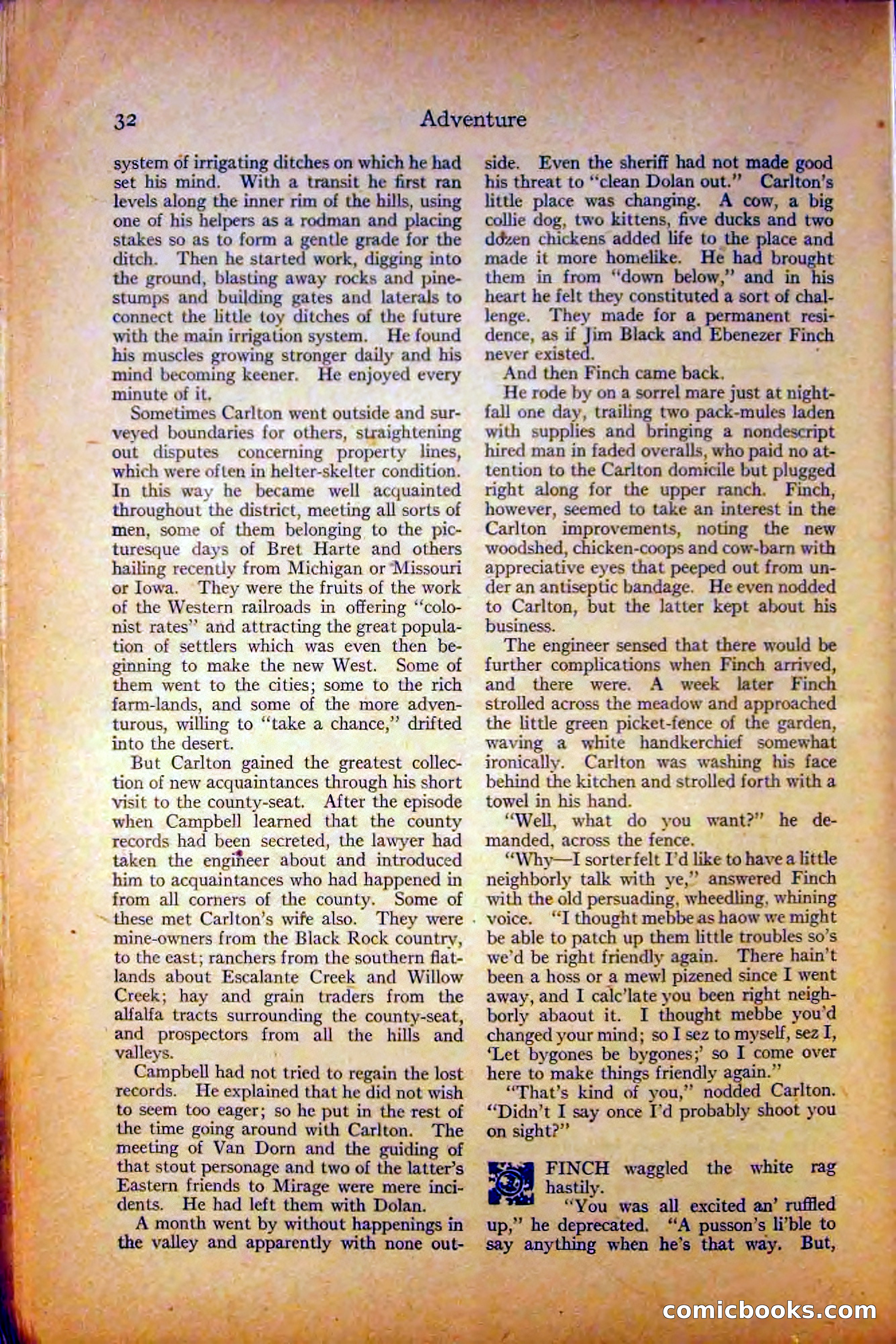
A restored page from Pulp Fiction, 1919. Page through the whole issue in the reader above.
📄 Transcribed text from this page (OCR, searchable)
Machine-transcribed from the original scan — historical spelling and the odd misread are preserved.
32 Adventure system of irrigating ditches on which he had set his mind. With a transit he first ran levels along the inner rim of the hills, using one of his helpers as a rodman and placing stakes so as to form a gentle grade for the ditch. Then he started work, digging into the ground, blasting away rocks and pine- stumps and building gates and laterals to connect the little toy ditches of the future with the main irrigation system. He found his muscles growing stronger daily and his mind becoming keener. He enjoyed every minute of it, Sometimes Carlton went outside and sur- veyed boundaries for others, straightening out disputes concerning property lines, which were often in helter-skelter condition. In this way he became well acquainted throughout the district, meeting all sorts of men, some of them belonging to the pic- turesque days of Bret Harte and others hailing recently from Michigan or “Missouri or Iowa. They were the fruits of the work of the Western railroads in offering ‘‘colo- nist rates’ and attracting the great popula- tion of settlers which was even then be- ginning to make the new West. Some of them went to the cities; some to the rich farm-lands, and some of the more adven- turous, willing to ‘‘take a chance,” drifted into the desert. But Carlton gained the greatest collec- tion of new acquaintances through his short visit to the county-seat. After the episode when Campbell learned that the county records had been secreted, the lawyer had taken the engiheer about and introduced him to acquaintances who had happened in from all corners of the county. Some of these met Carlton’s wife also. mine-owners from the Black Rock country, to the east; ranchers from the southern flat- lands about Escalante Creek and Willow Creek; hay and grain traders from the alfalfa tracts surrounding the county-seat, and prospectors from all the hills and valleys. Campbell had not tried to regain the lost records. He explained that he did not wish to seem too eager; so he put in the rest of the time going around with Carlton. The meeting of Van Dorn and the guiding of that stout personage and two of the latter’s Eastern friends to Mirage were mere inci- dents. si had sie them with Dolan. A month went by without ha: ings in the valley and apparently vithanniie out: They were . side. Even the sheriff had not made good his threat to “clean Dolan out.” Carlton's little place was changing. A cow, a big collie dog, two kittens, five ducks and two ddzen chickens added life a ki and made it more homelike. He brought them in from “down below,” and in his heart he felt they constituted a sort of chal- lenge. They made for a permanent resi- dence, as if Jim Black and Ebenezer Finch never existed. ° And then Finch came back, He rode by on a sorrel mare just at night- fall one day, trailing two pack-mules laden with supplies and bringing a nondescript hired man in faded overalls, who paid no at- tention to the Carlton domicile but plugged right along for the upper ranch. Finch, however, seemed to take an interest in the Carlton improvements, noting the new woodshed, chicken-coops and cow-barn with appreciative eyes that peeped out from un- der an antiseptic bandage. He even nodded to Carlton, but the latter kept about his business. The engineer sensed that there would be further complications when Finch arrived, and there were. A week later Finch strolled across the meadow and approached the little green picket-fence of the garden, waving a white handkerchief somewhat ironically. Carlton was washing his face behind the kitchen and strolled forth with a towel in his hand. “Well, what do you want?” he de- manded, across the fence, “Why—I sorterfelt I'd like to have a little neighborly talk with ye,’ answered Finch with the old persuading, wheedling, whining voice. “I thought mebbeas haow we might be able to patch up them little troubles so’s we'd be right friendly again. There hain’t been a hoss or a mew! pizened since I went away, and I calc’late you been right neigh- borly abaout it. I thought mebbe you'd changed your mind; so I sez to myself, sez I, ‘Let bygones be bygones; so I come over here to make things friendly again. “That's kind of you,” nodded Carlton. “Didn't I say once I'd probably shoot you on sight?” FINCH waggled the white rag hastily. “You was all excited an’ rufiled up,” he deprecated. “A pusson’s li’ble to say anything when he’s that way. But, comicbooks.com