
Pulp Fiction, 1919 · page 41 of 204
Adventure, August 3, 1919 — page 41: what you’re looking at
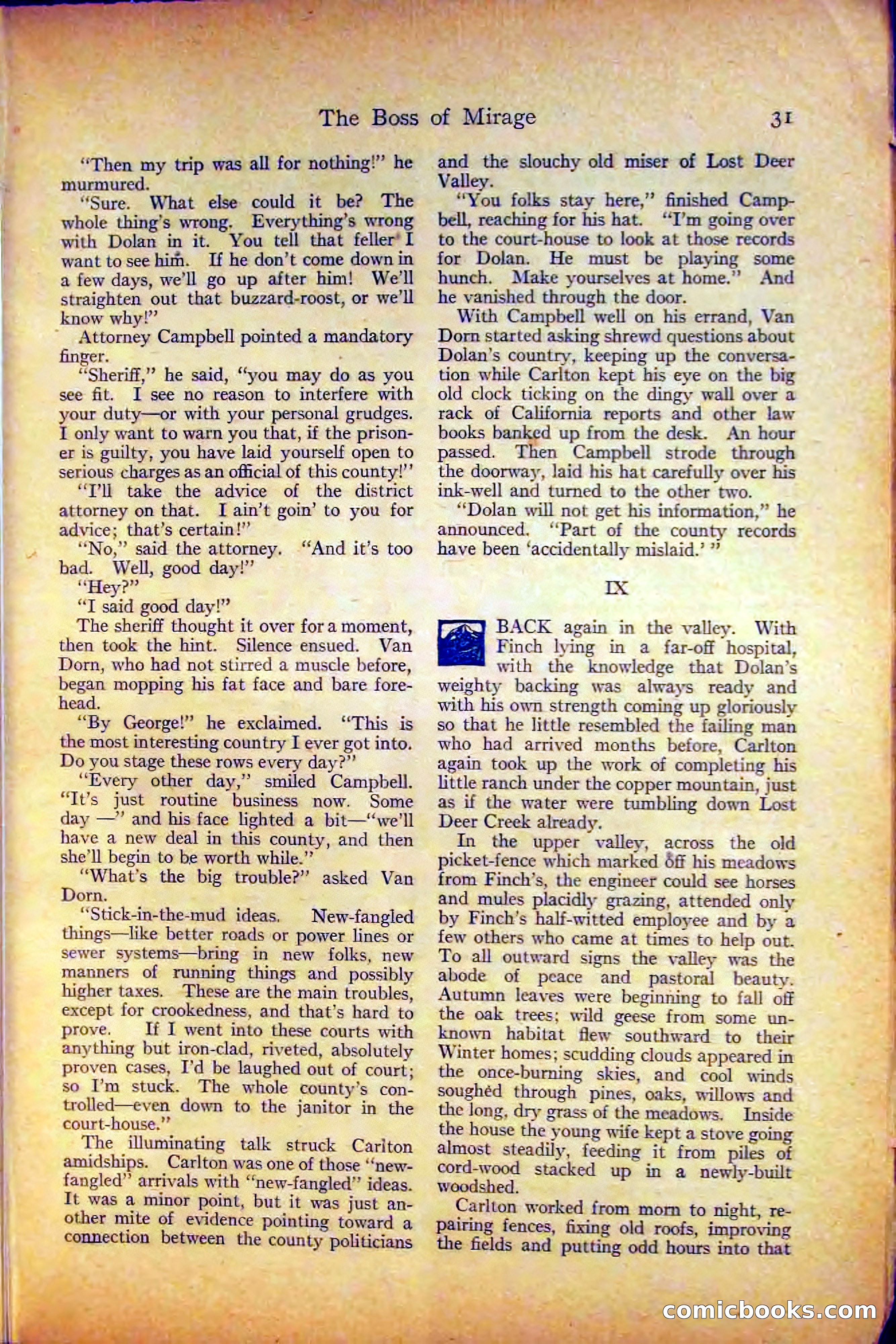
A restored page from Pulp Fiction, 1919. Page through the whole issue in the reader above.
📄 Transcribed text from this page (OCR, searchable)
Machine-transcribed from the original scan — historical spelling and the odd misread are preserved.
id “Then my trip was all for nothing!” he ‘a murmured. * “Sure. What else could Ae: The whole thing’s wrong. Everything’s wrong Sith Doles i fe. Mom tell that feller’ I - - want tosee him. If he don’t come down in a few days, we'll go up after him! We'll ; straighten out that buzzard-roost, or we’ll L know why?” ; 7 ~ Attorney Campbell pointed a mandatory finger. . 4 “Sheriff,” he said, “you may do as you see fit. I see no reason to interfere with your duty—or with your personal grudges. y I only want to warn you that, if the prison- er is guilty, you have laid yourself open to serious charges as an official of this county!’’ “Tll take the advice of the district attorney on that. [ain’t goin’ to you for advice; that’s certain!” “No,” said the attorney. “And it’s too bad. Well, good day!” “Hey?” “T said good day!” The sheriff thought it over for a moment, then took the hint. Silence ensued. Van Dorn, who had not stirred a muscle before, began mopping his fat face and bare fore- head. “By George!” he exclaimed. ‘This is the most interesting country I ever got into. Do you stage these rows every day?” c “Every other day,” smiled Campbell. “It’s just routine business now. Some day —” and his face lighted a bit—we'll have a new deal in this county, and then she’ll begin to be worth while.” “What's the big trouble?” asked Van Dorn. * < “Stick-in-the-mud ideas. | New-fangled things—like better roads or power lines or b sewer systems—bring in new folks, new manners of running things and possibly higher taxes. These are the main troubles, except for crookedness, and that’s hard to prove. If I went into these courts with anything but iron-clad, riveted, absolutely proven cases, I'd be laughed out of court; : so I’m stuck. The whole county’s con- trolled—even down to the janitor in the ___- court-house.”” _ The illuminating talk struck Cariton _ amidships. Carlton was one of those ‘‘new- t fangled” arrivals with “new-fangled” ideas. ____ It was a minor point, but it was just an- _ other mite of evidence pointing toward a etween the county politicians i oT lead A = i a ~~ i. 3’ ie oh Pes . “ ing an ” | ae hit ., . it —— and the slouchy old miser of Lost Deer Valley. “You folks stay here,” finished Camp- bell, reaching for his hat. “I’m going over to the court-house to look at those records for Dolan. He must be playing some hunch. Make yourselves at home.” And he vanished through the door. With Campbell well on his errand, Van Dorn started asking shrewd questions about Dolan’s country, keeping up the conversa- tion while Carlton kept his eye on the big old clock ticking on the dingy wall over a rack of California reports and other law books banked up from the desk. An hour passed. Then Campbell strode through the doorway, laid his hat carefully over his ink-well and turned to the other two. “Dolan will not get his information,” he announced. ‘‘Part of the county records have been ‘accidentally mislaid.’ ” IX aa BACK again in the valley. With Finch lying in a far-off hospital, with the knowledge that Dolan’s weighty backing was always ready and with his own strength coming up gloriously so that he little resembled the failing man who had arrived months before, Carlton again took up the work of completing his little ranch under the copper mountain, just as if the water were tumbling down Lost Deer Creek already. In the upper valley, across the old picket-fence which marked 6ff his meadows from Finch’s, the engineer could see horses and mules placidly grazing, attended only by Finch’s half-witted employee and by a few others who came at times to help out. To all outward signs the valley was the abode of peace and pastoral beauty. Autumn leaves were beginning to fall off the oak trees; wild from some un- known habitat flew southward to their Winter homes; scudding clouds appeared in the once-burning skies, and cool winds soughéd through pines, oaks, willows and the long, dry grass of the meadows. Inside the house the young wife kept a stove going almost steadily, feeding it from piles of cord-wood woodshed _ Carlton worked from mor to night, re- -~pairing fences, fixing ing old roofs, improving _ the fields and putting odd hours into that — ~~ i e ei 2 + "a < ; te p ee a eel oe Stacked up in a newly-built — e — s as — >. » i: ¢ > a? 4 Me