
Pulp Fiction, 1919 · page 148 of 204
Adventure, August 3, 1919 — page 148: what you’re looking at
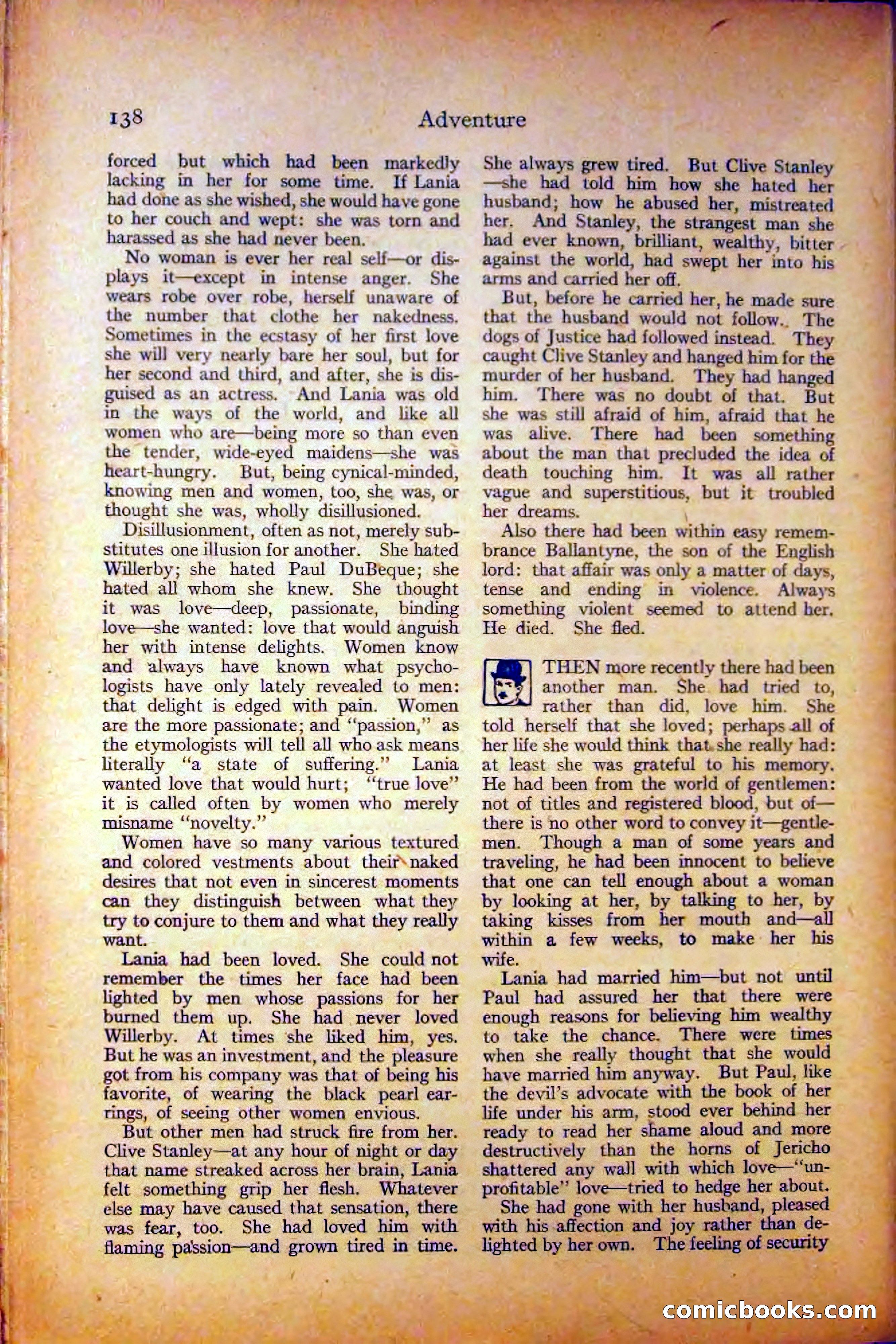
A restored page from Pulp Fiction, 1919. Page through the whole issue in the reader above.
📄 Transcribed text from this page (OCR, searchable)
Machine-transcribed from the original scan — historical spelling and the odd misread are preserved.
138 forced but which had been markedly lacking in her for some time. If Lania had dohe as she wished, she would have gone to her couch and wept: she was torn and harassed as she had never been. No woman is ever her real self—or dis- plays it—except in intense anger. She wears robe over robe, herself unaware of the number that clothe her nakedness. Sometimes in the ecstasy of her first love she will very nearly bare her soul, but for her second and third, and after, she is dis- guised as an actress. And Lania was old in the ways of the world, and like all women who are—being more so than even the tender, wide-eyed maidens—she was heart-hungry. But, being cynical-minded, knowing men and women, too, she was, or thought she was, wholly disillusioned. Disillusionment, often as not, merely sub- stitutes one illusion for another. She hated Willerby; she hated Paul DuBeque; she hated all whom she knew. She thought it was love—deep, passionate, binding love—she wanted: love that would anguish her with intense delights. Women know and always have known what psycho- logists have only lately revealed to men: that delight is edged with pain. Women are the more passionate; and ‘‘passion,”’ as the etymologists will tell all who ask means literally ‘a state of suffering.’’ Lania wanted love that would hurt; “true love” it is called often by women who merely misname “‘novelty.” Women have so many various textured and colored vestments about theirsnaked desires that not even in sincerest moments can they distinguish between what they try to conjure to them and what they really want. Lania had been loved. She could not remember the times her face had been lighted by men whose passions for her burned them up. She had never loved Willerby. At times ‘she liked him, yes. But he was an investment, and the pleasure got from his company was that of being his favorite, of wearing the black pearl ear- rings, of seeing other women envious. But other men had struck fire from her. Clive Stanley—at any hour of night or day that name streaked across her brain, Lania felt something grip her flesh. Whatever else may have caused that sensation, there was fear, too. She had loved him with flaming passion—and grown tired in time. Adventure She always grew tired. But Clive : —she had told him how she hated her husband; how he abused her, mistreated her. And Stanley, the strangest man she had ever known, brilliant, wealthy, bitter - against the world, had swept her into his arms and carried her off. But, before he carried her, he made sure that the husband would not follow.. The dogs of Justice had followed instead. They caught Clive Stanley and hanged him for the murder of her husband. They had hanged him. ‘There was no doubt of that. But she was still afraid of him, afraid that he was alive. There had been something about the man that precluded the idea of death touching him. It was all rather vague and superstitious, but it troubled her dreams. ' Also there had been within easy remem- brance Ballantyne, the son of the English lord: that affair was only a matter of days, tense and ending in violence. Always something violent seemed to attend her, He died. She fled. THEN more recently there had been fed another man. She. had tried to, -— rather than did, love him. She told herself that she loved; perhaps all of her life she would think that.she really had: at least she was grateful to his memory. He had been from the world of gentlemen: not of titles and registered blood, but of— there is no other word to convey it—gentle- men. Though a man of some years and traveling, he had been innocent to believe that one can tell enough about a woman by looking at her, by talking to her, by — taking kisses from mouth and—all within a few weeks, to make her his wife. Lania had married him—but not until Paul had assured her that there were enough reasons for believing him wealthy to take the chance. There were times when she really thought that she would have married him anyway. But Paul, like the devil’s advocate with the book of her life under his arm, stood ever behind her ready to read her shame aloud and more destructively than the horns of Jericho shattered any wall with which love—“un- profitable” love—tried to hedge her about. She sae with her husband, pleas with his affection and joy rath n de- “comicbooks.com 2 ees ———_—