
Pulp Fiction, 1919 · page 146 of 204
Adventure, August 3, 1919 — page 146: what you’re looking at
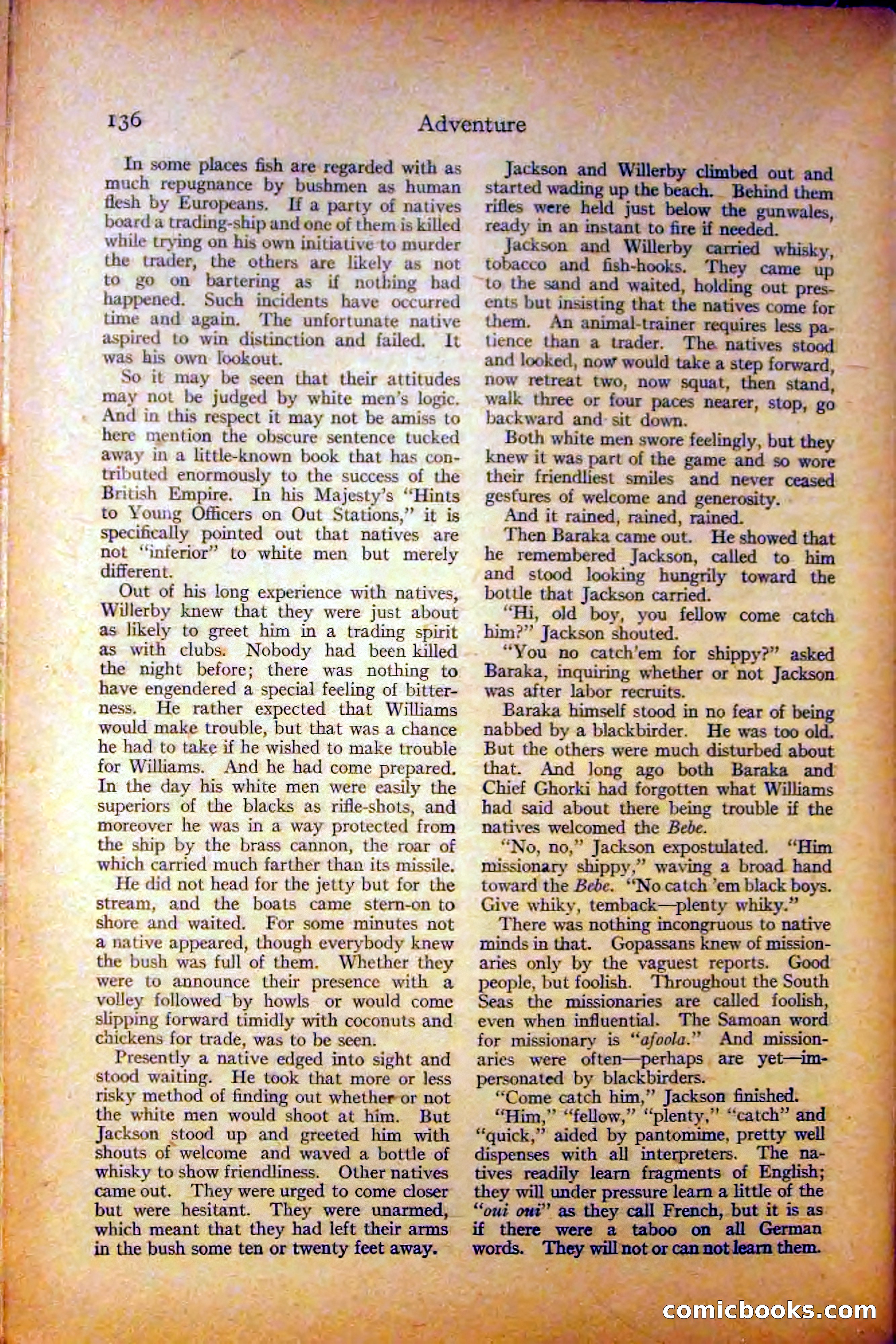
A restored page from Pulp Fiction, 1919. Page through the whole issue in the reader above.
📄 Transcribed text from this page (OCR, searchable)
Machine-transcribed from the original scan — historical spelling and the odd misread are preserved.
136 In some places fish are regarded with as much repugnance by bushmen as human flesh by Europeans, If a party of natives beard a trading-ship and one of them is killed while trying on his own initiative to murder the trader, the others are likely as not to go on bartering as if nothing had happened. Such incidents have occurred time and again. The unfortunate native aspired to win distinction and failed. It was his own lookout. So it may be seen that their attitudes may not be judged by white men’s logic, And in this respect it may not be amiss to here mention the obscure sentence tucked away in a little-known book that has con- tributed enormously to the success of the British Empire. In his Majesty’s “Hints to Young Officers on Out Stations,” it is specifically pointed out that natives are not “inferior” to white men but merely different. Out of his long experience with natives, Willerby knew that they were just about as likely to greet him in a trading spirit as with clubs: Nobody had been killed the night before; there was nothing to have engendered a special feeling of bitter- ness. He rather expected that Williams would make trouble, but that was a chance he had to take if he wished to make trouble for Williams. And he had come prepared. In the day his white men were easily the superiors of the blacks as rifle-shots, and moreover he was in a way protected from the ship by the brass cannon, the roar of which carried much farther than its missile. He did not head for the jetty but for the stream, and the boats came stern-on to shore and waited. For some minutes not a native appeared, though everybody knew the bush was full of them. Whether they were to announce their presence with a volley followed by howls or would come slipping forward timidly with coconuts and chickens for trade, was to be seen. Presently a native edged into sight and stood waiting. He took that more or less risky method of finding out whether or not the white men would shoot at him. But Jackson stood up and greeted him with shouts of welcome and waved a bottle of whisky to show friendliness. Other natives came out. They were urged to come closer but were hesitant. They were unarmed, which meant that they had left their arms in the bush some ten or twenty feet away. Adventure Jackson and Willerby climbed out and ready in an instant to fire if needed. Jackson and Willerby carried tobacco and fish-hooks. They came up to the sand and waited, holding out pres- ents but insisting that the natives come for them. An animal-trainer requires less pa- Uience than a trader. The natives stood and looked, now would take a step forward, now retreat two, now squat, then stand, walk three or four paces nearer, stop, go backward and: sit down. Both white men swore feelingly, but they knew it was part of the game and so wore their friendliest smiles and never ceased gestures of welcome and generosity. And it rained, rained, barat Then Baraka came out. He showed that he remembered Jackson, called to him and stood looking hungrily toward the bottle that Jackson carried. “Hi, old boy, you fellow come catch him?” Jackson shouted. “You no catch’em for shippy?” asked Baraka, inquiring whether or not Jackson was after labor recruits. Baraka himself stood in no fear of being nabbed by a blackbirder. He was too old, But the others were much disturbed about that. And long ago both Baraka and Chief Ghorki had forgotten what Williams had said about there being trouble if the natives welcomed the Bebe. “No, no,” Jackson expostulated. “Him missionary shippy,”’ waving a broad hand toward the Bebe. “No catch ‘em black boys. Give whiky, temback—plenty whiky.” There was nothing incongruous to native minds in that. Gopassans knew of mission- aries only by the vaguest reports. Good people, but foolish. Throughout the South Seas the missionaries are called foolish, even when influential. The Samoan word for missionary is “afoola.” And mission- aries were often—perhaps are yet—im- personated by blackbirders. , “Come catch him,” Jackson finished. “Him,” “fellow,” “plenty,” “catch” and “quick,” aided by pantomime, pretty well dispenses with all interpreters. The na- tives readily learn fragments of English; they will under pressure learn a little of the “out out’’ as they call French, but it is as if there were 2 taboo on all German comicbooks.com lied