
Pulp Fiction, 1960 · page 48 of 68
Action for Men, May 1960 — page 48: what you’re looking at
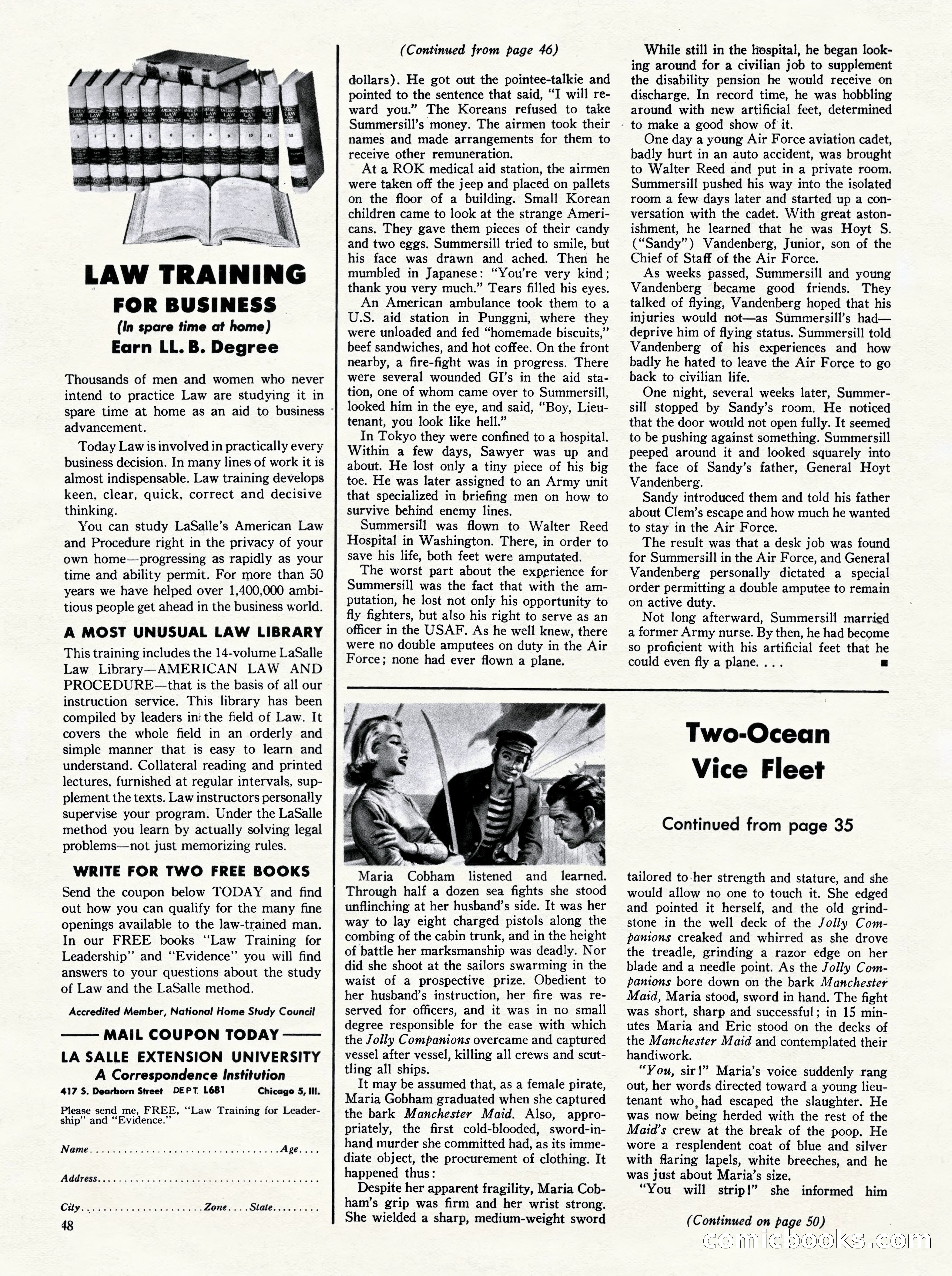
A restored page from Pulp Fiction, 1960. Page through the whole issue in the reader above.
📄 Transcribed text from this page (OCR, searchable)
Machine-transcribed from the original scan — historical spelling and the odd misread are preserved.
LAW TRAINING FOR BUSINESS | (In spare time at home) Earn LL.B. Degree Thousands of men and women who never intend to practice Law are studying it in Spare time at home as an aid to business advancement. Today Law is involved in practically every business decision. In many lines of work it is almost indispensable. Law training develops keen, clear, quick, correct and decisive thinking. You can study LaSalle’s American Law and Procedure right in the privacy of your own home—progressing as rapidly as your time and ability permit. For more than 50 years we have helped over 1,400,000 ambi- tious people get ahead in the business world. A MOST UNUSUAL LAW LIBRARY This training includes the 14-volume LaSalle Law Library—AMERICAN LAW AND PROCEDURE—that is the basis of all our instruction service. This library has been compiled by leaders in’ the field of Law. It covers the whole field in an orderly and simple manner that is easy to learn and understand. Collateral reading and printed lectures, furnished at regular intervals, sup- plement the texts. Law instructors personally supervise your program. Under the LaSalle method you learn by actually solving legal problems—not just memorizing rules. WRITE FOR TWO FREE BOOKS Send the coupon below TODAY and find out how you can qualify for the many fine openings available to the law-trained man. In our FREE books “Law Training for Leadership” and ‘‘Evidence’”’ you will find answers to your questions about the study of Law and the LaSalle method. Accredited Member, National Home Study Council MAIL COUPON TODAY LA SALLE EXTENSION UNIVERSITY A Correspondence Institution 417 S. Dearborn Street DEPT. L681 Chicago 5, lll. Please send me, FREE, ‘‘Law Training for Leader- ship” and ‘‘Evidence.”’ (Continued from page 46) dollars). He got out the pointee-talkie and pointed to the sentence that said, “I will re- ward you.” The Koreans refused to take Summersill’s money. The airmen took their names and made arrangements for them to receive other remuneration. At a ROK medical aid station, the airmen were taken off the jeep and placed on pallets on the floor of a building. Small Korean children came to look at the strange Ameri- cans. They gave them pieces of their candy and two eggs. Summersill tried to smile, but his face was drawn and ached. Then he mumbled in Japanese: ‘“You’re very kind; thank you very much.” Tears filled his eyes. An American ambulance took them to a U.S. aid station in Punggni, where they were unloaded and fed “homemade biscuits,” beef sandwiches, and hot coffee. On the front nearby, a fire-fight was in progress. There were several wounded GI’s in the aid sta- tion, one of whom came over to Summersill, looked him in the eye, and said, “Boy, Lieu- tenant, you look like hell.” In Tokyo they were confined to a hospital. Within a few days, Sawyer was up and about. He lost only a tiny piece of his big toe. He was later assigned to an Army unit that specialized in briefing men on how to survive behind enemy lines. Summersill was flown to Walter Reed Hospital in Washington. There, in order to save his life, both feet were amputated. The worst part about the experience for Summersill was the fact that with the am- putation, he lost not only his opportunity to fly fighters, but also his right to serve as an officer in the USAF. As he well knew, there were no double amputees on duty in the Air Force; none had ever flown a plane. While still in the Hospital, he began look- ing around for a civilian job to supplement the disability pension he would receive on discharge. In record time, he was hobbling around with new artificial feet, determined - to make a good show of it. One day a young Air Force aviation cadet, badly hurt in an auto accident, was brought to Walter Reed and put in a private room. Summersill pushed his way into the isolated room a few days later and started up a con- versation with the cadet. With great aston- ishment, he learned that he was Hoyt S. (“Sandy”) Vandenberg, Junior, son of the Chief of Staff of the Air Force. As weeks passed, Summersill and young Vandenberg became good friends. They talked of flying, Vandenberg hoped that his injuries would not—as Summersill’s had— deprive him of flying status. Summersill told Vandenberg of his experiences and how badly he hated to leave the Air Force to go back to civilian life. One night, several weeks later, Summer- sill stopped by Sandy’s room. He noticed that the door would not open fully. It seemed to be pushing against something. Summersill peeped around it and looked squarely into the face of Sandy’s father, General Hoyt Vandenberg. Sandy introduced them and told his father about Clem’s escape and how much he wanted to stay in the Air Force. The result was that a desk job was found for Summersill in the Air Force, and General Vandenberg personally dictated a special order permitting a double amputee to remain on active duty. Not long afterward, Summersill married a former Army nurse. By then, he had become so proficient with his artificial feet that he could even fly a plane. ... Cs ee Maria Cobham listened and_ learned. Through half a dozen sea fights she stood unflinching at her husband’s side. It was her way to lay eight charged pistols along the combing of the cabin trunk, and in the height of battle her marksmanship was deadly. Nor did she shoot at the sailors swarming in the waist of a prospective prize. Obedient to her husband’s instruction, her fire was re- served for officers, and it was in no small degree responsible for the ease with which the Jolly Companions overcame and captured vessel after vessel, killing all crews and scut- tling all ships. It may be assumed that, as a female pirate, Maria Gobham graduated when she captured the bark Manchester Maid. Also, appro- priately, the first cold-blooded, sword-in- hand murder she committed had, as its imme- diate object, the procurement of clothing. It happened thus: Despite her apparent fragility, Maria Cob- ham’s grip was firm and her wrist strong. She wielded a sharp, medium-weight sword Two-Ocean Vice Fleet Continued from page 35 tailored to-her strength and stature, and she would allow no one to touch it. She edged and pointed it herself, and the old grind- stone in the well deck of the Jolly Com- pamions creaked and whirred as she drove the treadle, grinding a razor edge on her blade and a needle point. As the Jolly Com- panions bore down on the bark Manchester Maid, Maria stood, sword in hand. The fight was short, sharp and successful; in 15 min- utes Maria and Eric stood on the decks of the Manchester Maid and contemplated their handiwork. “You, sir!” Maria’s voice suddenly rang out, her words directed toward a young lieu- tenant who, had escaped the slaughter. He was now being herded with the rest of the Maid’s crew at the break of the poop. He wore a resplendent coat of blue and silver with flaring lapels, white breeches, and he was just about Maria’s size. “You will strip!” she informed him (Continued on page 50) ECoOnnicloooks COA