
Pulp Fiction, 1960 · page 36 of 68
Action for Men, May 1960 — page 36: what you’re looking at
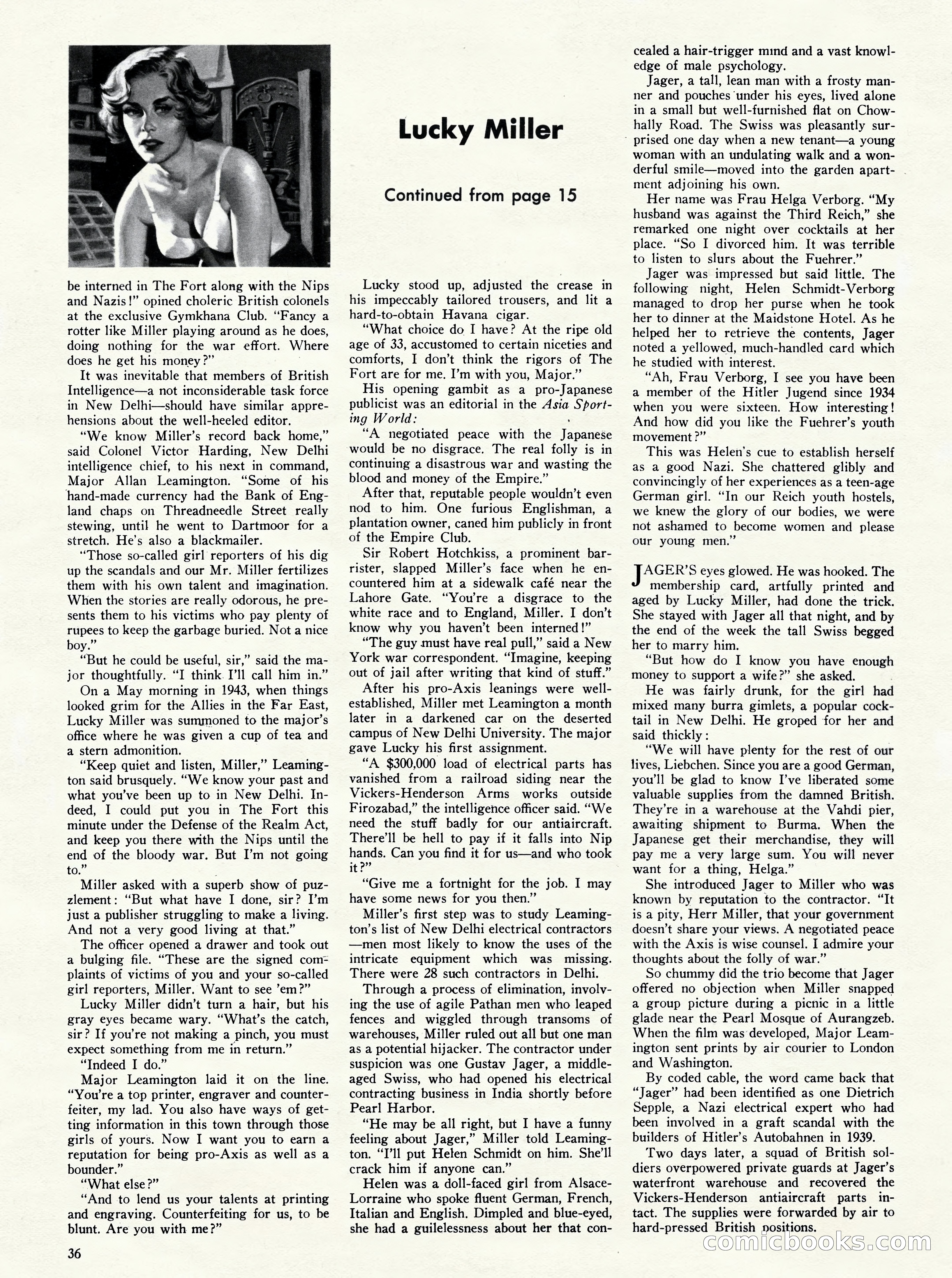
A restored page from Pulp Fiction, 1960. Page through the whole issue in the reader above.
📄 Transcribed text from this page (OCR, searchable)
Machine-transcribed from the original scan — historical spelling and the odd misread are preserved.
be interned in The Fort along with the Nips and Nazis!” opined choleric British colonels at the exclusive Gymkhana Club. “Fancy a rotter like Miller playing around as he does, doing nothing for the war effort. Where does he get his money ?” It was inevitable that members of British Intelligence—a not inconsiderable task force in New Delhi—should have similar appre- hensions about the well-heeled editor. “We know Miller’s record back home,” said Colonel Victor Harding, New Delhi intelligence chief, to his next in command, Major Allan Leamington. “Some of his hand-made currency had the Bank of Eng- land chaps on Threadneedle Street really stewing, until he went to Dartmoor for a stretch. He’s also a blackmailer. “Those so-called girl reporters of his dig up the scandals and our Mr. Miller fertilizes them with his own talent and imagination. When the stories are really odorous, he pre- sents them to his victims who pay plenty of rupees to keep the garbage buried. Not a nice boy.” “But he could be useful, sir,” said the ma- jor thoughtfully. “I think. I’ll call him in.” On a May morning in 1943, when things looked grim for the Allies in the Far East, Lucky Miller was summoned to the major’s office where he was given a cup of tea and a stern admonition. “Keep quiet and listen, Miller,” Leaming- ton said brusquely. “We know your past and what you’ve been up to in New Delhi. In- deed, I could put you in The Fort this minute under the Defense of the Realm Act, and keep you there with the Nips until the end of the bloody war. But I’m not going to.” Miller asked with a superb show of puz- zlement: ‘But what have I done, sir? I’m just a publisher struggling to make a living. And not a very good living at that.” The officer opened a drawer and took out a bulging file. “These are the signed com- plaints of victims of you and your so-called girl reporters, Miller, Want to see ’em?” Lucky Miller didn’t turn a hair, but his gray eyes became wary. “What’s the catch, sir? If you’re not making a pinch, you must expect something from me in return.” “Indeed I do.” Major Leamington laid it on the line. “You're a top printer, engraver and counter- feiter, my lad. You also have ways of get- ting information in this town through those girls of yours. Now I want you to earn a reputation for being pro-Axis as well as a bounder.” “What else?” “And to lend us your talents at printing and engraving. Counterfeiting for us, to be blunt. Are you with me?” 36 Lucky Miller Continued from page 15 Lucky stood up, adjusted the crease in his impeccably tailored trousers, and lit a hard-to-obtain Havana cigar. “What choice do I have? At the ripe old age of 33, accustomed to certain niceties and comforts, I don’t think the rigors of The Fort are for me. I’m with you, Major.” His opening gambit as a pro-Japanese publicist was an editorial in the Asia Sport- ing World: “A negotiated peace with the Japanese would be no disgrace. The real folly is in continuing a disastrous war and wasting the blood and money of the Empire.” After that, reputable people wouldn’t even nod to him. One furious Englishman, a plantation owner, caned him publicly in front of the Empire Club. Sir Robert Hotchkiss, a prominent bar- rister, slapped Miller’s face when he en- countered him at a sidewalk café near the Lahore Gate. “You’re a disgrace to the white race and to England, Miller. I don’t know why you haven't been interned!” “The guy must have real pull,” said a New York war correspondent. “Imagine, keeping out of jail after writing that kind of stuff.” After his pro-Axis leanings were well- established, Miller met Leamington a month later in a darkened car on the deserted campus of New Delhi University. The major gave Lucky his first assignment. “A $300,000 load of electrical parts has vanished from a railroad siding near the Vickers-Henderson Arms works outside Firozabad,” the intelligence officer said. “We need the stuff badly for our antiaircraft. There'll be hell to pay if it falls into Nip hands. Can you find it for us—and who took itt: “Give me a fortnight for the job. I may have some news for you then.” Miller’s first step was to study Leaming- ton’s list of New Delhi electrical contractors —men most likely to know the uses of the intricate equipment which was missing. There were 28 such contractors in Delhi. Through a process of elimination, involv- ing the use of agile Pathan men who leaped fences and wiggled through transoms of warehouses, Miller ruled out all but one man as a potential hijacker. The contractor under suspicion was one Gustav Jager, a middle- aged Swiss, who had opened his electrical contracting business in India shortly before Pearl Harbor. “He may be all right, but I have a funny feeling about Jager,” Miller told Leaming- on. “I’ll put Helen Schmidt on him. She'll crack him if anyone can.” Helen was a doll-faced girl from Alsace- Lorraine who spoke fluent German, French, Italian and English. Dimpled and blue-eyed, she had a guilelessness about her that con- cealed a hair-trigger mind and a vast knowl- edge of male psychology. Jager, a tall, lean man with a frosty man- ner and pouches ‘under his eyes, lived alone in a small but well-furnished flat on Chow- hally Road. The Swiss was pleasantly sur- ’ prised one day when a new tenant—a young woman with an undulating walk and a won- derful smile—moved into the garden apart- . ment adjoining his own. Her name was Frau Helga Verborg. “My husband was against the Third Reich,” she remarked one night over cocktails at her place. “So I divorced him. It was terrible to listen to slurs about the Fuehrer.” Jager was impressed but said little. The following night, Helen Schmidt-Verborg managed to drop her purse when he took her to dinner at the Maidstone Hotel. As he helped her to retrieve the contents, Jager noted a yellowed, much-handled card which he studied with interest. “Ah, Frau Verborg, I see you have been a member of the Hitler Jugend since 1934 when you were sixteen. How interesting! And how did you like the Fuehrer’s youth movement ?” This was Helen's cue to establish herself as a good Nazi. She chattered glibly and convincingly of her experiences as a teen-age German girl. “In our Reich youth hostels, we knew the glory of our bodies, we were not ashamed to become women and please our young men.” | pele eyes glowed. He was hooked. The membership card, artfully printed and aged by Lucky Miller, had done the trick. She stayed with Jager all that night, and by the end of the week the tall Swiss begged her to marry him. “But how do I know you have enough money to support a wife?” she asked. He was fairly drunk, for the girl had mixed many burra gimlets, a popular cock- tail in New Delhi. He groped for her and said thickly : | “We will have plenty for the rest of our lives, Liebchen. Since you are a good German, you'll be glad to know I’ve liberated some valuable supplies from the damned British. They’re in a warehouse at the Vahdi pier, awaiting shipment to Burma. When the Japanese get their merchandise, they will pay me a very large sum. You will never want for a thing, Helga.” She introduced Jager to Miller who was known by reputation to the contractor. “It is a pity, Herr Miller, that your government doesn’t share your views. A negotiated peace with the Axis is wise counsel. I admire your thoughts about the folly of war.” So chummy did the trio become that Jager offered no objection when Miller snapped a group picture during a picnic in a little glade near the Pearl Mosque of Aurangzeb. When the film was developed, Major Leam- ington sent prints by air courier to London and Washington. By coded cable, the word came back that “Jager” had been identified as one Dietrich Sepple, a Nazi electrical expert who had been involved in a graft scandal with the builders of Hitler’s Autobahnen in 1939. Two days later, a squad of British sol- diers overpowered private guards at Jager’s waterfront warehouse and recovered the Vickers-Henderson antiaircraft parts in- tact. The supplies were forwarded by air to hard-pressed British positions. CONMUCLIOOLKS (el @)