
Pulp Fiction, 1960 · page 35 of 68
Action for Men, May 1960 — page 35: what you’re looking at
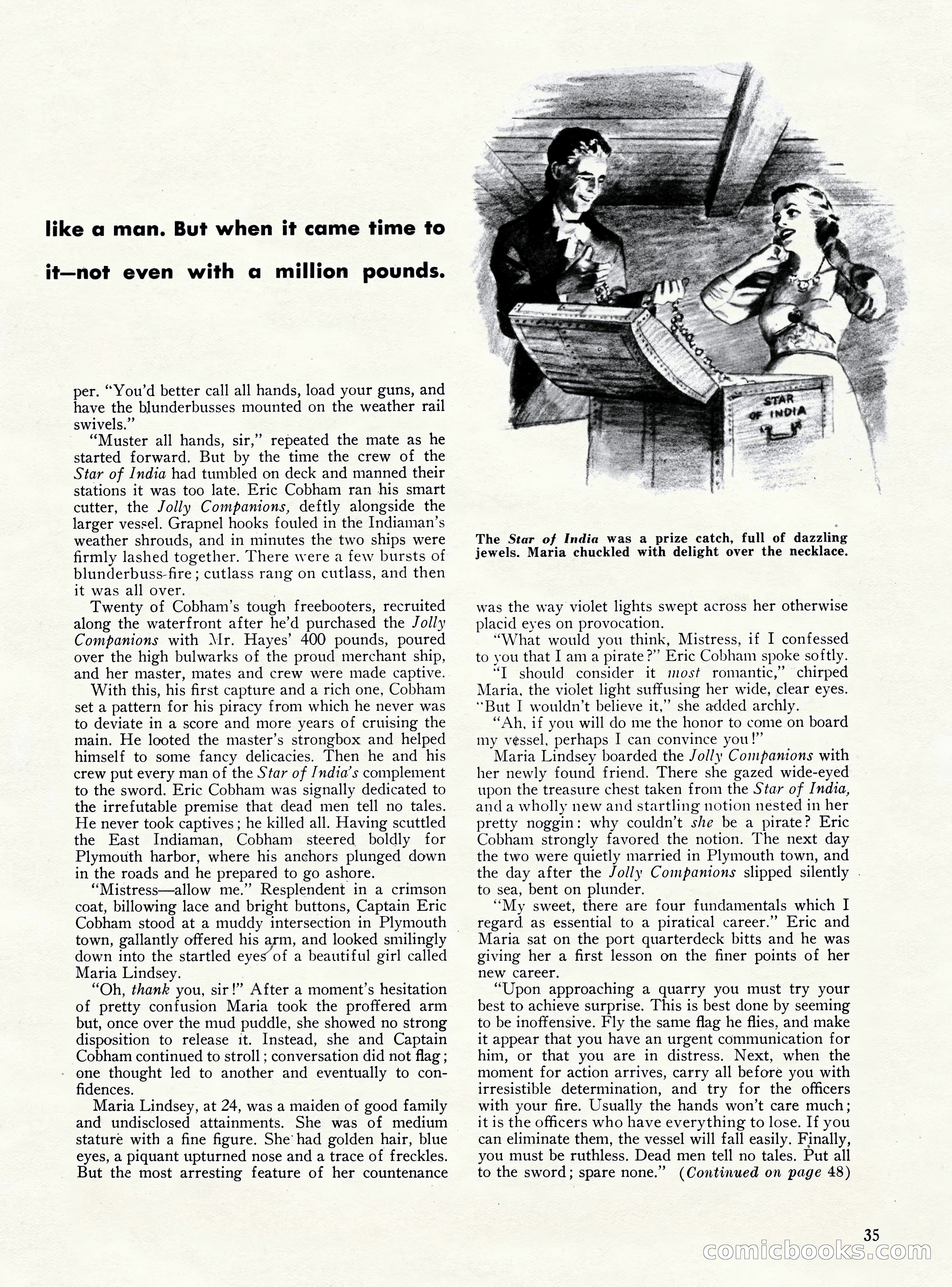
A restored page from Pulp Fiction, 1960. Page through the whole issue in the reader above.
📄 Transcribed text from this page (OCR, searchable)
Machine-transcribed from the original scan — historical spelling and the odd misread are preserved.
like a man. But when it came time to it—not even with a million pounds. per. “You'd better call all hands, load your guns, and have the blunderbusses mounted on the weather rail swivels.” “Muster all hands, sir,” repeated the mate as he started forward. But by the time the crew of the Star of India had tumbled on deck and manned their stations it was too late. Eric Cobham ran his smart cutter, the Jolly Companions, deftly alongside the larger vessel. Grapnel hooks fouled in the Indiaman’s weather shrouds, and in minutes the two ships were firmly lashed together. There were a few bursts of blunderbuss-fire ; cutlass rang on cutlass, and then it was all over. Twenty of Cobham’s tough freebooters, recruited along the waterfront after he’d purchased the Jolly Companions with Mr. Hayes’ 400 pounds, poured over the high bulwarks of the proud merchant ship, and her master, mates and crew were made captive. With this, his first capture and a rich one, Cobham set a pattern for his piracy from which he never was to deviate in a score and more years of cruising the main. He looted the master’s strongbox and helped himself to some fancy delicacies. Then he and his crew put every man of the Star of /ndia’s complement to the sword. Eric Cobham was signally dedicated to the irrefutable premise that dead men tell no tales. He never took captives; he killed all. Having scuttled the East Indiaman, Cobham steered boldly for Plymouth harbor, where his anchors plunged down in the roads and he prepared to go ashore. “Mistress—allow me.’’ Resplendent in a crimson coat, billowing lace and bright buttons, Captain Eric Cobham stood at a muddy intersection in Plymouth © town, gallantly offered his arm, and looked smilingly down into the startled eyes” of a beautiful girl called Maria Lindsey. | “Oh, thank you, sir!” After a moment’s hesitation of pretty confusion Maria took the proffered arm but, once over the mud puddle, she showed no strong disposition to release it. Instead, she and Captain Cobham continued to stroll ; conversation did not flag ; one thought led to another and eventually to con- fidences. Maria Lindsey, at 24, was a maiden of good family and undisclosed attainments. She was of medium stature with a fine figure. She had golden hair, blue eyes, a piquant upturned nose and a trace of freckles. But the most arresting feature of her countenance The Star of India was a prize catch, full of dazzling jewels. Maria chuckled with delight over the necklace. was the way violet lights swept across her otherwise placid eyes on provocation. ‘What would you think, Mistress, if I confessed to you that Iam a pirate?” Eric Cobham spoke softly. “I should consider it most romantic,’ chirped Maria, the violet light suffusing her wide, clear eyes. “But I wouldn’t believe it,” she added archly. ‘Ah, if you will do me the honor to come on board my véssel, perhaps I can convince you!” Maria Lindsey boarded the Jolly Companions with her newly found friend. There she gazed wide-eyed upon the treasure chest taken from the Star of India, anda wholly new and startling notion nested 1n her pretty noggin: why couldn’t she be a pirate? Eric Cobham strongly favored the notion. The next day the two were quietly married in Plymouth town, and the day after the Jolly Companions slipped silently . to sea, bent on plunder. ‘‘My sweet, there are four fundamentals which I regard as essential to a piratical career.” Eric and Maria sat on the port quarterdeck bitts and he was giving her a first lesson on the finer points of her new career. “Upon approaching a quarry you must try your best to achieve surprise. This is best done by seeming to be inoffensive. Fly the same flag he flies, and make it appear that you have an urgent communication for him, or that you are in distress. Next, when the moment for action arrives, carry all before you with irresistible determination, and try for the officers with your fire. Usually the hands won’t care much; it is the officers who have everything to lose. If you can eliminate them, the vessel will fall easily. Finally, you must be ruthless. Dead men tell no tales. Put all to the sword; spare none.” (Continued on page 48) 35 GOMIGEIOOKSKEO ()