
Pulp Fiction · page 52 of 68
Aboriginal Science Fiction, Issues 57–58 — page 52: what you’re looking at
A restored page from Pulp Fiction. Page through the whole issue in the reader above.
📄 Transcribed text from this page (OCR, searchable)
Machine-transcribed from the original scan — historical spelling and the odd misread are preserved.
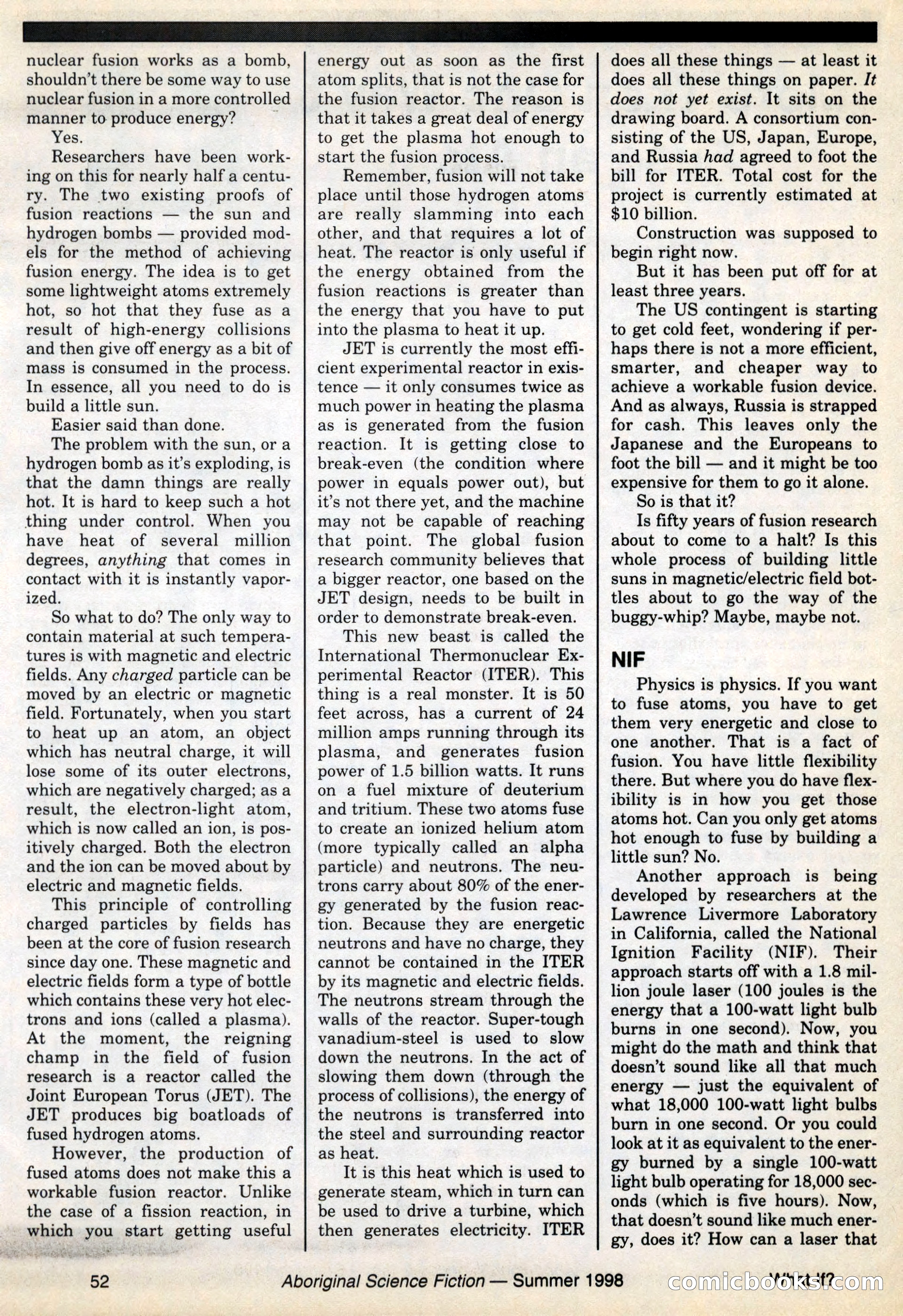
nuclear fusion works as a bomb, shouldn’t there be some way to use nuclear fusion in a more controlled manner to produce energy? . Yes, Researchers have been work- ing on this for nearly half a centu- ry. The two existing proofs of fusion reactions — the sun and hydrogen bombs — provided mod- els for the method of achieving fusion energy. The idea is to get some lightweight atoms extremely hot, so hot that they fuse as a result of high-energy collisions and then give off energy as a bit of mass is consumed in the process. In essence, all you need to do is build a little sun. Easier said than done. The problem with the sun, or a hydrogen bomb as it’s exploding, is that the damn things are really hot. It is hard to keep such a hot thing under control. When you have heat of several million degrees, anything that comes in contact with it is instantly vapor- ized. So what to do? The only way to contain material at such tempera- tures is with magnetic and electric fields. Any charged particle can be moved by an electric or magnetic field. Fortunately, when you start to heat up an atom, an object which has neutral charge, it will lose some of its outer electrons, which are negatively charged; as a result, the electron-light atom, which is now called an ion, is pos- itively charged. Both the electron and the ion can be moved about by electric and magnetic fields. This principle of controlling charged particles by fields has been at the core of fusion research since day one. These magnetic and electric fields form a type of bottle which contains these very hot elec- trons and ions (called a plasma). At the moment, the reigning champ in the field of fusion research is a reactor called the Joint European Torus (JET). The JET produces big boatloads of fused hydrogen atoms. However, the production of fused atoms does not make this a workable fusion reactor. Unlike the case of a fission reaction, in which you start getting useful 52 Aboriginal Science Fiction — Summer 1998 energy out as soon as the first atom splits, that is not the case for the fusion reactor. The reason is that it takes a great deal of energy to get the plasma hot enough to start the fusion process. Remember, fusion will not take place until those hydrogen atoms are really slamming into each other, and that requires a lot of heat. The reactor is only useful if the energy obtained from the fusion reactions is greater than the energy that you have to put into the plasma to heat it up. JET is currently the most effi- cient experimental reactor in exis- tence — it only consumes twice as much power in heating the plasma as is generated from the fusion reaction. It is getting close to break-even (the condition where power in equals power out), but it’s not there yet, and the machine may not be capable of reaching that point. The global fusion research community believes that a bigger reactor, one based on the JET design, needs to be built in order to demonstrate break-even. This new beast is called the International Thermonuclear Ex- perimental Reactor (ITER). This thing is a real monster. It is 50 feet across, has a current of 24 million amps running through its plasma, and generates fusion power of 1.5 billion watts. It runs on a fuel mixture of deuterium and tritium. These two atoms fuse to create an ionized helium atom (more typically called an alpha particle) and neutrons. The neu- trons carry about 80% of the ener- gy generated by the fusion reac- tion. Because they are energetic neutrons and have no charge, they cannot be contained in the ITER by its magnetic and electric fields. The neutrons stream through the walls of the reactor. Super-tough vanadium-steel is used to slow down the neutrons. In the act of slowing them down (through the process of collisions), the energy of the neutrons is transferred into the steel and surrounding reactor as heat. It is this heat which is used to generate steam, which in turn can be used to drive a turbine, which then generates electricity. ITER does all these things — at least it does all these things on paper. It does not yet exist. It sits on the drawing board. A consortium con- sisting of the US, Japan, Europe, and Russia had agreed to foot the bill for ITER. Total cost for the project is currently estimated at $10 billion. Construction was supposed to begin right now. But it has been put off for at least three years. The US contingent is starting to get cold feet, wondering if per- haps there is not a more efficient, smarter, and cheaper way to achieve a workable fusion device. And as always, Russia is strapped for cash. This leaves only the Japanese and the Europeans to foot the bill — and it might be too expensive for them to go it alone. So is that it? Is fifty years of fusion research about to come to a halt? Is this whole process of building little suns in magnetic/electric field bot- tles about to go the way of the buggy-whip? Maybe, maybe not. NIF Physics is physics. If you want to fuse atoms, you have to get them very energetic and close to one another. That is a fact of fusion. You have little flexibility there. But where you do have flex- ibility is in how you get those atoms hot. Can you only get atoms hot enough to fuse by building a little sun? No. Another approach is being developed by researchers at the Lawrence Livermore Laboratory in California, called the National Ignition Facility (NIF). Their approach starts off with a 1.8 mil- lion joule laser (100 joules is the energy that a 100-watt light bulb burns in one second). Now, you might do the math and think that doesn’t sound like all that much energy — just the equivalent of what 18,000 100-watt light bulbs burn in one second. Or you could look at it as equivalent to the ener- gy burned by a single 100-watt light bulb operating for 18,000 sec- onds (which is five hours). Now, that doesn’t sound like much ener- gy, does it? How can a laser that Gomichbooks:ecom