
Pulp Fiction · page 51 of 68
Aboriginal Science Fiction, Issues 57–58 — page 51: what you’re looking at
A restored page from Pulp Fiction. Page through the whole issue in the reader above.
📄 Transcribed text from this page (OCR, searchable)
Machine-transcribed from the original scan — historical spelling and the odd misread are preserved.
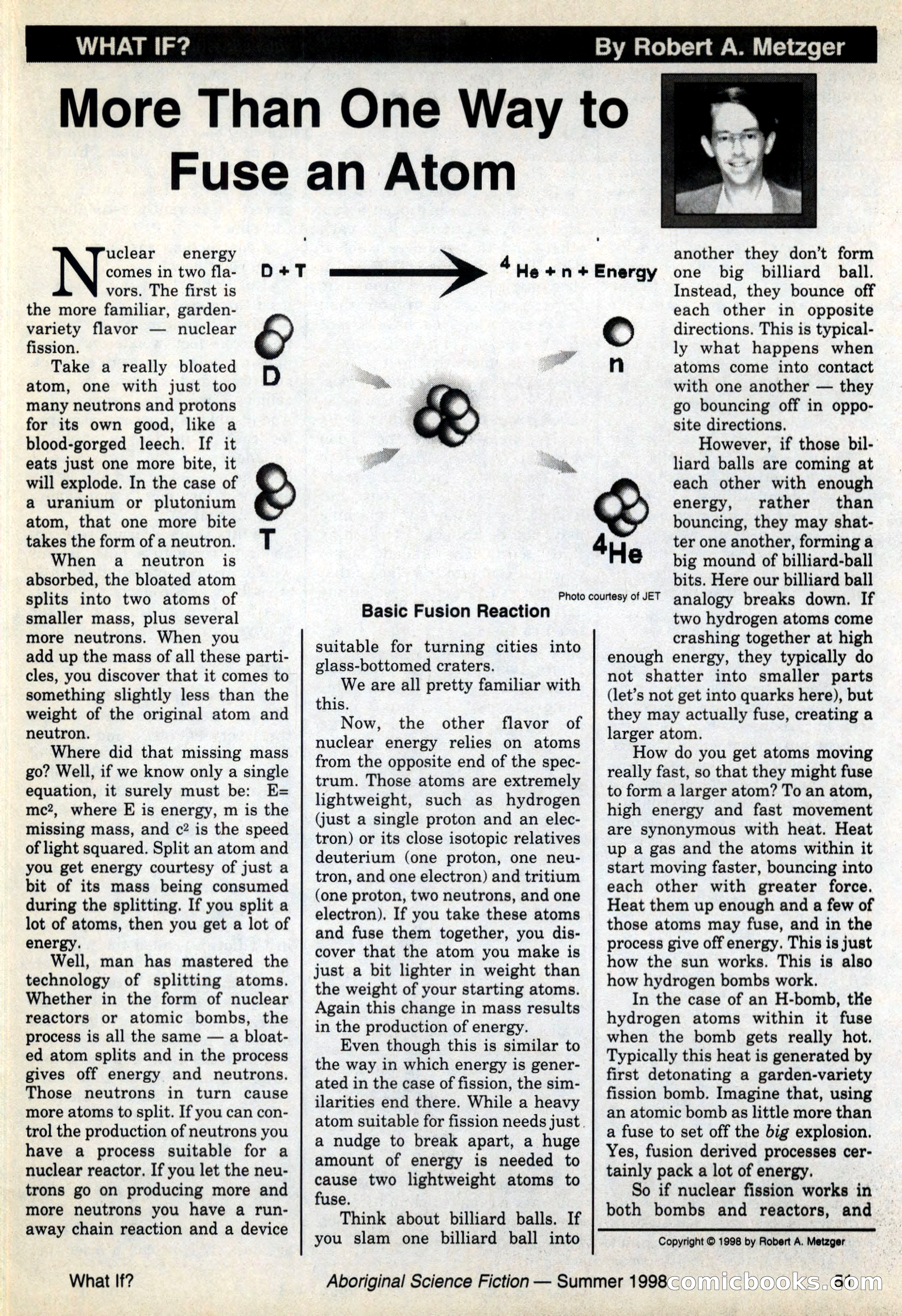
Fuse an Atom uclear energy comes in two fla- vors. The first is the more familiar, garden- variety flavor — nuclear fission. Take a really bloated atom, one with just too many neutrons and protons for its own good, like a blood-gorged leech. If it eats just one more bite, it will explode. In the case of a uranium or plutonium atom, that one more bite takes the form of a neutron. When a neutron is absorbed, the bloated atom splits into two atoms of smaller mass, plus several more neutrons. When you add up the mass of all these parti- cles, you discover that it comes to something slightly less than the weight of the original atom and neutron. Where did that missing mass go? Well, if we know only a single equation, it surely must be: E= mc?, where E is energy, m is the missing mass, and c? is the speed of light squared. Split an atom and you get energy courtesy of just a bit of its mass being consumed during the splitting. If you split a lot of atoms, then you get a lot of energy. Well, man has mastered the technology of splitting atoms. Whether in the form of nuclear reactors or atomic bombs, the process is all the same — a bloat- ed atom splits and in the process gives off energy and neutrons. Those neutrons in turn cause more atoms to split. If you can con- trol the production of neutrons you have a process suitable for a nuclear reactor. If you let the neu- trons go on producing more and more neutrons you have a run- away chain reaction and a device What If? Photo courtesy of JET Basic Fusion Reaction suitable for turning cities into glass-bottomed craters. We are all pretty familiar with this. Now, the other flavor of nuclear energy relies on atoms from the opposite end of the spec- trum. Those atoms are extremely lightweight, such as hydrogen (just a single proton and an elec- tron) or its close isotopic relatives deuterium (one proton, one neu- tron, and one electron) and tritium (one proton, two neutrons, and one electron), If you take these atoms and fuse them together, you dis- cover that the atom you make is just a bit lighter in weight than the weight of your starting atoms. Again this change in mass results in the production of energy. Even though this is similar to the way in which energy is gener- ated in the case of fission, the sim- ilarities end there. While a heavy atom suitable for fission needs just. a nudge to break apart, a huge amount of energy is needed to cause two lightweight atoms to fuse. Think about billiard balls. If you slam one billiard ball into Aboriginal Science Fiction — Summer 1998 D+T Saami of 4 He +n + Energy More Than One Way to another they don’t form one big billiard ball. Instead, they bounce off each other in opposite directions. This is typical- ly what happens when atoms come into contact with one another — they go bouncing off in oppo- site directions. However, if those bil- liard balls are coming at each other with enough energy, rather’ than bouncing, they may shat- ter one another, forming a big mound of billiard-ball bits. Here our billiard ball analogy breaks down. If two hydrogen atoms come crashing together at high enough energy, they typically do not shatter into smaller parts (let’s not get into quarks here), but they may actually fuse, creating a larger atom. How do you get atoms moving really fast, so that they might fuse to form a larger atom? To an atom, high energy and fast movement are synonymous with heat. Heat up a gas and the atoms within it start moving faster, bouncing into each other with greater force. Heat them up enough and a few of those atoms may fuse, and in the process give off energy. This is just how the sun works. This is also how hydrogen bombs work. In the case of an H-bomb, tHe hydrogen atoms within it fuse when the bomb gets really hot. Typically this heat is generated by first detonating a garden-variety fission bomb. Imagine that, using an atomic bomb as little more than a fuse to set off the big explosion. Yes, fusion derived processes cer- tainly pack a lot of energy. So if nuclear fission works in both bombs and reactors, and Copyright © 1998 by Robert A. Metzger VOO|KS COL ANUS