
Pulp Fiction · page 45 of 68
Aboriginal Science Fiction, Issues 57–58 — page 45: what you’re looking at
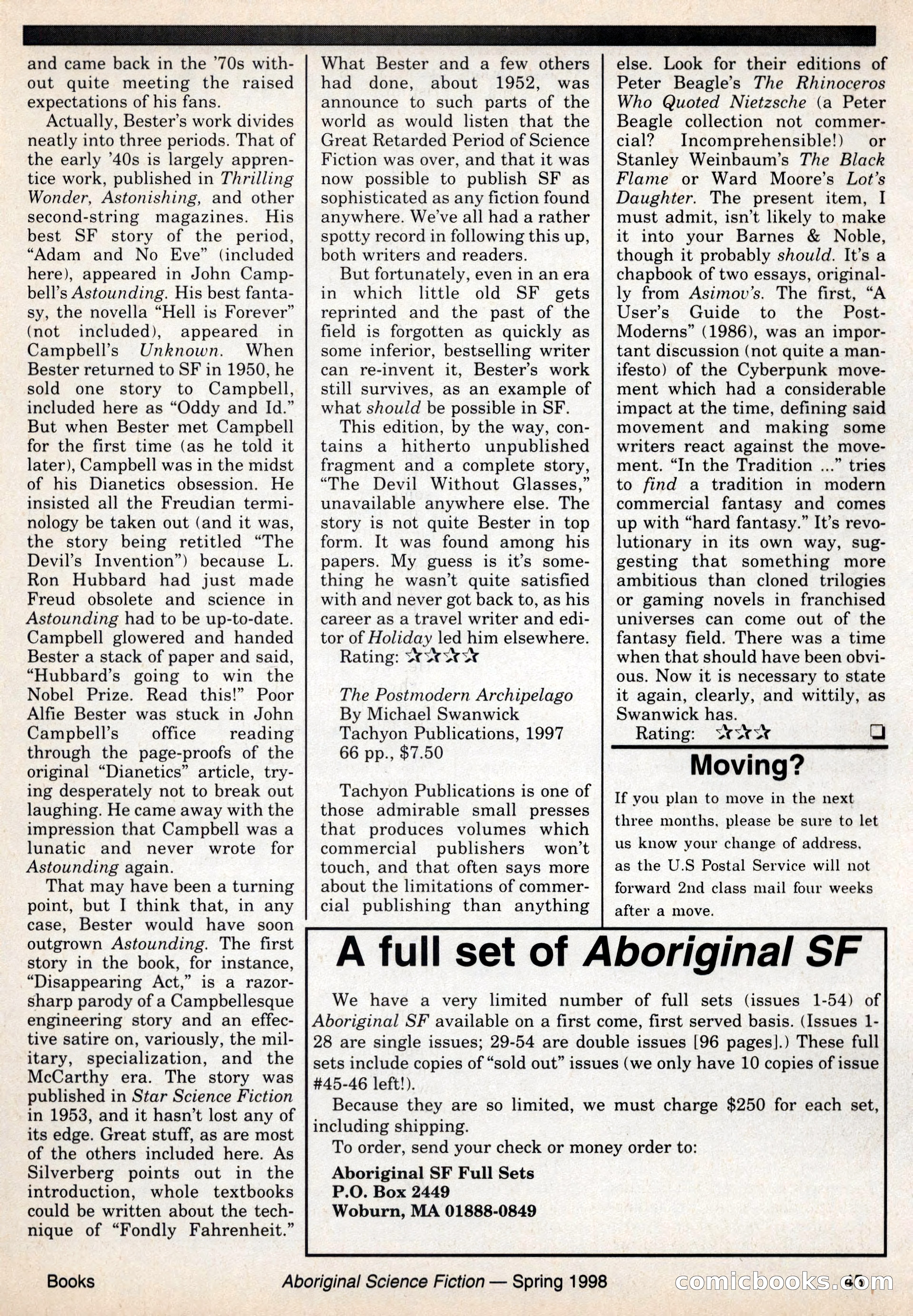
A restored page from Pulp Fiction. Page through the whole issue in the reader above.
📄 Transcribed text from this page (OCR, searchable)
Machine-transcribed from the original scan — historical spelling and the odd misread are preserved.
and came back in the ’70s with- out quite meeting the raised expectations of his fans. Actually, Bester’s work divides neatly into three periods. That of the early 40s is largely appren- tice work, published in Thrilling Wonder, Astonishing, and other second-string magazines. His best SF story of the period, “Adam and No Eve” (included here), appeared in John Camp- bell’s Astounding. His best fanta- sy, the novella “Hell is Forever” (not included), appeared in Campbell's Unknown. When Bester returned to SF in 1950, he sold one story to Campbell, included here as “Oddy and Id.” But when Bester met Campbell for the first time (as he told it later), Campbell was in the midst of his Dianetics obsession. He insisted all the Freudian termi- nology be taken out (and it was, the story being retitled “The Devil’s Invention”) because L. Ron Hubbard had just made Freud obsolete and science in Astounding had to be up-to-date. Campbell glowered and handed Bester a stack of paper and said, “Hubbard’s going to win the Nobel Prize. Read this!” Poor Alfie Bester was stuck in John Campbell’s office reading through the page-proofs of the original “Dianetics” article, try- ing desperately not to break out laughing. He came away with the impression that Campbell was a lunatic and never wrote for Astounding again. That may have been a turning point, but I think that, in any case, Bester would have soon outgrown Astounding. The first story in the book, for instance, “Disappearing Act,” is a razor- sharp parody of a Campbellesque engineering story and an effec- tive satire on, variously, the mil- itary, specialization, and the McCarthy era. The story was published in Star Science Fiction in 19538, and it hasn’t lost any of its edge. Great stuff, as are most of the others included here. As Silverberg points out in the introduction, whole textbooks could be written about the tech- nique of “Fondly Fahrenheit.” Books What Bester and a few others had done, about 1952, was announce to such parts of the world as would listen that the Great Retarded Period of Science Fiction was over, and that it was now possible to publish SF as sophisticated as any fiction found anywhere. We've all had a rather spotty record in following this up, both writers and readers. But fortunately, even in an era in which little old SF gets reprinted and the past of the field is forgotten as quickly as some inferior, bestselling writer can re-invent it, Bester’s work still survives, as an example of what should be possible in SF. This edition, by the way, con- tains a hitherto unpublished fragment and a complete story, “The Devil Without Glasses,” unavailable anywhere else. The story is not quite Bester in top form. It was found among his papers. My guess is it’s some- thing he wasn’t quite satisfied with and never got back to, as his career as a travel writer and edi- tor of Holiday led him elsewhere. Rating: “verve The Postmodern Archipelago By Michael Swanwick Tachyon Publications, 1997 66 pp., $7.50 Tachyon Publications is one of those admirable small presses that produces volumes which commercial publishers won't touch, and that often says more about the limitations of commer- cial publishing than anything else. Look for their editions of Peter Beagle’s The Rhinoceros Who Quoted Nietzsche (a Peter Beagle collection not commer- cial? Incomprehensible!) or Stanley Weinbaum’s The Black Flame or Ward Moore’s Lot’s Daughter. The present item, I must admit, isn’t likely to make it into your Barnes & Noble, though it probably should. It’s a chapbook of two essays, original- ly from Asimov’s. The first, “A User’s Guide to the Post- Moderns” (1986), was an impor- tant discussion (not quite a man- ifesto) of the Cyberpunk move- ment which had a considerable impact at the time, defining said movement and making some writers react against the move- ment. “In the Tradition ...” tries to find a tradition in modern commercial fantasy and comes up with “hard fantasy.” It’s revo- lutionary in its own way, sug- gesting that something more ambitious than cloned trilogies or gaming novels in franchised universes can come out of the fantasy field. There was a time when that should have been obvi- ous. Now it is necessary to state it again, clearly, and wittily, as Swanwick has. Rating: worst a Moving? If you plan to move in the next three months, please be sure to let us know your change of address, as the U.S Postal Service will not forward 2nd class mail four weeks after a move. A full set of Aboriginal SF We have a very limited number of full sets (issues 1-54) of Aboriginal SF available on a first come, first served basis. (Issues 1- 28 are single issues; 29-54 are double issues [96 pages].) These full sets include copies of “sold out” issues (we only have 10 copies of issue #45-46 left!). Because they are so limited, we must charge $250 for each set, including shipping. To order, send your check or money order to: Aboriginal SF Full Sets P.O. Box 2449 Woburn, MA 01888-0849 Aboriginal Science Fiction — Spring 1998 COPNICLOOOLK Com