
Pulp Fiction · page 44 of 68
Aboriginal Science Fiction, Issues 57–58 — page 44: what you’re looking at
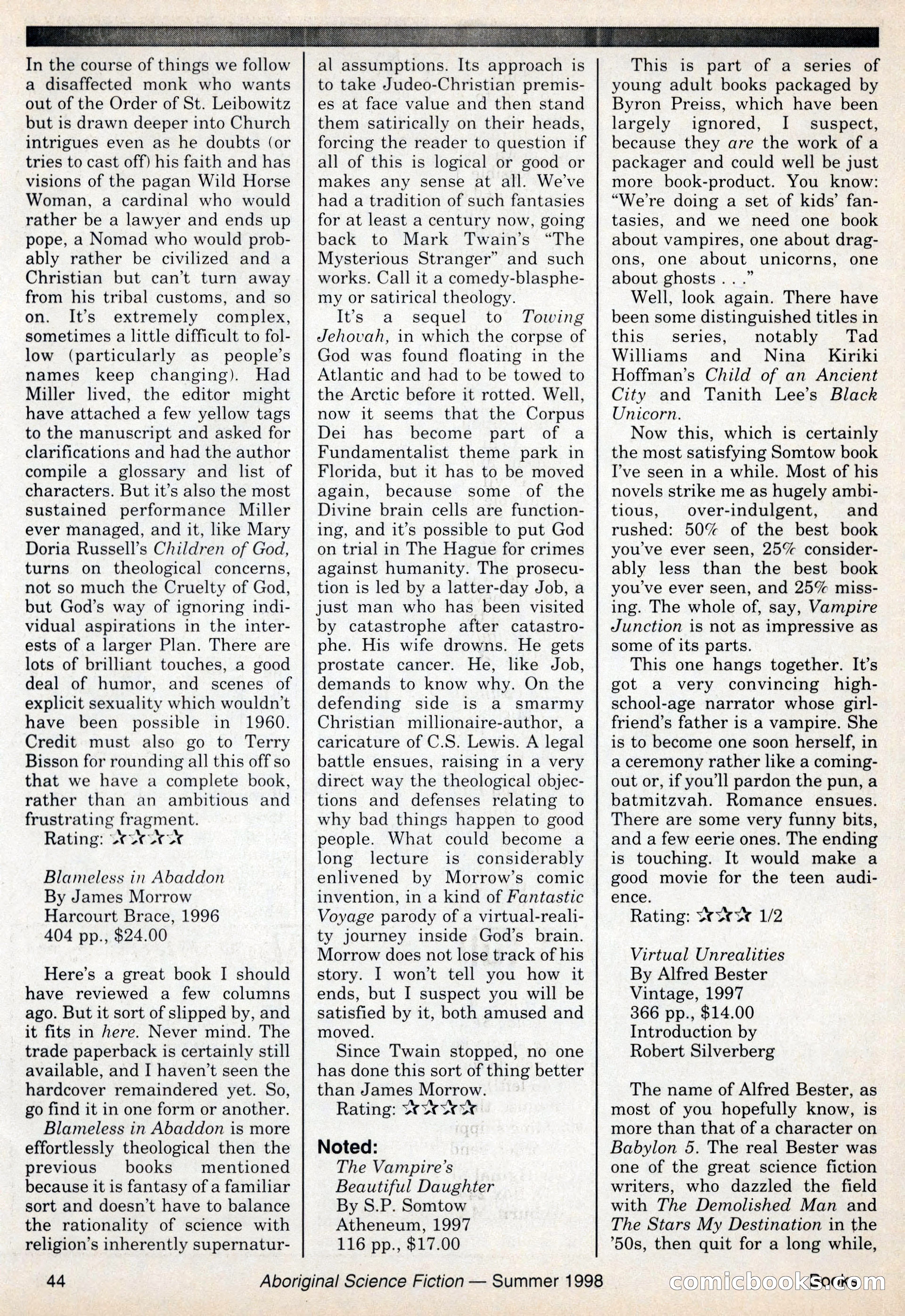
A restored page from Pulp Fiction. Page through the whole issue in the reader above.
📄 Transcribed text from this page (OCR, searchable)
Machine-transcribed from the original scan — historical spelling and the odd misread are preserved.
In the course of things we follow a disaffected monk who wants out of the Order of St. Leibowitz but is drawn deeper into Church intrigues even as he doubts (or tries to cast off) his faith and has visions of the pagan Wild Horse Woman, a cardinal who would rather be a lawyer and ends up pope, a Nomad who would prob- ably rather be civilized and a Christian but can’t turn away from his tribal customs, and so on. It’s extremely complex, sometimes a little difficult to fol- low (particularly as _ people’s names keep changing). Had Miller lived, the editor might have attached a few yellow tags to the manuscript and asked for clarifications and had the author compile a glossary and list of characters. But it’s also the most sustained performance Miller ever managed, and it, like Mary Doria Russell’s Children of God, turns on theological concerns, not so much the Cruelty of God, but God’s way of ignoring indi- vidual aspirations in the inter- ests of a larger Plan. There are lots of brilliant touches, a good deal of humor, and scenes of explicit sexuality which wouldn't have been possible in 1960. Credit must also go to Terry Bisson for rounding all this off so that we have a complete book, rather than an ambitious and frustrating fragment. Rating: vevecrse Blameless in Abaddon By James Morrow Harcourt Brace, 1996 404 pp., $24.00 Here’s a great book I should have reviewed a few columns ago. But it sort of slipped by, and it fits in here. Never mind. The trade paperback is certainly still available, and I haven’t seen the hardcover remaindered yet. So, go find it in one form or another. Blameless in Abaddon is more effortlessly theological then the previous books mentioned because it is fantasy of a familiar sort and doesn’t have to balance the rationality of science with religion’s inherently supernatur- 44 Aboriginal Science Fiction — Summer 1998 al assumptions. Its approach is to take Judeo-Christian premis- es at face value and then stand them satirically on their heads, forcing the reader to question if all of this is logical or good or makes any sense at all. We’ve had a tradition of such fantasies for at least a century now, going back to Mark Twain’s “The Mysterious Stranger” and such works. Call it a comedy-blasphe- my or satirical theology. It's a sequel to Towing Jehovah, in which the corpse of God was found floating in the Atlantic and had to be towed to the Arctic before it rotted. Well, now it seems that the Corpus Dei has become part of a Fundamentalist theme park in Florida, but it has to be moved again, because some of the Divine brain cells are function- ing, and it’s possible to put God on trial in The Hague for crimes against humanity. The prosecu- tion is led by a latter-day Job, a just man who has been visited by catastrophe after catastro- phe. His wife drowns. He gets prostate cancer. He, like Job, demands to know why. On the defending side is a smarmy Christian millionaire-author, a caricature of C.S. Lewis. A legal battle ensues, raising in a very direct way the theological objec- tions and defenses relating to why bad things happen to good people. What could become a long lecture is considerably enlivened by Morrow’s comic invention, in a kind of Fantastic Voyage parody of a virtual-reali- ty journey inside God’s brain. Morrow does not lose track of his story. I won't tell you how it ends, but I suspect you will be satisfied by it, both amused and moved. Since Twain stopped, no one has done this sort of thing better than James Morrow. Rating: ever re Noted: The Vampire's Beautiful Daughter By S.P. Somtow Atheneum, 1997 116 pp., $17.00 This is part of a series of young adult books packaged by Byron Preiss, which have been largely ignored, I _ suspect, because they are the work of a packager and could well be just more book-product. You know: “We're doing a set of kids’ fan- tasies, and we need one book about vampires, one about drag- ons, one about unicorns, one about ghosts...” Well, look again. There have been some distinguished titles in this series, notably Tad Williams and Nina_ Kiriki Hoffman’s Child of an Ancient City and Tanith Lee’s Black Unicorn. Now this, which is certainly the most satisfying Somtow book I’ve seen in a while. Most of his novels strike me as hugely ambi- tious, over-indulgent, and rushed: 50% of the best book you've ever seen, 25% consider- ably less than the best book you've ever seen, and 25% miss- ing. The whole of, say, Vampire Junction is not as impressive as some of its parts. This one hangs together. It’s got a very convincing high- school-age narrator whose girl- friend’s father is a vampire. She is to become one soon herself, in a ceremony rather like a coming- out or, if you'll pardon the pun, a batmitzvah. Romance ensues. There are some very funny bits, and a few eerie ones. The ending is touching. It would make a good movie for the teen audi- ence. Rating: vevrve 1/2 Virtual Unrealities By Alfred Bester Vintage, 1997 366 pp., $14.00 Introduction by Robert Silverberg The name of Alfred Bester, as most of you hopefully know, is more than that of a character on Babylon 5. The real Bester was one of the great science fiction writers, who dazzled the field with The Demolished Man and The Stars My Destination in the 50s, then quit for a long while, CORNICLMHOOKRGOI