
Pulp Fiction · page 42 of 68
Aboriginal Science Fiction, Issues 57–58 — page 42: what you’re looking at
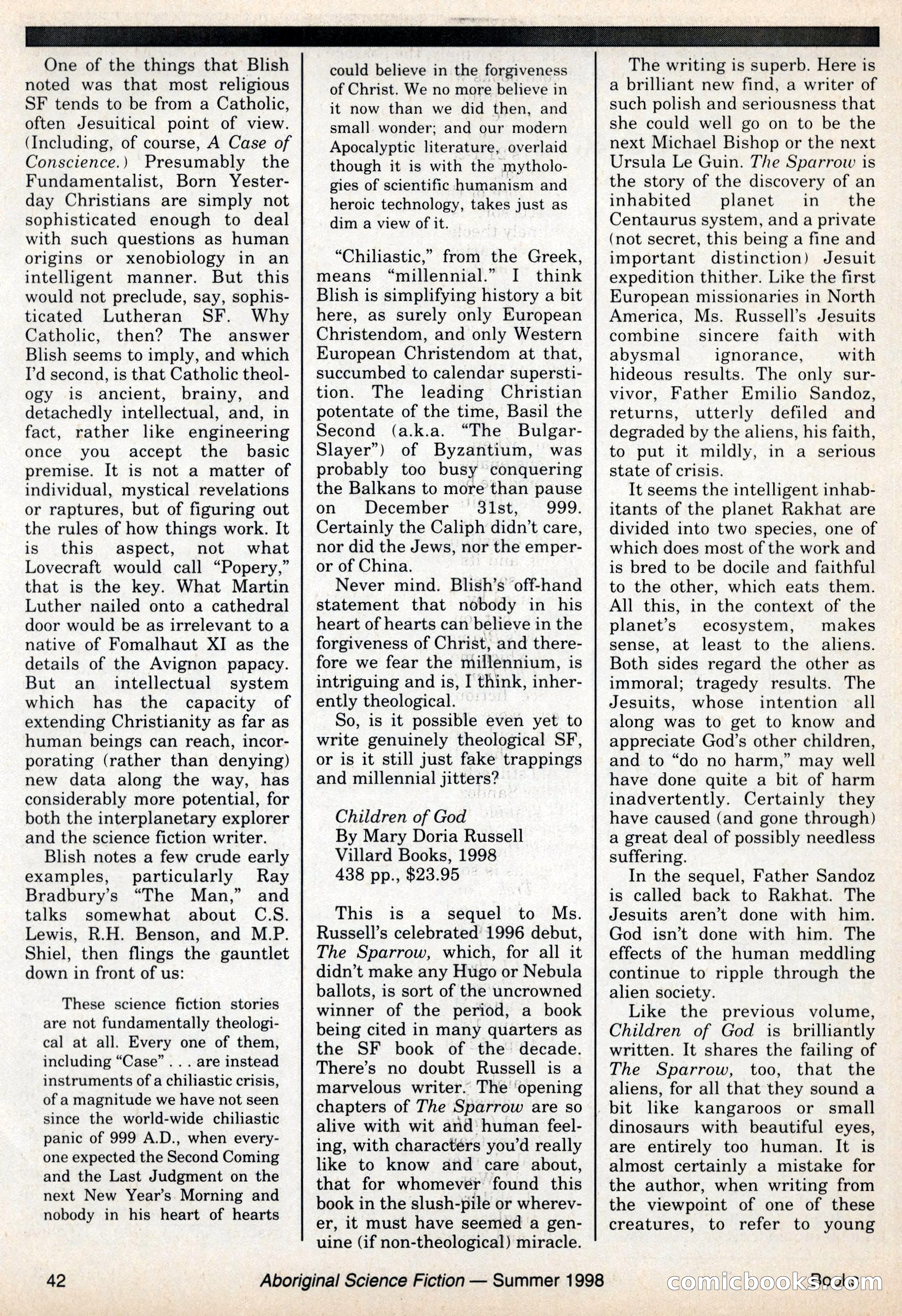
A restored page from Pulp Fiction. Page through the whole issue in the reader above.
📄 Transcribed text from this page (OCR, searchable)
Machine-transcribed from the original scan — historical spelling and the odd misread are preserved.
wet One of the things that Blish noted was that most religious SF tends to be from a Catholic, often Jesuitical point of view. (Including, of course, A Case of Conscience.) Presumably the Fundamentalist, Born Yester- day Christians are simply not sophisticated enough to deal with such questions as human origins or xenobiology in an intelligent manner. But this would not preclude, say, sophis- ticated Lutheran SF. Why Catholic, then? The answer Blish seems to imply, and which I'd second, is that Catholic theol- ogy is ancient, brainy, and detachedly intellectual, and, in fact, rather like engineering once you accept the _ basic premise. It is not a matter of individual, mystical revelations or raptures, but of figuring out the rules of how things work. It is this aspect, not what Lovecraft would call “Popery,” that is the key. What Martin Luther nailed onto a cathedral door would be as irrelevant to a native of Fomalhaut XI as the details of the Avignon papacy. But an _ intellectual system which has the capacity of extending Christianity as far as human beings can reach, incor- porating (rather than denying) new data along the way, has considerably more potential, for both the interplanetary explorer and the science fiction writer. Blish notes a few crude early examples, particularly Ray Bradbury’s “The Man,” and talks somewhat about C-.S. Lewis, R.H. Benson, and M.P. Shiel, then flings the gauntlet down in front of us: These science fiction stories are not fundamentally theologi- cal at all. Every one of them, including “Case”... are instead instruments of a chiliastic crisis, of a magnitude we have not seen since the world-wide chiliastic panic of 999 A.D., when every- one expected the Second Coming and the Last Judgment on the next New Year’s Morning and nobody in his heart of hearts 42 Aboriginal Science Fiction — Summer 1998 could believe in the forgiveness of Christ. We no more believe in it now than we did then, and small wonder; and our modern Apocalyptic literature, overlaid though it is with the mytholo- gies of scientific humanism and heroic technology, takes just as dim a view of it. “Chiliastic,” from the Greek, means “millennial.” I think Blish is simplifying history a bit here, as surely only European Christendom, and only Western European Christendom at that, succumbed to calendar supersti- tion. The leading Christian potentate of the time, Basil the Second (a.k.a. “The Bulgar- Slayer”) of Byzantium, was probably too busy conquering the Balkans to more than pause on December 3lst, 999. Certainly the Caliph didn’t care, nor did the Jews, nor the emper- or of China. Never mind. Blish’s off-hand statement that nobody in his heart of hearts can believe in the forgiveness of Christ, and there- fore we fear the millennium, is intriguing and is, I think, inher- ently theological. So, is it possible even yet to write genuinely theological SF, or is it still just fake trappings and millennial jitters? Children of God By Mary Doria Russell Villard Books, 1998 438 pp., $23.95 This is a sequel to Ms. Russell’s celebrated 1996 debut, The Sparrow, which, for all it didn’t make any Hugo or Nebula ballots, is sort of the uncrowned winner of the period, a book being cited in many quarters as the SF book of the decade. There’s no doubt Russell is a marvelous writer. The ‘opening chapters of The Sparrow are so alive with wit and human feel- ing, with characters you'd really like to know and care about, that for whomever found this book in the slush-pile or wherev- er, it must have seemed a gen- uine (if non-theological) miracle. The writing is superb. Here is a brilliant new find, a writer of such polish and seriousness that she could well go on to be the next Michael Bishop or the next Ursula Le Guin. The Sparrow is the story of the discovery of an inhabited planet in the Centaurus system, and a private (not secret, this being a fine and important distinction) Jesuit expedition thither. Like the first European missionaries in North America, Ms. Russell’s Jesuits combine sincere faith with abysmal ignorance, with hideous results. The only sur- vivor, Father Emilio Sandoz, returns, utterly defiled and degraded by the aliens, his faith, to put it mildly, in a serious state of crisis. It seems the intelligent inhab- itants of the planet Rakhat are divided into two species, one of which does most of the work and is bred to be docile and faithful to the other, which eats them. All this, in the context of the planet’s ecosystem, makes sense, at least to the aliens. Both sides regard the other as immoral; tragedy results. The Jesuits, whose intention all along was to get to know and appreciate God’s other children, and to “do no harm,” may well have done quite a bit of harm inadvertently. Certainly they have caused (and gone through) a great deal of possibly needless suffering. In the sequel, Father Sandoz is called back to Rakhat. The Jesuits aren’t done with him. God isn’t done with him. The effects of the human meddling continue to ripple through the alien society. Like the previous volume, Children of God is brilliantly written. It shares the failing of The Sparrow, too, that the aliens, for all that they sound a _bit like kangaroos or small dinosaurs with beautiful eyes, are entirely too human. It is almost certainly a mistake for the author, when writing from the viewpoint of one of these creatures, to refer to young COMmMicooekSaeonn