
Pulp Fiction · page 41 of 68
Aboriginal Science Fiction, Issues 57–58 — page 41: what you’re looking at
A restored page from Pulp Fiction. Page through the whole issue in the reader above.
📄 Transcribed text from this page (OCR, searchable)
Machine-transcribed from the original scan — historical spelling and the odd misread are preserved.
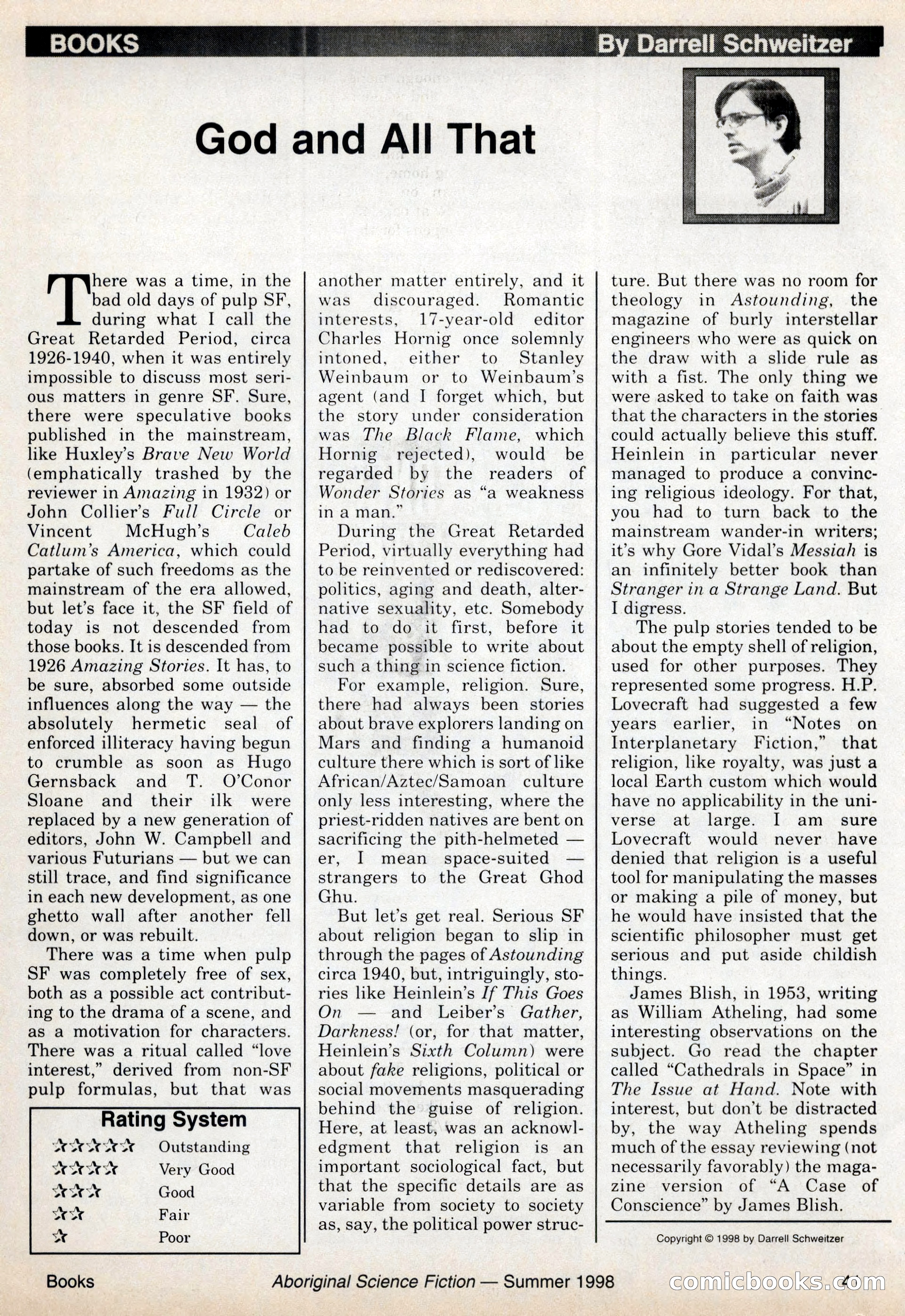
God and All That here was a time, in the [hse old days of pulp SF, during what I call the Great Retarded Period, circa 1926-1940, when it was entirely impossible to discuss most seri- ous matters in genre SF. Sure, there were speculative books published in the mainstream, like Huxley’s Brave New World (emphatically trashed by the reviewer in Amazing in 1932) or John Collier's Full Circle or Vincent McHugh’s Caleb Catlum’s America, which could partake of such freedoms as the mainstream of the era allowed, but let’s face it, the SF field of today is not descended from those books. It is descended from 1926 Amazing Stories. It has, to be sure, absorbed some outside influences along the way — the absolutely hermetic seal of enforced illiteracy having begun to crumble as soon as Hugo Gernsback and T. O’Conor Sloane and their ilk were replaced by a new generation of editors, John W. Campbell and various Futurians — but we can still trace, and find significance in each new development, as one ghetto wall after another fell down, or was rebuilt. There was a time when pulp SF was completely free of sex, both as a possible act contribut- ing to the drama of a scene, and as a motivation for characters. There was a ritual called “love interest,” derived from non-SF pulp formulas, but that was Rating System x OX Ok OX ag verre Outstanding Very Good Good Fair vk wt Poor Books another matter entirely, and it was discouraged. Romantic interests, 17-year-old editor Charles Hornig once solemnly intoned, either to Stanley Weinbaum or to Weinbaum’s agent (and I forget which, but the story under consideration was The Black Flame, which Hornig rejected), would be regarded by the readers of Wonder Stories as “a weakness in a man.” During the Great Retarded Period, virtually everything had to be reinvented or rediscovered: politics, aging and death, alter- native sexuality, etc. Somebody had to do it first, before it became possible to write about such a thing in science fiction. For example, religion. Sure, there had always been stories about brave explorers landing on Mars and finding a humanoid culture there which is sort of like African/Aztec/Samoan_ culture only less interesting, where the priest-ridden natives are bent on sacrificing the pith-helmeted — er, I mean _ space-suited — strangers to the Great Ghod Ghu. But let’s get real. Serious SF about religion began to slip in through the pages of Astounding circa 1940, but, intriguingly, sto- ries like Heinlein’s If This Goes On — and Leiber’s Gather, Darkness! (or, for that matter, Heinlein’s Sixth Column) were about fake religions, political or social movements masquerading behind the guise of religion. Here, at least, was an acknowl- edgment that religion is an important sociological fact, but that the specific details are as variable from society to society as, say, the political power struc- Aboriginal Science Fiction — Summer 1998 By Darrell Schweitzer ture. But there was no room for theology in Astounding, the magazine of burly interstellar engineers who were as quick on the draw with a slide rule as with a fist. The only thing we were asked to take on faith was that the characters in the stories could actually believe this stuff. Heinlein in particular never managed to produce a convinc- ing religious ideology. For that, you had to turn back to the mainstream wander-in writers; it’s why Gore Vidal’s Messiah is an infinitely better book than Stranger in a Strange Land. But I digress. The pulp stories tended to be about the empty shell of religion, used for other purposes. They represented some progress. H.P. Lovecraft had suggested a few years earlier, in “Notes on Interplanetary Fiction,” that religion, like royalty, was just a local Earth custom which would have no applicability in the uni- verse at large. | am _ sure Lovecraft would never have denied that religion is a useful tool for manipulating the masses or making a pile of money, but he would have insisted that the scientific philosopher must get serious and put aside childish things. James Blish, in 19538, writing as William Atheling, had some interesting observations on the subject. Go read the chapter called “Cathedrals in Space” in The Issue at Hand. Note with interest, but don’t be distracted by, the way Atheling spends much of the essay reviewing (not necessarily favorably) the maga- zine version of “A Case of Conscience” by James Blish. Copyright © 1998 by Darrell Schweitzer Gomicbooksecom