
Pulp Fiction, 1950 · page 83 of 135
A. Merritt's Fantasy Magazine, October 1950 — page 83: what you’re looking at
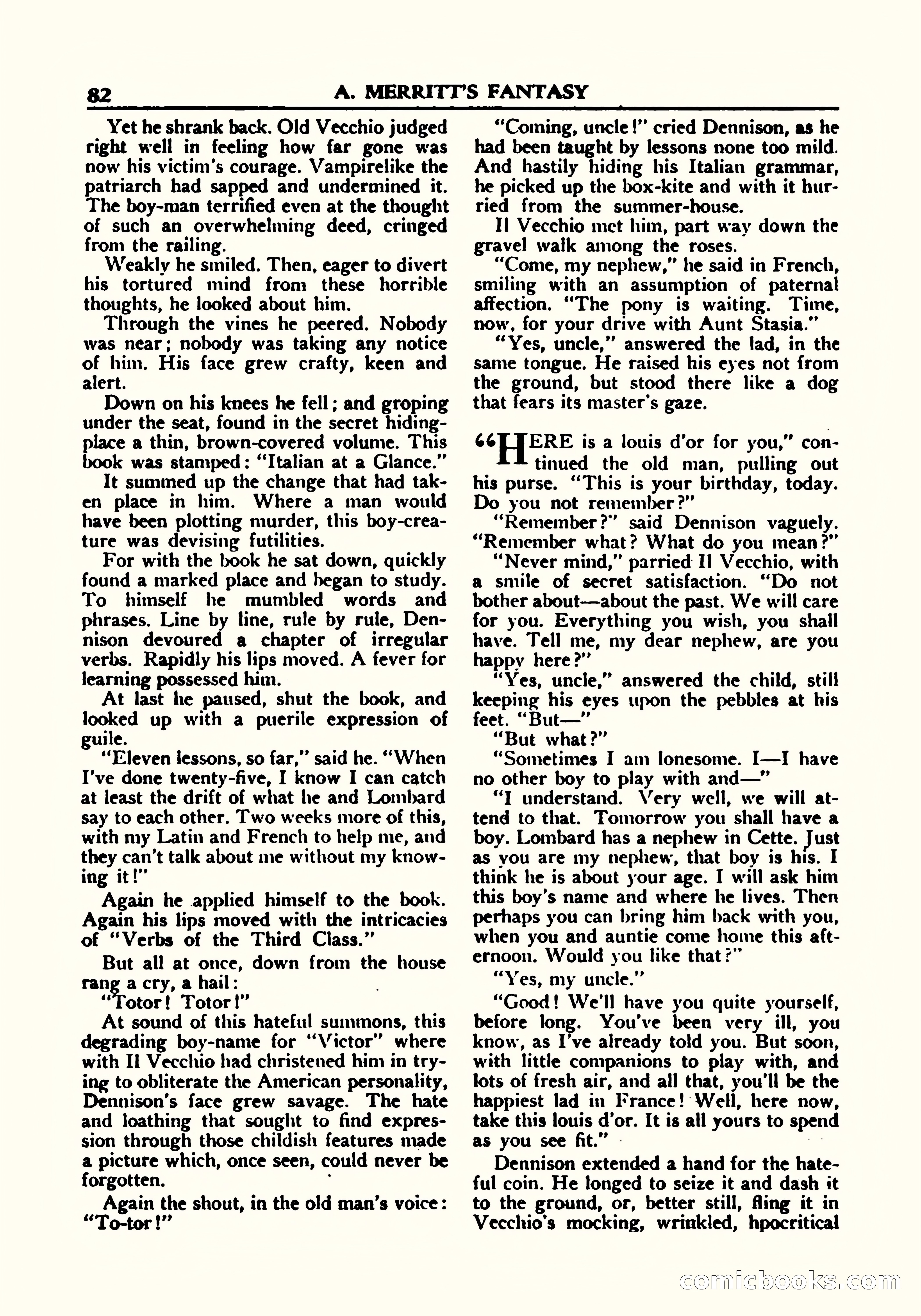
A restored page from Pulp Fiction, 1950. Page through the whole issue in the reader above.
📄 Transcribed text from this page (OCR, searchable)
Machine-transcribed from the original scan — historical spelling and the odd misread are preserved.
82 A. MERRITT’S FANTASY Yet he shrank back. Old Vecchio judged right well in feeling how far gone was now his victim’s courage. Vampirelike the patriarch had sapped and undermined it. The boy-man terrified even at the thought of such an overwhelming deed, cringed from the railing. Weakly he smiled. Then, eager to divert his tortured mind from these horrible thoughts, he looked about him. Through the vines he peered. Nobody was near; nobody was taking any notice of him. His face grew crafty, keen and alert. Down on his knees he fell; and groping under the seat, found in the secret hiding- place a thin, brown-covered volume. This book was stamped: “Italian at a Glance.” It summed up the change that had tak- en place in him. Where a man would have been plotting murder, this boy-crea- ture was devising futilities. For with the book he sat down, quickly found a marked place and hegan to study. To himself he mumbled words and phrases. Line by line, rule by rule, Den- nison devoured a chapter of irregular verbs. Rapidly his lips moved. A fever for learning possessed him. At last he paused, shut the book, and looked up with a puerile expression of guile. ‘Eleven lessons, so far,” said he. ‘When I’ve done twenty-five, I know I can catch at least the drift of what he and Lombard say to each other. Two weeks more of this, with my Latin and French to help me, and they can’t talk about me without my know- ing it!” Again he applied himself to the book. Again his lips moved with the intricacies of “Verbs of the Third Class.” But all at once, down from the house fang acry, a hail: “‘Totor! Totor!” At sound of this hateful summons, this degrading boy-name for “Victor” where with IL Vecchio had christened him in try- ing to obliterate the American personality, Dennison’s face grew savage. The hate and loathing that sought to find expres- sion through those childish features made a picture which, once seen, could never be forgotten. Again the shout, in the old man’s voice: “To-tor !”’ “Coming, uncle!’ cried Dennison, as he had been taught by lessons none too mild. And hastily hiding his Italian grammar, he picked up the box-kite and with it hur- ried from the summer-house. Il Vecchio mct him, part way down the gravel walk among the roses. “Come, my nephew,” he said in French, smiling with an assumption of paternal affection. “The pony is waiting. Time, now, for your drive with Aunt Stasia.” “Yes, uncle,”’ answered the lad, in the same tongue. He raised his eyes not from the ground, but stood there like a dog that fears its master’s gaze. COHTERE is a louis d’or for you,” con- tinued the old man, pulling out his purse. ‘“‘This is your birthday, today. Do you not remember ?” “Remember ?” said Dennison vaguely. “Remember what? What do you mean?” “Never mind,” parried I! Vecchio, with a smile of secret satisfaction. “Do not bother about—about the past. We will care for you. Everything you wish, you shall have. Tell me, my dear nephew, are you happy here?” “Yes, uncle,” answered the child, still keeping his eyes upon the pebbles at his feet. “But—” “But what?” “Sometimes I am lonesome. I—I have no other boy to play with and—” “I understand. Very well, we will at- tend to that. Tomorrow you shall have a boy. Lombard has a nephew in Cette. Just as you are my nephew, that boy is his. I think he is about your age. I will ask him this boy’s name and where he lives. Then perhaps you can bring him back with you, when you and auntie come homme this aft- ernoon. Would you like that?" “Yes, my uncle.” “Good! We'll have you quite yourself, before long. You've been very ill, you know, as I’ve already told you. But soon, with little companions to play with, and lots of fresh air, and all that, you'll be the happiest lad in I'rance! Well, here now, take this louis d’ or. It is all yours to spend as you see fit.” Dennison extended a hand for the hate- ful coin. He longed to seize it and dash it to the ground, or, better still, fling it in Vecchio’s mocking, wrinkled, hpocritical oP ECOMICLOC|S (C(O)