
Pulp Fiction, 1950 · page 82 of 135
A. Merritt's Fantasy Magazine, October 1950 — page 82: what you’re looking at
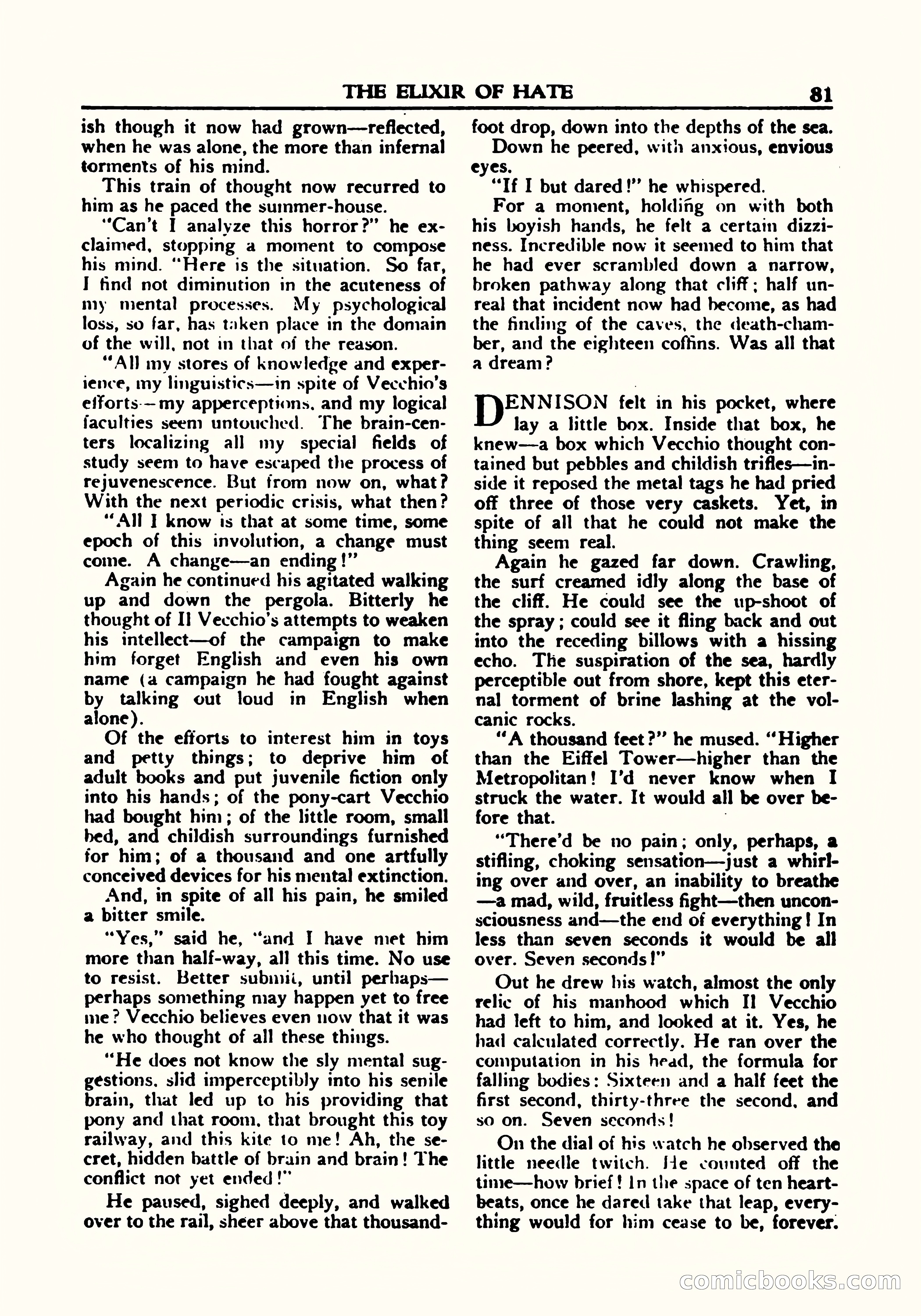
A restored page from Pulp Fiction, 1950. Page through the whole issue in the reader above.
📄 Transcribed text from this page (OCR, searchable)
Machine-transcribed from the original scan — historical spelling and the odd misread are preserved.
THE ELIXIR OF HATE 81 ish though it now had grown—reflected, when he was alone, the more than infernal torments of his mind. This train of thought now recurred to him as he paced the summer-house. “Can't I analyze this horror?” he ex- claimed, stopping a moment to compose his mind. “Here is the situation. So far, I find not diminution in the acuteness of my mental processes. My psychological loss, so far, has taken place in the domain of the will, not in that of the reason. “All my stores of knowledge and exper- lence, my linguistics—in spite of Vecchio’s efforts-—my apperceptions, and my logical faculties seem untouched. The brain-cen- ters localizing all my special fields of study seem to have escaped the process of rejyuvenescence. But from now on, what? With the next periodic crisis, what then? ‘All I know is that at some time, some epoch of this involution, a change must come. A change—an ending!” Again he continued his agitated walking up and down the pergola. Bitterly he thought of II Vecchio’s attempts to weaken his intellect—of the campaign to make him forget English and even his own name (a campaign he had fought against by talking out loud in English when alone). Of the efforts to interest him in toys and petty things; to deprive him of adult books and put juvenile fiction only into his hands; of the pony-cart Vecchio had bought him; of the little room, small bed, and childish surroundings furnished for him; of a thousand and one artfully conceived devices for his mental extinction. And, in spite of all his pain, he smiled a bitter smile. “Yes,” said he, “and I have met him more than half-way, all this time. No use to resist. Better subnui, until perhaps— perhaps something may happen yet to free me? Vecchio believes even now that it was he who thought of all these things. “He does not know the sly mental sug- gestions, slid imperceptibly into his senile brain, that led up to his providing that pony and that room, that brought this toy railway, and this kite to me! Ah, the se- cret, hidden battle of brain and brain! The conflict not yet ended!" He paused, sighed deeply, and walked over to the rail, sheer above that thousand- foot drop, down into the depths of the sea. eyes. “If I but dared !’’ he whispered. For a moment, holding on with both his boyish hands, he felt a certain dizz1- ness. Incredible now it seemed to him that he had ever scrambled down a narrow, broken pathway along that cliff; half un- real that incident now had become, as had the finding of the caves, the death-cham- ber, and the eighteen coffins. Was all that a dream? ENNISON felt in his pocket, where lay a little box. Inside that box, he knew—a box which Vecchio thought con- tained but pebbles and childish trifles—in- side it reposed the metal tags he had pried off three of those very caskets. Yet, in spite of all that he could not make ‘the thing seem real. Again he gazed far down. Crawling, the surf creamed idly along the base of the cliff. He could see the up-shoot of the spray ; could see it fling back and out into the receding billows with a hissing echo. The suspiration of the sea, hardly perceptible out from shore, kept this eter- nal torment of brine lashing at the vol- canic rocks. “‘A thousand feet ?’’ he mused. “ Higher than the Eiffel Tower—higher than the Metropolitan! I’d never know when I struck the water. It would all be over be- fore that. “There'd be no pain; only, perhaps, a stifling, choking sensation—just a whirl- ing over and over, an inability to breathe —a mad, wild, fruitless fight—then uncon- sciousness and—the end of everything! In less than seven seconds it would be all over. Seven seconds!” Out he drew his watch, almost the only relic of his manhood which II Vecchio had left to him, and looked at it. Yes, he had calculated correctly. He ran over the computation in his head, the formula for falling bodies: Sixteen and a half feet the first second, thirty-three the second, and so on. Seven seconds! On the dial of his watch he observed the little needle twitch. Ie counted off the tin1e—how brief! 1n the space of ten heart- beats, once he dared take that leap, every- thing would for him cease to be, forever. Down he peered, with anxious, envious nn) (C 6)(0)©) <S (C(O)