
Pulp Fiction, 1950 · page 33 of 135
A. Merritt's Fantasy Magazine, October 1950 — page 33: what you’re looking at
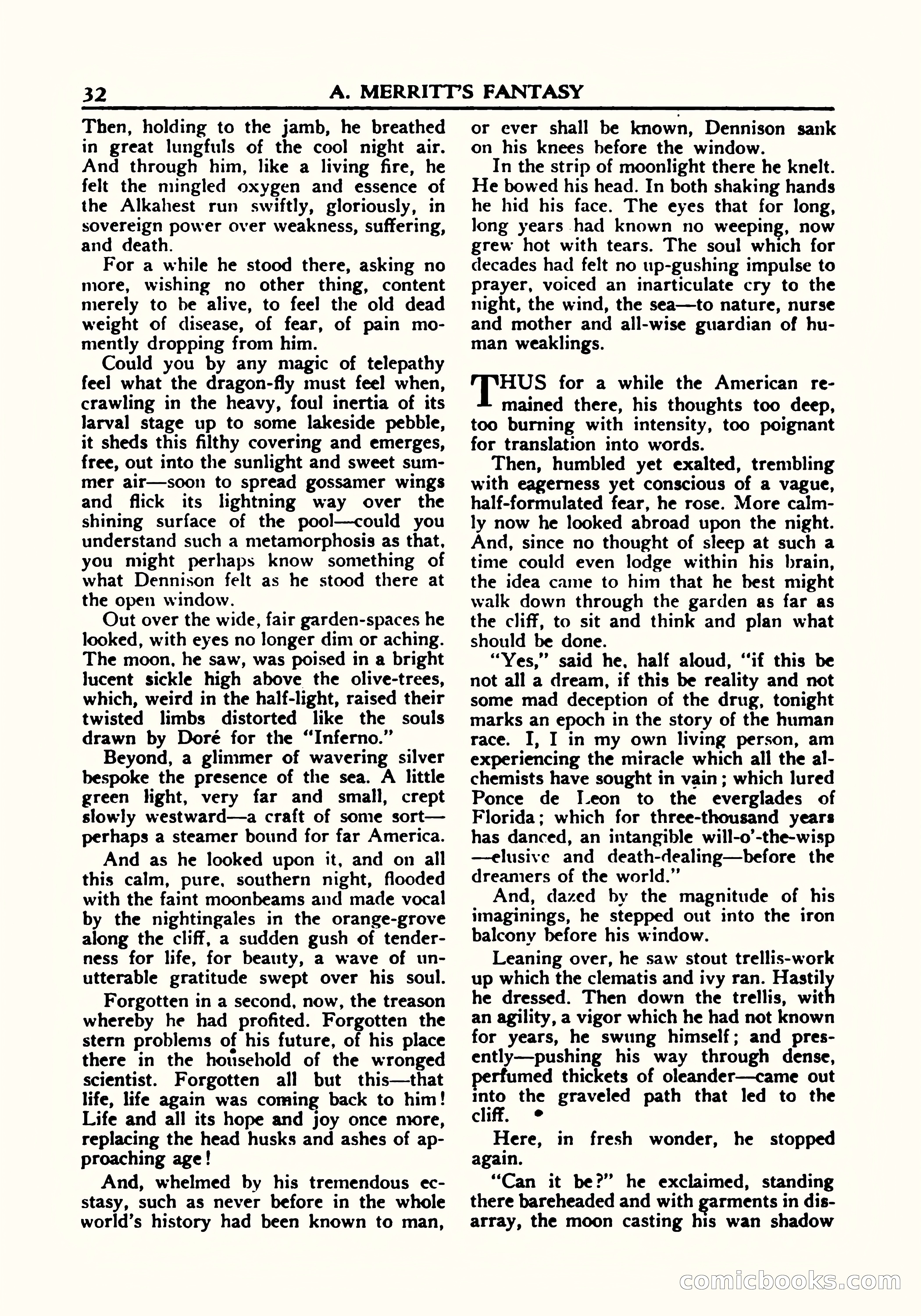
A restored page from Pulp Fiction, 1950. Page through the whole issue in the reader above.
📄 Transcribed text from this page (OCR, searchable)
Machine-transcribed from the original scan — historical spelling and the odd misread are preserved.
32 A. MERRITT’S FANTASY Then, holding to the jamb, he breathed in great lungfuls of the cool night air. And through him, like a living fire, he felt the mingled oxygen and essence of the Alkahest run swiftly, gloriously, in sovereign power over weakness, suffering, and death. For a while he stood there, asking no more, wishing no other thing, content merely to be alive, to feel the old dead weight of disease, of fear, of pain mo- mently dropping from him. Could you by any magic of telepathy feel what the dragon-fly must feel when, crawling in the heavy, foul inertia of its larval stage up to some lakeside pebble, it sheds this filthy covering and emerges, free, out into the sunlight and sweet sum- mer air—soon to spread gossamer wings and flick its lightning way over the shining surface of the pool—could you understand such a metamorphosis as that, you might perhaps know something of what Dennison felt as he stood there at the open window. Out over the wide, fair garden-spaces he looked, with eyes no longer dim or aching. The moon, he saw, was poised in a bright lucent sickle high above the olive-trees, which, weird in the half-light, raised their twisted limbs distorted like the souls drawn by Doré for the “Inferno.” Beyond, a glimmer of wavering silver bespoke the presence of the sea. A little green light, very far and small, crept slowly westward—a craft of some sort— perhaps a steamer bound for far America. And as he looked upon it, and on all this calm, pure, southern night, flooded with the faint moonbeams and made vocal by the nightingales in the orange-grove along the cliff, a sudden gush of tender- ness for life, for beauty, a wave of un- utterable gratitude swept over his soul. Forgotten in a second, now, the treason whereby he had profited. Forgotten the stern problems of his future, of his place there in the household of the wronged scientist. Forgotten all but this—that life, life again was coming back to him! Life and all its hope and joy once more, replacing the head husks and ashes of ap- proaching age! And, whelmed by his tremendous ec- stasy, such as never before in the whole world’s history had been known to man, or ever shall be known, Dennison sank on his knees before the window. In the strip of moonlight there he knelt. He bowed his head. In both shaking hands he hid his face. The eyes that for long, long years had known no weeping, now grew hot with tears. The soul which for decades had felt no up-gushing impulse to prayer, voiced an inarticulate cry to the night, the wind, the sea—to nature, nurse and mother and all-wise guardian of hu- man weaklings. HUS for a while the American re- mained there, his thoughts too deep, too burning with intensity, too poignant for translation into words. Then, humbled yet exalted, trembling with eagerness yet conscious of a vague, half-formulated fear, he rose. More calm- ly now he looked abroad upon the night. And, since no thought of sleep at such a time could even lodge within his brain, the idea came to him that he best might walk down through the garden as far as the cliff, to sit and think and plan what should be done. “Yes,” said he, half aloud, “if this be not all a dream, if this be reality and not some mad deception of the drug, tonight marks an epoch in the story of the human race. I, I in my own living person, am experiencing the miracle which all the al- chemists have sought in vain ; which lured Ponce de ITeon to the everglades of Florida; which for three-thousand years has danced, an intangible will-o’-the-wisp —elusive and death-dealing—before the dreamers of the world.” And, dazed by the magnitude of his imaginings, he stepped out into the iron balcony before his window. Leaning over, he saw stout trellis-work up which the clematis and ivy ran. Hastil he dressed. Then down the trellis, wit an agility, a vigor which he had not known for years, he swung himself; and pres- ently—pushing his way through dense, rfumed thickets of oleander—came out into the graveled path that led to the cliff. ° Here, in fresh wonder, he_ stopped again. “Can it be?” he exclaimed, standing there bareheaded and with garments in dis- array, the moon casting his wan shadow (C(O) nn) (C 6)(0)©) S (C(O)