
Pulp Fiction, 1950 · page 32 of 135
A. Merritt's Fantasy Magazine, October 1950 — page 32: what you’re looking at
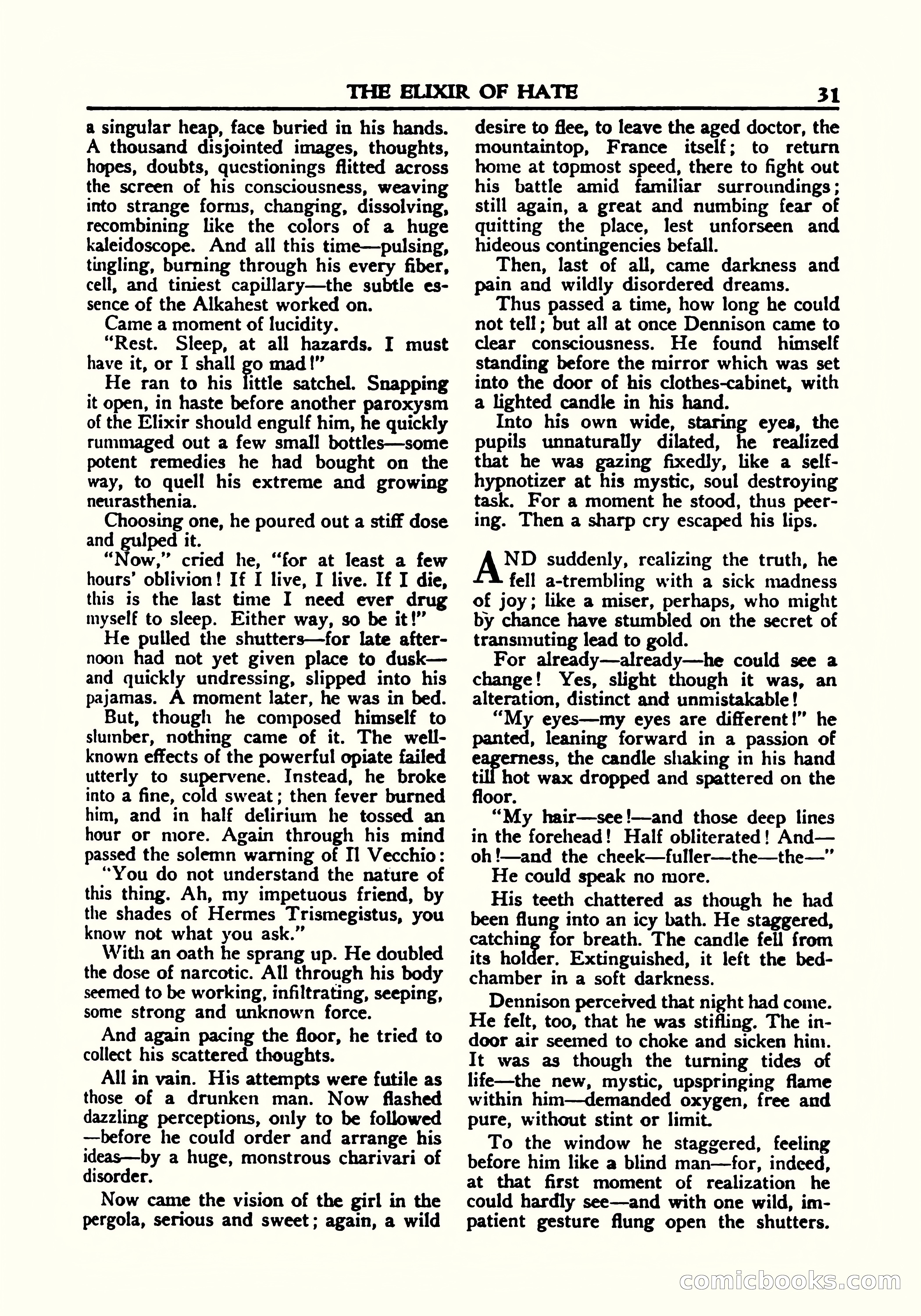
A restored page from Pulp Fiction, 1950. Page through the whole issue in the reader above.
📄 Transcribed text from this page (OCR, searchable)
Machine-transcribed from the original scan — historical spelling and the odd misread are preserved.
THE ELIXIR OF HATE 31 a singular heap, face buried in his hands. A thousand disjointed images, thoughts, hopes, doubts, questionings flitted across the screen of his consciousness, weaving into strange forms, changing, dissolving, recombining like the colors of a huge kaleidoscope. And all this time—pulsing, tingling, burning through his every fiber, cell, and tiniest capullary—the subtle es- sence of the Alkahest worked on. Came a moment of lucidity. “Rest. Sleep, at all hazards. I must have it, or I shall go mad!” He ran to his little satchel. Snapping it open, in haste before another paroxysm of the Elixir should engulf him, he quickly rummaged out a few small bottles—some potent remedies he had bought on the way, to quell his extreme and growing neurasthenia. Choosing one, he poured out a stiff dose and gulped it. “Now,” cried he, “for at least a few hours’ oblivion! If I live, I live. If I die, this is the last time I need ever d myself to sleep. Either way, so be it!” He pulled the shutters—for late after- noon had not yet given place to dusk— and quickly undressing, slipped into his pajamas. A moment later, he was in bed. But, though he composed himself to slumber, nothing came of it. The well- known effects of the powerful opiate failed utterly to supervene. Instead, he broke into a fine, cold sweat; then fever burned him, and in half delirium he tossed an hour or more. Again through his mind passed the solemn warning of I] Vecchio: “You do not understand the nature of this thing. Ah, my impetuous friend, by the shades of Hermes Trismegistus, you know not what you ask.” With an oath he sprang up. He doubled the dose of narcotic. All through his body seemed to be working, infiltrating, seeping, some strong and unknown force. And again pacing the floor, he tried to collect his scattered thoughts. All in vain. His attempts were futile as those of a drunken man. Now flashed dazzling perceptions, only to be followed —before he could order and arrange his ideas—by a huge, monstrous charivari of disorder. Now came the vision of the girl in the pergola, serious and sweet; again, a wild desire to flee, to leave the aged doctor, the mountaintop, France itself; to return home at topmost speed, there to fight out his battle amid familiar surroundings; still again, a great and numbing fear of quitting the place, lest unforseen and hideous contingencies befall. Then, last of all, came darkness and pain and wildly disordered dreams. Thus passed a time, how long he could not tell; but all at once Dennison came to clear consciousness. He found himself standing before the mirror which was set into the door of his clothes-cabinet, with a lighted candle in his hand. Into his own wide, staring eyes, the pupils unnaturally dilated, he realized that he was gazing fixedly, like a self- hypnotizer at his mystic, soul destroying task. For a moment he stood, thus peer- ing. Then a sharp cry escaped his lips. Ane suddenly, realizing the truth, he fell a-trembling with a sick madness of joy; like a miser, perhaps, who might by chance have stumbled on the secret of transmuting lead to gold. For already—already—he could see a change! Yes, slight though it was, an alteration, distinct and unmistakable! “My eyes—my eyes are different!” he panted, leaning forward in a passion of eagerness, the candle shaking in his hand till hot wax dropped and spattered on the floor. “My hair—see!—and those deep lines in the forehead! Half obliterated! And— oh !—and the cheek—fuller—the—the—” He could speak no more. His teeth chattered as though he had been flung into an icy bath. He staggered, catching for breath. The candle fell from its holder. Extinguished, it left the bed- chamber in a soft darkness. Dennison percetved that night had come. He felt, too, that he was stifling. The in- door air seemed to choke and sicken hin. It was as though the turning tides of life—the new, mystic, upspringing flame within him—demanded oxygen, free and pure, without stint or limit. To the window he staggered, feeling before him like a blind man—for, indeed, at that first moment of realization he could hardly see—and with one wild, im- patient gesture flung open the shutters. (C(O)