
Pulp Fiction, 1950 · page 21 of 135
A. Merritt's Fantasy Magazine, October 1950 — page 21: what you’re looking at
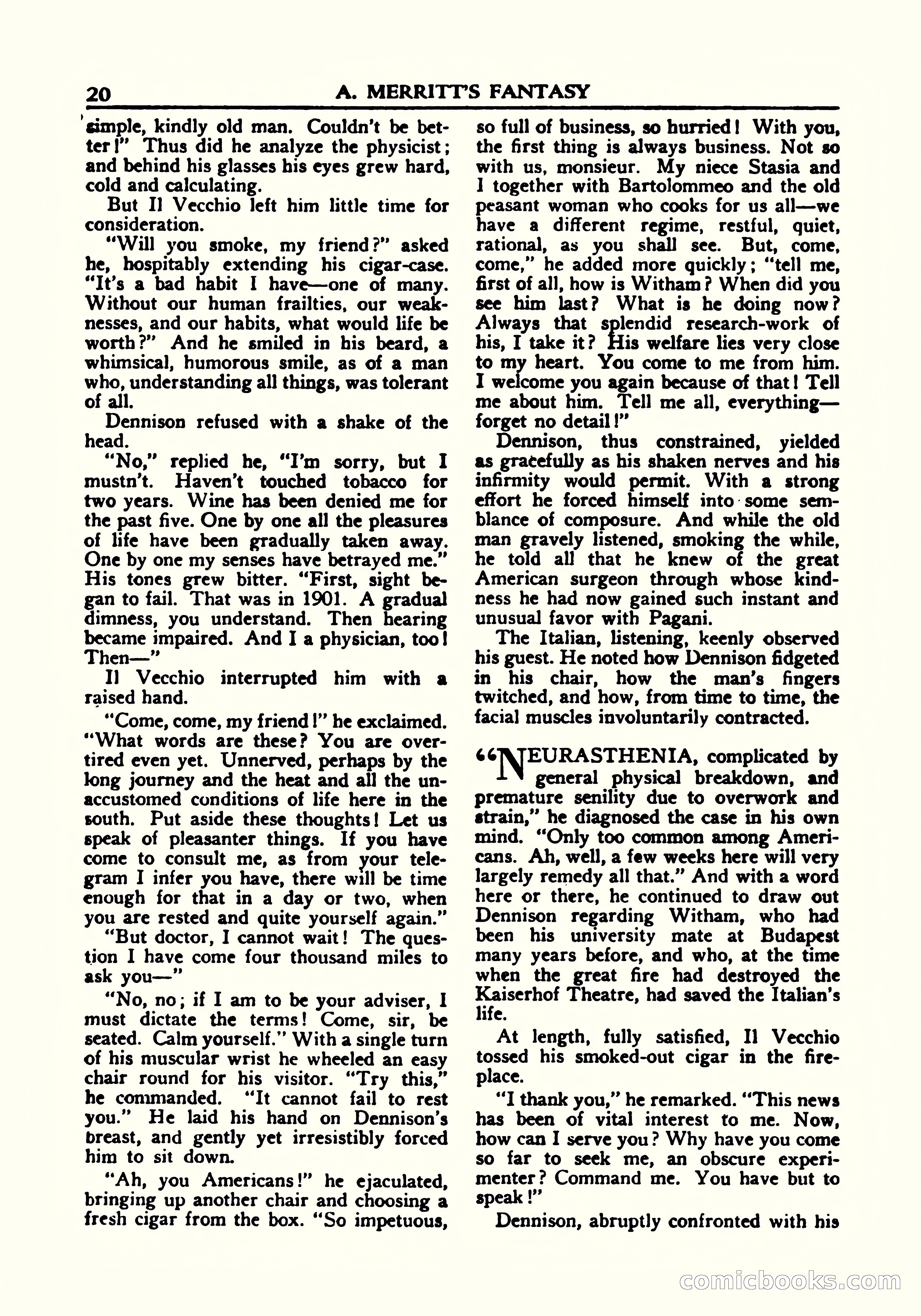
A restored page from Pulp Fiction, 1950. Page through the whole issue in the reader above.
📄 Transcribed text from this page (OCR, searchable)
Machine-transcribed from the original scan — historical spelling and the odd misread are preserved.
20 ‘simple, kindly old man. Couldn’t be bet- ter!” Thus did he analyze the physicist; and behind his glasses his eyes grew hard, cold and calculating. But I] Vecchio left him little time for consideration. “Will you smoke, my friend?” asked he, hospitably extending his cigar-case. “It’s a bad habit I have—one of many. Without our human frailties, our weak- nesses, and our habits, what would life be worth?” And he smiled in his beard, a whimsical, humorous smile, as of a man he understanding all things, was tolerant of all. Dennison refused with a shake of the head. “No,” replied he, “I’m sorry, but I mustn’t. Haven’t touched tobacco for two years. Wine has been denied me for the past five. One by one all the pleasures of life have been gradually taken away. One by one my senses have betrayed me.” His tones grew bitter. “First, sight be- gan to fail. That was in 1901. A gradual dimness, you understand. Then hearing became impaired. And I a physician, too! Then—” I] Vecchio interrupted him with a raised hand. “Come, come, my friend!” he exclaimed. “‘What words are these? You are over- tired even yet. Unnerved, perhaps by the long journey and the heat and all the un- accustomed conditions of life here in the south. Put aside these thoughts! Let us speak of pleasanter things. If you have come to consult me, as from your tele- gram I infer you have, there will be time enough for that in a day or two, when you are rested and quite yourself again.” “But doctor, I cannot wait! The ques- tion I have come four thousand miles to ask you—” “No, no; if I am to be your adviser, | must dictate the terms! Come, sir, be seated. Calm yourself.” With a single turn of his muscular wrist he wheeled an easy chair round for his visitor. “Try this,” he commanded. “It cannot fail to rest you.” He laid his hand on Dennison’s breast, and gently yet irresistibly forced him to sit down. “Ah, you Americans!” he ejaculated, bringing up another chair and choosing a fresh cigar from the box. “So impetuous, A. MERRITT’S FANTASY so full of business, so hurried! With you, the first thing is always business. Not so with us, monsieur. My niece Stasia and ] together with Bartolommeo and the old peasant woman who cooks for us all—we have a different regime, restful, quiet, rational, as you shall see. But, come, come,” he added more quickly; “tell me, first of all, how is Witham? When did you see him last? What is he doing now? Always that splendid research-work of his, I take it? His welfare lies very close to my heart. You come to me from him. I welcome you again because of that! Tell me about him. Tell me all, everything— forget no detail !’’ Dennison, thus constrained, yielded as gratefully as his shaken nerves and his infirmity would permit. With a strong effort he forced himself into: some sem- blance of composure. And while the old man gravely listened, smoking the while, he told all that he knew of the great American surgeon through whose kind- ness he had now gained such instant and unusual favor with Pagani. The Italian, listening, keenly observed his guest. He noted how Dennison fidgeted in his chair, how the man’s fingers twitched, and how, from time to time, the facial muscles involuntarily contracted. SS) ZUSASTBENIA, complicated by general physical breakdown, and premature senility due to overwork and strain,” he diagnosed the case in his own mind. “Only too common among Ameri- cans. Ah, well, a few weeks here will very largely remedy all that.” And with a word here or there, he continued to draw out Dennison regarding Witham, who had been his university mate at Budapest many years before, and who, at the time when the great fire had destroyed the Kaiserhof Theatre, had saved the Italian’s life. At length, fully satisfied, I) Vecchio tossed his smoked-out cigar in the fire- place. “I thank you,” he remarked. ‘This news has been of vital interest to me. Now, how can I serve you? Why have you come so far to seek me, an obscure experi- menter? Command me. You have but to speak !” Dennison, abruptly confronted with his an) (C 6)(0)©) <S (C(O)