
Pulp Fiction, 1950 · page 20 of 135
A. Merritt's Fantasy Magazine, October 1950 — page 20: what you’re looking at
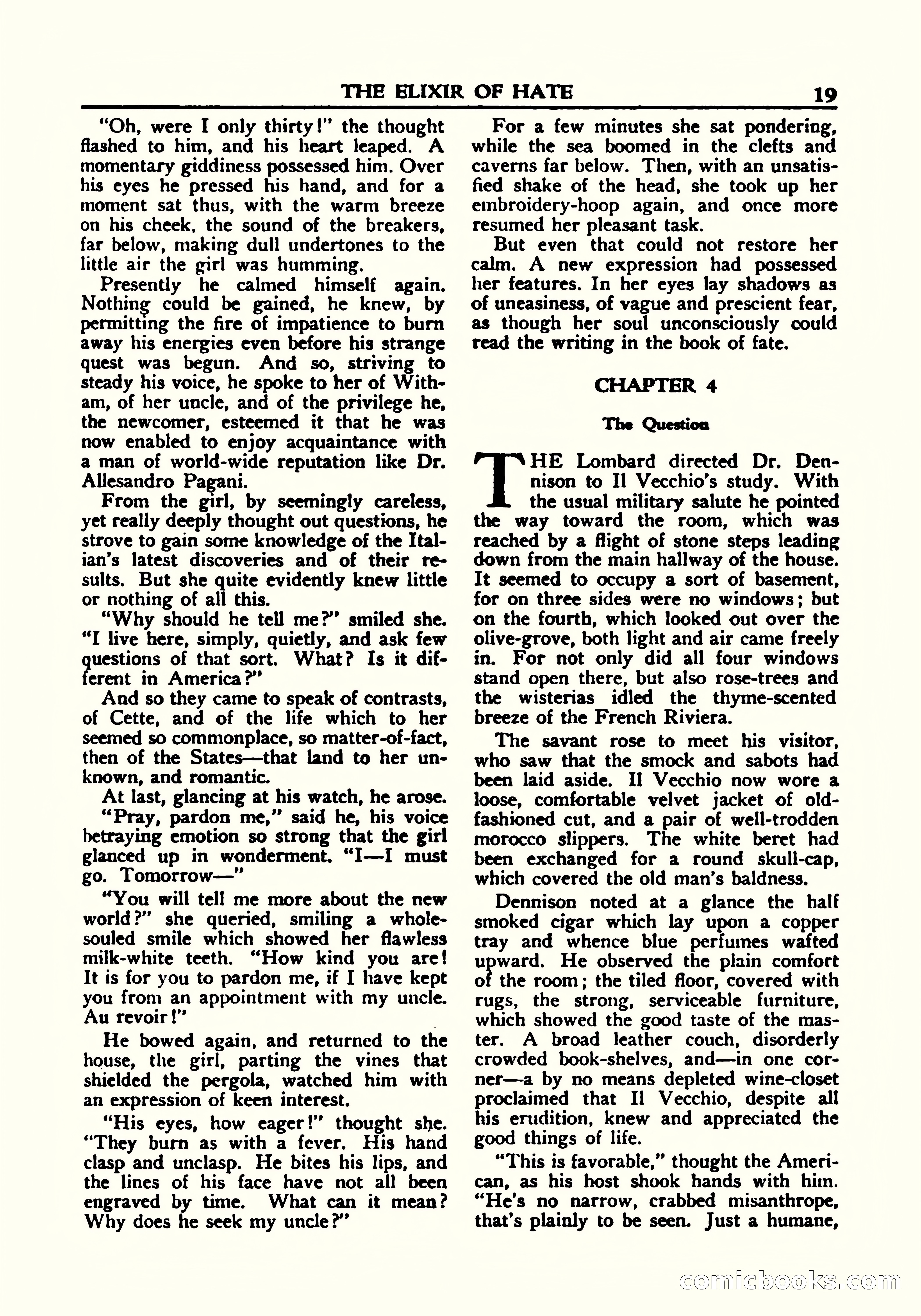
A restored page from Pulp Fiction, 1950. Page through the whole issue in the reader above.
📄 Transcribed text from this page (OCR, searchable)
Machine-transcribed from the original scan — historical spelling and the odd misread are preserved.
THE ELIXIR OF HATE 19 “Oh, were I only thirty!” the thought flashed to him, and his heart leaped. A momentary giddiness possessed him. Over his eyes he pressed his hand, and for a moment sat thus, with the warm breeze on his cheek, the sound of the breakers, far below, making dull undertones to the little air the girl was humming. Presently he calmed himself again. Nothing could be gained, he knew, by permitting the fire of impatience to burn away his energies even before his strange quest was begun. And so, striving to steady his voice, he spoke to her of With- am, of her uncle, and of the privilege he, the newcomer, esteemed it that he was now enabled to enjoy acquaintance with a man of world-wide reputation like Dr. Allesandro Pagani. From the girl, by seemingly careless, yet really deeply thought out questions, he strove to gain some knowledge of the Ital- ian’s latest discoveries and of their re- sults. But she quite evidently knew little or nothing of all this. “Why should he tell me?’ smiled she. “I live here, simply, quietly, and ask few questions of that sort. What? Is it dif- ferent in America ?”’ And so they came to speak of contrasts, of Cette, and of the life which to her seemed so commonplace, so matter-of-fact, then of the States—that land to her un- known, and romantic. At last, glancing at his watch, he arose. “Pray, pardon me,” said he, his voice betraying emotion so strong that the girl glanced up in wonderment. “I—I must go. Tomorrow—” “You will tell me more about the new world?” she queried, smiling a whole- souled smile which showed her flawless milk-white teeth. “How kind you are! It is for you to pardon me, tf I have kept you from an appointment with my uncle. Au revoir !” | He bowed again, and returned to the house, the girl, parting the vines that shielded the pergola, watched him with an expression of keen interest. “His eyes, how eager!’’ thought she. “They burn as with a fever. His hand clasp and unclasp. He bites his lips, and the lines of his face have not all been engraved by time. What can it mean? Why does he seek my uncle?” For a few minutes she sat pondering, while the sea boomed in the clefts and caverns far below. Then, with an unsatis- fied shake of the head, she took up her embroidery-hoop again, and once more resumed her pleasant task. But even that could not restore her calm. A new expression had possessed her features. In her eyes lay shadows as of uneasiness, of vague and prescient fear, as though her soul unconsciously could read the writing in the book of fate. CHAPTER 4 The Question HE Lombard directed Dr. Den- nison to Il Vecchio’s study. With the usual military salute he pointed the way toward the room, which was reached by a flight of stone steps leading down from the main hallway of the house. It seemed to occupy a sort of basement, for on three sides were no windows; but on the fourth, which looked out over the olive-grove, both light and air came freely in. For not only did all four windows stand open there, but also rose-trees and the wisterias idled the thyme-scented breeze of the French Riviera. The savant rose to meet his visitor, who saw that the smock and sabots had been laid aside. II Vecchio now wore a loose, comfortable velvet jacket of old- fashioned cut, and a pair of well-trodden morocco slippers. The white beret had been exchanged for a round skull-cap, which covered the old man’s baldness. Dennison noted at a glance the half smoked cigar which lay upon a copper tray and whence blue perfumes wafted we gis He observed the plain comfort of the room; the tiled floor, covered with rugs, the strong, serviceable furniture, which showed the good taste of the mas- ter. A broad leather couch, disorderly crowded book-shelves, and—in one cor- ner—a by no means depleted wine-closet proclaimed that Il Vecchio, despite all his erudition, knew and appreciated the good things of life. “This is favorable,” thought the Ameri- can, as his host shook hands with him. “He’s no narrow, crabbed misanthrope, that’s plainly to be seen. Just a humane, an) (C 6)(0)©) S (C(O)