
Pulp Fiction, 1950 · page 80 of 132
A. Merritt's Fantasy Magazine, April 1950 — page 80: what you’re looking at
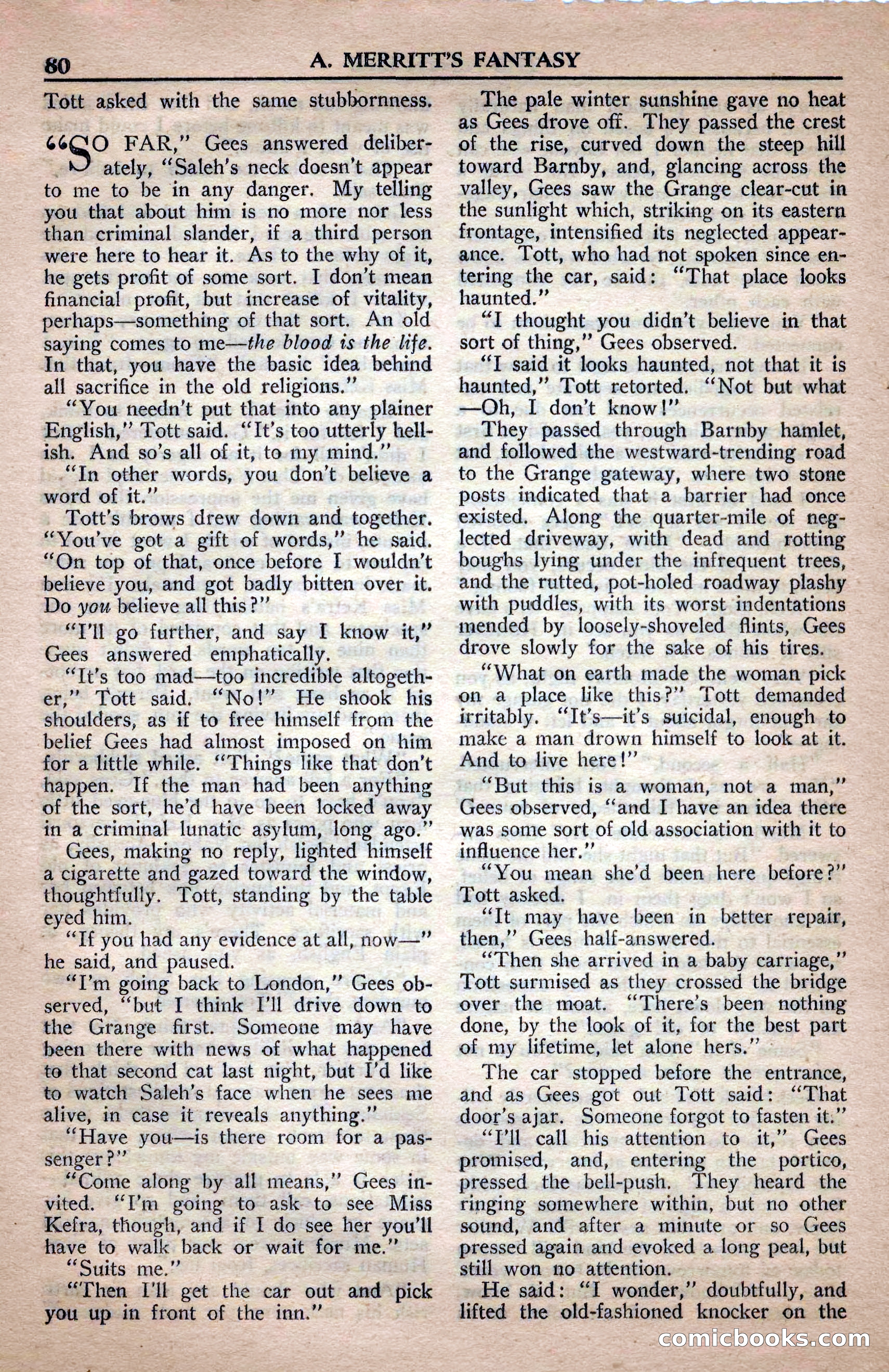
A restored page from Pulp Fiction, 1950. Page through the whole issue in the reader above.
📄 Transcribed text from this page (OCR, searchable)
Machine-transcribed from the original scan — historical spelling and the odd misread are preserved.
&0 A. MERRITT’S FANTASY Tott asked with the same stubbornness. 66010 FAR,” Gees answered deliber- ately, ‘‘Saleh’s neck doesn’t appear to me to be in any danger. My telling you that about him is no more nor less than criminal slander, if a third person were here to hear it. As to the why of it, he gets profit of some sort. I don’t mean financial profit, but increase of vitality, perhaps—something of that sort. An old saying comes to me—the blood ts the life. In that, you have the basic idea behind all sacrifice in the old religions.” “You needn't put that into any plainer English,” Tott said. “It’s too utterly hell- ish. And so’s all of it, to my mind.” “Tn other words, you don’t believe a word of it.” Tott’s brows drew down and together. “You've got a gift of words,” he said. “On top of that, once before I wouldn’t believe you, and got badly bitten over it. Do you believe all this ?”’ “T’ll go further, and say I know it,” Gees answered emphatically. “Tt! s too mad—too incredible altogeth- ’ Tott said. “No!” He shook his Bouaters as if to free himself from the belief Gees had almost imposed on him for a little while. ‘Things like that don’t happen. If the man had been anything of the sort, he’d have been locked away in a criminal lunatic asylum, long ago.” _ Gees, making no reply, lighted himself a cigarette and gazed toward the window, thoughtfully. Tott, standing by the table eyed him. “Tf you had any evidence at all, now—” he said, and paused. “I’m going back to London,” Gees ob- served, “but I think I'll drive down to the Grange first. Someone may have been there with news of what happened to that second cat last night, but I’d like to watch Saleh’s face when he sees me alive, in case it reveals anything.” “Have you—is there room for a pas- senger?”’ “Come along by all means,” Gees in- vited. “I’m going to ask to see Miss Kefra, though, and if I do see her you'll have to walle back or wait for me.” “Suits me.’ “Then L'lk get the car out and > pick you up in front of the inn.’ The pale winter sunshine gave no heat as Gees drove off. They passed the crest of the rise, curved down the steep hill toward Barnby, and, glancing across the valley, Gees saw the Grange clear-cut in the sunlight which, striking on its eastern frontage, intensified its neglected appear- ance. Tott, who had not spoken since en- tering the car, said: “That place looks haunted.” “I thought you didn’t believe in that sort of thing,” Gees observed. “T said it looks haunted, not that it ts sce ” Tott retorted. “Not but what —QOh, I don’t know!” They passed through Barnby hamlet, and followed the westward-trending road to the Grange gateway, where two stone posts indicated that a barrier had once existed. Along the quarter-mile of neg- lected driveway, with dead and rotting boughs lying under the infrequent trees, and. the rutted, pot-holed roadway plashy with puddles, with its worst indentations mended by loosely-shoveled flints, Gees drove slowly for the sake of his tires, “What on earth made the woman pick on a place like this?” Tott demanded irritably. “It’s—it’s suicidal, enough to make a man drown himself to look at it. And to live here!” “But this is a woman, Gees observed, not a man,” ‘‘and I have an idea there was some sort of old association with it to influence her.’’ : “You mean she’d been here before?” Tott asked. “It may have been in better repair, then,” Gees half-answered. “Then she arrived in a baby carriage,”’ Tott surmised as they crossed the bridge over the moat. “There’s been nothing done, by the look of it, for the best part of my lifetime, let alone hers,”’ The car stopped before the entrance, and as Gees got out Tott said: “That door’s ajar. Someone forgot to fasten it.” “T’ll call his attention to it,” Gees promised, and, entering the portico, pressed the bell-push. They heard the fringing somewhere within, but no other sound, and after a minute or so Gees pressed again and evoked a long peal, but still won no attention. He said: “I wonder,” doubtfully, and lifted the old-fashioned knocker on the — comicbooks.co