
Pulp Fiction, 1950 · page 79 of 132
A. Merritt's Fantasy Magazine, April 1950 — page 79: what you’re looking at
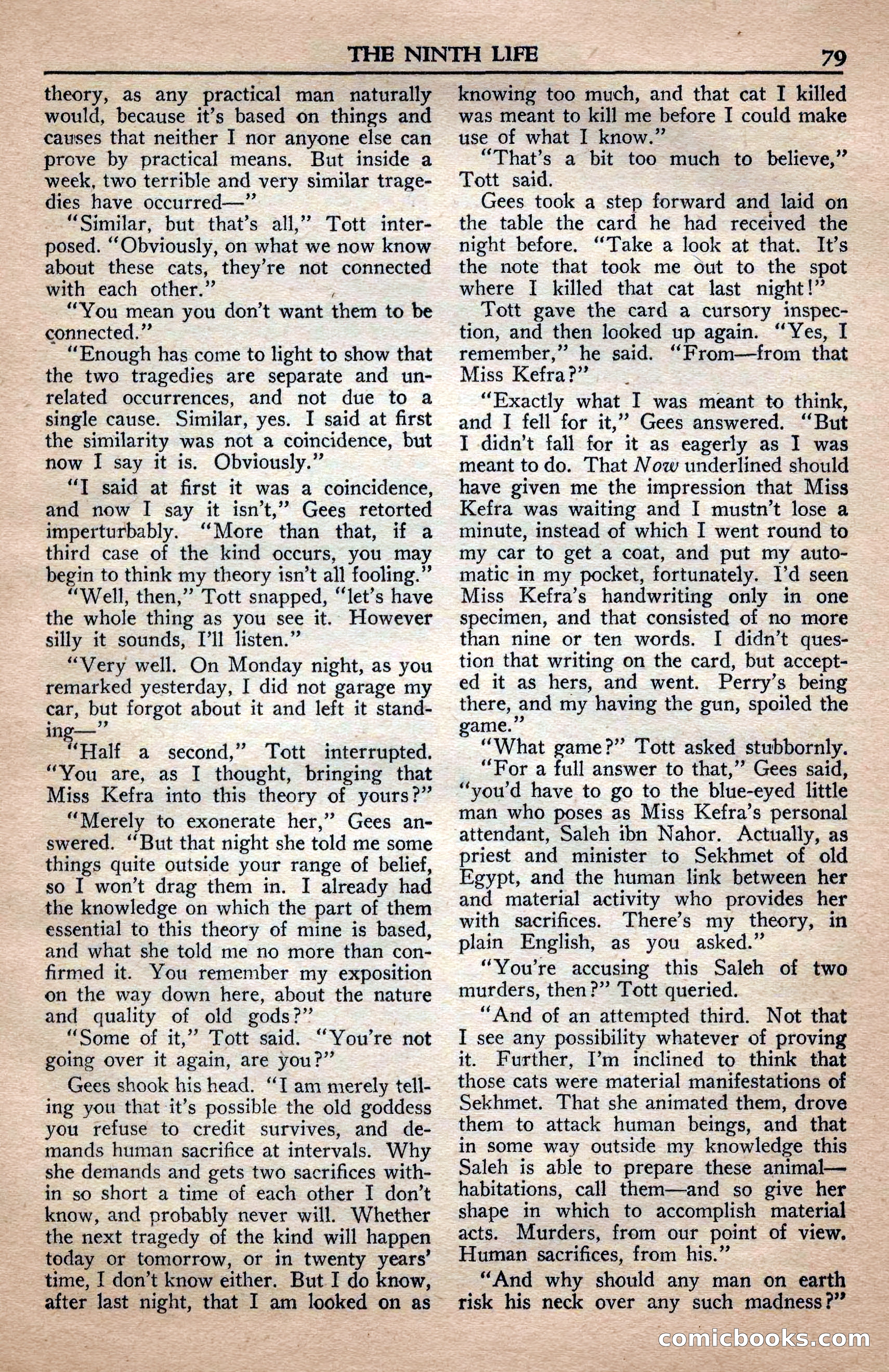
A restored page from Pulp Fiction, 1950. Page through the whole issue in the reader above.
📄 Transcribed text from this page (OCR, searchable)
Machine-transcribed from the original scan — historical spelling and the odd misread are preserved.
THE NINTH LIFE 79 theory, as any practical man naturally would, because it’s based on things and causes that neither I nor anyone else can prove by practical means. But inside a week, two terrible and very similar trage- dies have occurred—” “Similar, but that’s all,” Tott inter- posed. “Obviously, on what we now know about these cats, they’re not connected with each other.” “You mean you don’t want them to be connected.” “Enough has come to light to show that the two tragedies are separate and un- related occurrences, and not due to a single cause. Similar, yes. I said at first the similarity was not a coincidence, but now I say it is. Obviously.” “T said at first it was a coincidence, and now I say it isn’t,” Gees retorted imperturbably. ‘More than that, if a third case of the kind occurs, you may begin to think my theory isn’t ail fooling.” “Well, then,” Tott snapped, “‘let’s have the whole thing as you see it. However silly it sounds, I’ll listen.” “Very well. On Monday night, as you remarked yesterday, I did not garage my car, but forgot about it and left it stand- in ay “Half a second,’ Tott interrupted. “You are, as I thought, bringing that Miss Kefra into this theory of yours?” “Merely to exonerate her,” Gees an- swered. “But that night she told me some things quite outside your range of belief, so I won't drag them in. I already had the knowledge on which the part of them essential to this theory of mine is based, and what she told me no more than con- firmed it. You remember my exposition on the way down here, about the nature and quality of old gods?” 7 “Some of it,” Tott said. “You’re not going over it again, are you?” Gees shook his head. “T am merely tell- ing you that it’s possible the old goddess you refuse to credit survives, and de- mands human sacrifice at intervals. Why she demands and gets two sacrifices with- in so short a time of each other I don’t know, and probably never will. Whether the next tragedy of the kind will happen today or tomorrow, or in twenty years’ time, I don’t know either. But I do know, after last night, that I am looked on as— knowing too much, and that cat I killed was meant to kill me before I could make use of what I know.” “That’s a bit too much to believe,” Tott said. Gees took a step forward and laid on the table the card he had received the night before. “Take a look at that. It’s the note that took me out to the spot where I killed that cat last night!” Tott gave the card a cursory inspec- tion, and then looked up again. “Yes, I remember,” he said. “From—from that Miss Kefra?” “Exactly what I was meant to think, and I fell for it,’’ Gees answered. “But I didn’t fall for it as eagerly as I was meant todo. That Now underlined should have given me the impression that Miss Kefra was waiting and I mustn’t lose a minute, instead of which I went round to my car to get a coat, and put my auto- matic in my pocket, fortunately. I’d seen Miss Kefra’s handwriting only in one specimen, and that consisted of no more than nine or ten words. I didn’t ques- tion that writing on the card, but accept- ed it as hers, and went. Perry’s being there, and my having the gun, spoiled the game.’ “What game?” Tott asked stubbornly. “For a full answer to that,’’ Gees said, “you'd have to go to the blue-eyed little man who poses as Miss Kefra’s personal attendant, Saleh ibn Nahor. Actually, as priest and minister to Sekhmet of old Egypt, and the human link between her and material activity who provides her with sacrifices. There’s my theory, in plain English, as you asked.” “You're accusing this Saleh of two murders, then?” Tott queried. “And of an attempted third. Not that I see any possibility whatever of proving it. Further, I’m inclined to think that those cats were material manifestations of Sekhmet. That she animated them, drove them to attack human beings, and that in some way outside my knowledge this Saleh is able to prepare these animal— habitations, call them—and so give her shape in which to accomplish material acts. Murders, from our point of view. Human sacrifices, from his.” “And why should any man on earth risk his neck over any such madness?” ECOMmiIchboo <Si€O