
Pulp Fiction, 1950 · page 41 of 132
A. Merritt's Fantasy Magazine, April 1950 — page 41: what you’re looking at
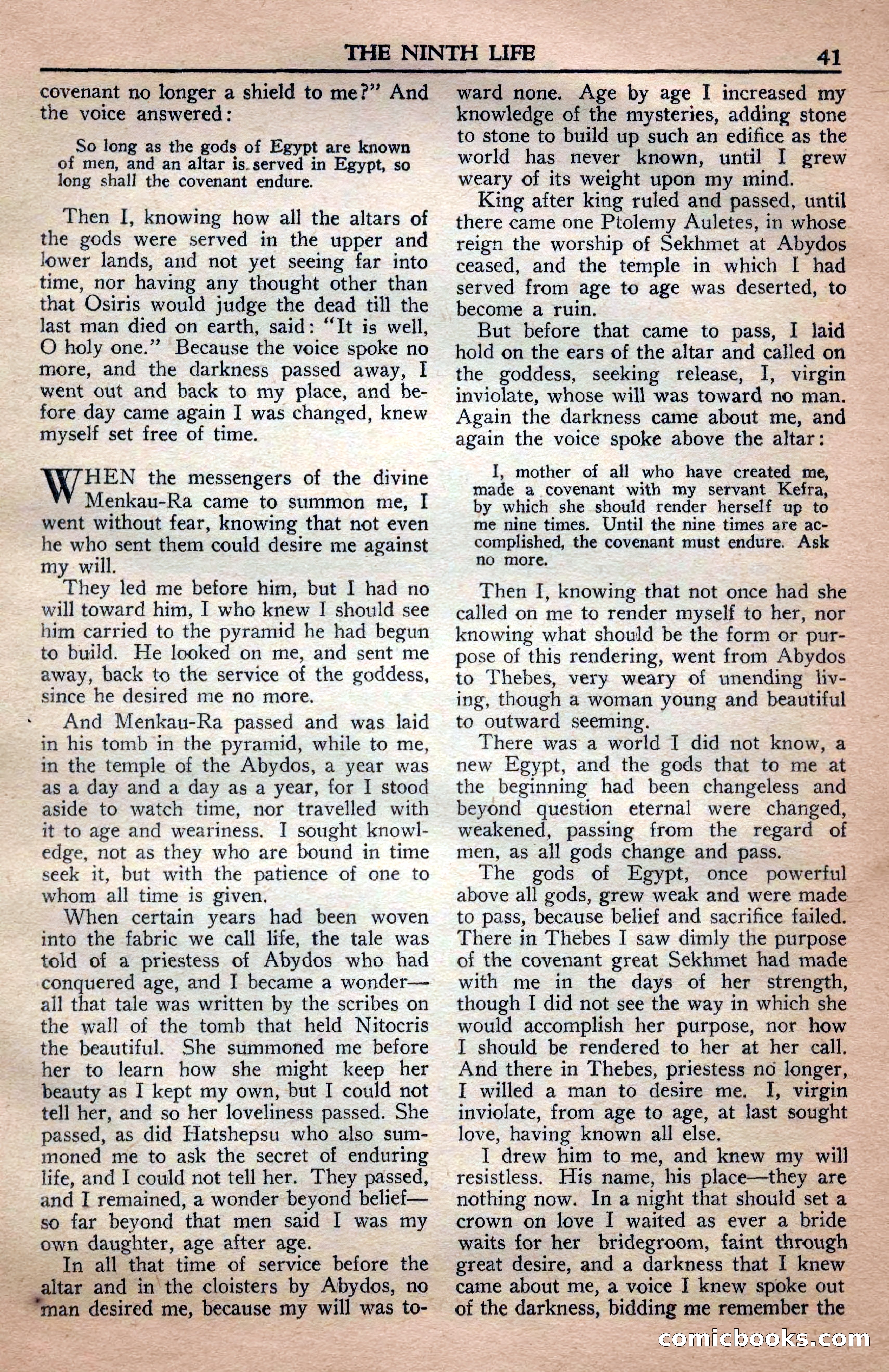
A restored page from Pulp Fiction, 1950. Page through the whole issue in the reader above.
📄 Transcribed text from this page (OCR, searchable)
Machine-transcribed from the original scan — historical spelling and the odd misread are preserved.
THE NINTH LIFE 41 covenant no longer a shield to me?” And the voice answered: So long as the gods of Egypt are known of men, and an altar is. served in Egypt, so long shall the covenant endure. Then I, knowing how all the altars of the gods were served in the upper and lower lands, and not yet seeing far into time, nor having any thought other than that Osiris would judge the dead till the last man died on earth, said: ‘‘It is well, O holy one.” Because the voice spoke no more, and the darkness passed away, I went out and back to my place, and be- fore day came again I was changed, knew myself set free of time. ALBEN the messengers of the divine Menkau-Ra came to summon me, I went without fear, knowing that not even he who sent them could desire me against my will. They led me before him, but I had no will toward him, I who knew I should see him carried to the pyramid he had begun to build. He looked on me, and sent me away, back to the service of the goddess, since he desired me no more. And Menkau-Ra passed and was laid in his tomb in the pyramid, while to me, in the temple of the Abydos, a year was as a day and a day as a year, for I stood aside to watch time, nor travelled with it to age and weariness. I sought knowl- edge, not as they who are bound in time seek it, but with the patience of one to whom all time is given, When certain years had been woven into the fabric we call life, the tale was told of a priestess of Abydos who had conquered age, and I became a wonder— all that tale was written by the scribes on the wall of the tomb that held Nitocris the beautiful. She summoned me before her to learn how she might keep her beauty as I kept my own, but I could not tell her, and so her loveliness passed. She passed, as did Hatshepsu who also sum- moned me to ask the secret of enduring life, and I could not tell her. They passed, and I remained, a wonder beyond beliefi— so far beyond that men said I was my own daughter, age after age. In all that time of service before the ; altar and in the cloisters by Abydos, no - “man desired me, because my will was to- ward none. Age by age I increased my knowledge of the mysteries, adding stone to stone to build up such an edifice as the world has never known, until I grew weary of its weight upon my mind. King after king ruled and passed, until there came one Ptolemy Auletes, in whose reign the worship of Sekhmet at Abydos — ceased, and the temple in which I had served from age to age was deserted, to become a ruin. 3 But before that came to pass, I laid hold on the ears of the altar and called on the goddess, seeking release, I, virgin inviolate, whose will was toward no man. Again the darkness came about me, and again the voice spoke above the altar: I, mother of all who have created me, made a covenant with my servant Kefra, by which she should render herself up to me nine times. Until the nine times are ac- complished, the covenant must endure. Ask no more. Then I, knowing that not once had she called on me to render myself to her, nor knowing what should be the form or pur- pose of this rendering, went from Abydos to Thebes, very weary of unending liv- ing, though a woman young and beautiful to outward seeming. There was a world I did not know, a new Egypt, and the gods that to me at the beginning had been changeless and beyond question eternal were changed, weakened, passing from the regard of men, as all gods change and pass. The gods of Egypt, once powerful above all gods, grew weak and were made | to pass, because belief and sacrifice failed. There in Thebes I saw dimly the purpose of the covenant great Sekhmet had made with me in the days of her strength, though I did not see the way in which she would accomplish her purpose, nor how J should be rendered to her at her call. And there in Thebes, priestess no longer, I willed a man to desire me. JI, virgin inviolate, from age to age, at last sought love, having known all else. I drew him to me, and knew my will resistless. His name, his place—they are nothing now. In a night that should set a crown on love I waited as ever a bride waits for her bridegroom, faint through great desire, and a darkness that I knew came about me, a voice I knew spoke out of the darkness, bidding me remember the Gomicbooks:co