
Pulp Fiction, 1950 · page 112 of 134
A. Merritt's Fantasy Magazine, February 1950 — page 112: what you’re looking at
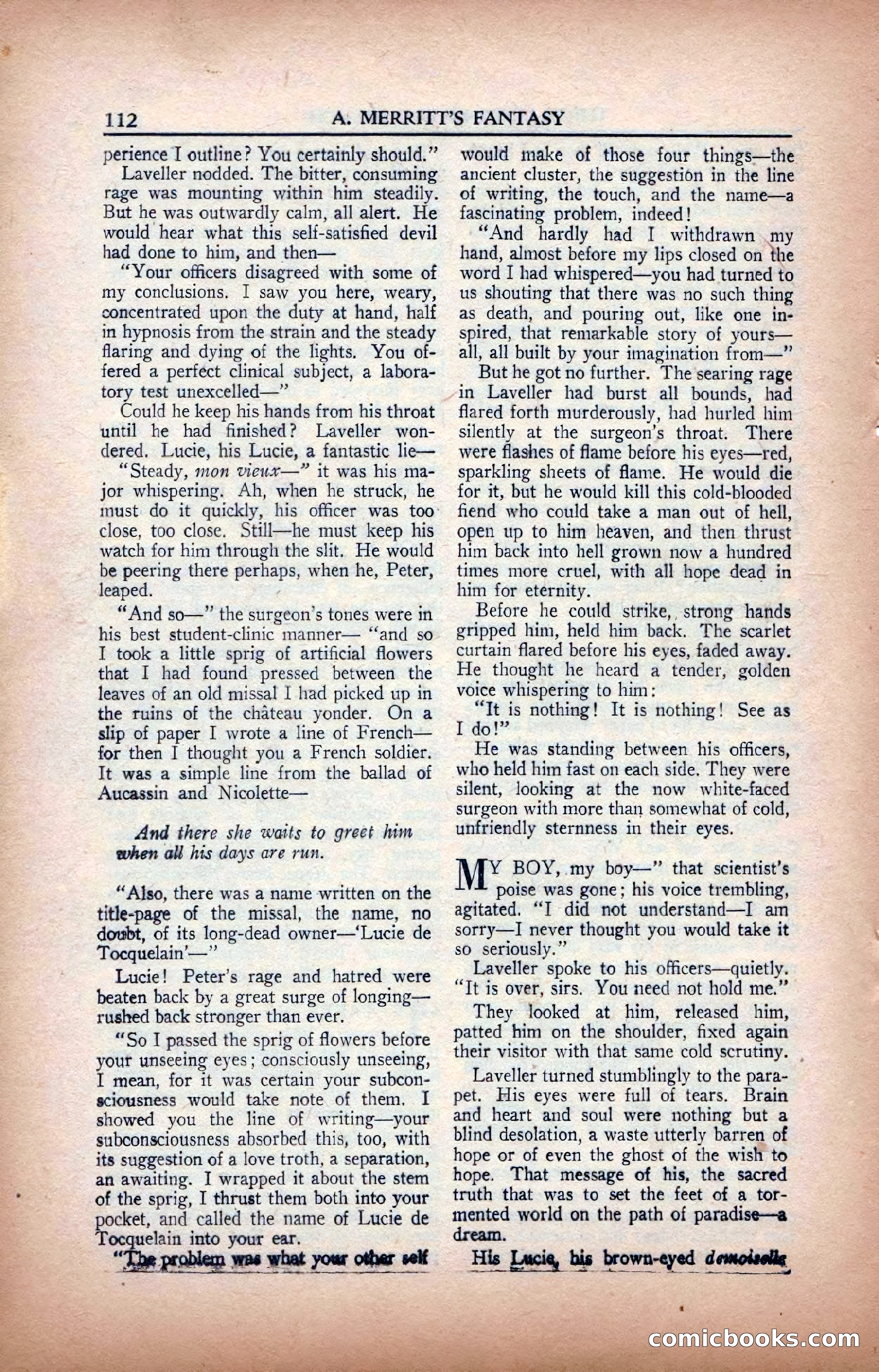
A restored page from Pulp Fiction, 1950. Page through the whole issue in the reader above.
📄 Transcribed text from this page (OCR, searchable)
Machine-transcribed from the original scan — historical spelling and the odd misread are preserved.
112 A. MERRITT’S FANTASY perience I outline? You certainly should.” Laveller nodded. The bitter, consuming rage was mounting within him steadily. But he was outwardly calm, all alert. He would hear what this self-satisfied devil had done to him, and then— “Your officers disagreed with some of my conclusions. I saw you here, weary, concentrated upon the duty at hand, half in hypnosis from the strain and the steady flaring and dying of the lights. You of- fered a perfect clinical subject, a labora- tory test unexcelled—” Could he keep his hands from his throat until he had finished? Laveller won- dered. Lucie, his Lucie, a fantastic lie— “Steady, mon viewux—” it was his ma- jor whispering. Ah, when he struck, he must do it quickly, his officer was too: close, too close. Still—he must keep his watch for him through the slit. He would be peering there perhaps, when he, Peter, leaped. “And so—” the surgeon's tones were in his best student-clinic manner— ‘“‘and so I took a little sprig of artificial flowers that I had found pressed between the leaves of an old missal I had picked up in the ruins of the chateau yonder. On a slip of paper I wrote a line of French— for then I thought you a French soldier. It was a simple line from the ballad of Aucassin and Nicolette— And there she waits to greet him when ali his days are run. “ Also, there was a name written on the title-page of the missal, the name, no doubt, of its long-dead owner—‘Lucie de Tocquelain’—” Lucie! Peter's rage and hatred were beaten back by a great surge of longing— rushed back stronger than ever, “So I passed the sprig of flowers before your unseeing eyes; consciously unseeing, I mean, for it was certain your subcon- sciousness would take note of them. I showed you the line of writing—your subconsciousness absorbed this, too, with its suggestion of a love troth, a separation, an awaiting. I wrapped it about the stem of the sprig, I thrust them both into your pocket, and called the name of Lucie de Tocquelain into your ear. would make of those four things—the ancient cluster, the suggestion in the line of writing, the touch, and the name—a fascinating problem, indeed! “And hardly had I withdrawn my hand, almost before my lips closed on the word I had whispered—you had turned to us shouting that there was no such thing as death, and pouring out, like one in- spired, that remarkable story of yours— all, all built by your imagination from—” But he got no further. The searing rage in Laveller had burst all bounds, had flared forth murderously, had hurled him silently at the surgeon’s throat. There were flashes of flame before his eyes—red, sparkling sheets of flame. He would die for it, but he would kill this cold-blooded fiend who could take a man out of hell, open up to him heaven, and then thrust him back into hell grown now a hundred times more cruel, with all hope dead in him for eternity. Before he could strike, strong hands gripped him, held him back. The scarlet curtain flared before his eyes, faded away. He thought he heard a tender, golden voice whispering to him; “Tt is nothing! It is nothing! See as I do!” He was standing between his officers, who held him fast on each side. They were silent, looking at the now white-faced surgeon with more than somewhat of cold, unfriendly sternness in their eyes. MY BOY, my boy—” that scientist’s poise was gone; his voice trembling, agitated. “I did not understand—I am sorry—I never thought you would take it so seriously.” Laveller spoke to his officers—quietly. “Tt is over, sirs. You need not hold me.” They looked at him, released him, patted him on the shoulder, fixed again their visitor with that same cold scrutiny. | Laveller turned stumblingly to the para- pet. His eyes were full of tears. Brain and heart and soul were nothing but a blind desolation, a waste utterly barren of hope or of even the ghost of the wish to hope. That message of his, the sacred truth that was to set the feet of a tor- mented world on the path of paradise—a dream ows his’ oe