
Pulp Fiction, 1950 · page 111 of 134
A. Merritt's Fantasy Magazine, February 1950 — page 111: what you’re looking at
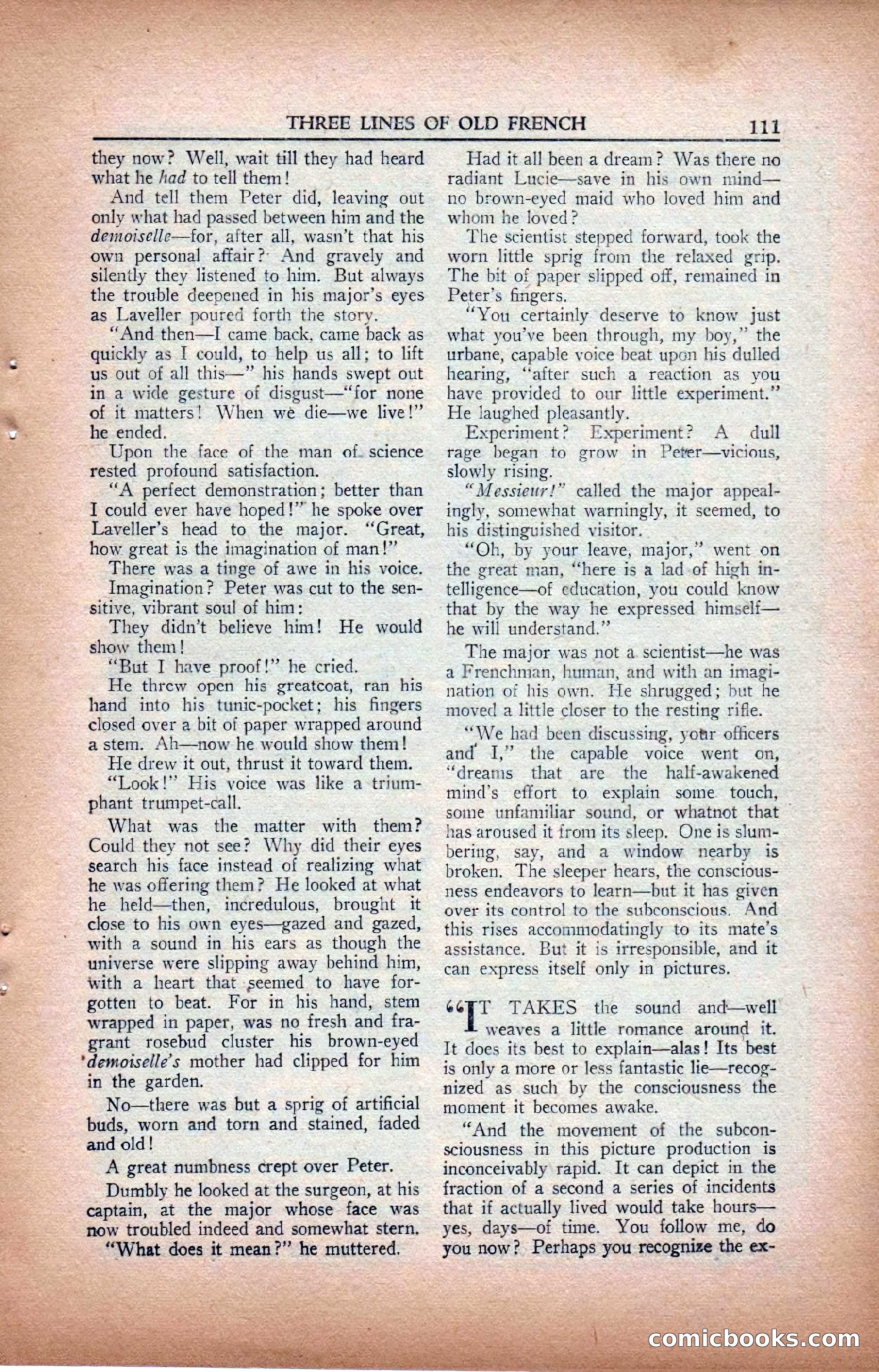
A restored page from Pulp Fiction, 1950. Page through the whole issue in the reader above.
📄 Transcribed text from this page (OCR, searchable)
Machine-transcribed from the original scan — historical spelling and the odd misread are preserved.
they now? Well, wait till they had heard what he /iad to tell them! And tell them Peter did, leaving out only what had passed between him and the demoiselle—for, after all, wasn’t that his own personal affair?’ And gravely and silently they listened to him. But always _ the trouble deepened in his major’s eyes as Laveller poured forth the story. “And then—I came back, came back as quickly as I could, to help us all; to lift us out of all this—” his hands swept out in a wide gesture of disgust—‘for none of it matters! When we die—we live!” he ended. ~ Upon the face of the man of. science rested profound satisfaction. “A perfect demonstration; better than I could ever have hoped!” he spoke over Laveller’s head to the major. ‘Great, how great is the imagination of man!” There was a tinge of awe in his voice. Imagination? Peter was cut to the sen- sitive, vibrant soul of him: They didn’t believe him! He would show them! “But I have proof!” he cried. He threw open his greatcoat, ran his hand into his tunic-pocket; his fingers closed over a bit of paper wrapped around a stem. Ah—now he would show them! He drew it out, thrust it toward them. “Look!” His voice was like a trium- phant trumpet-call. What was the matter with them? Could they not see? Why did their eyes - gearch his face instead of realizing what he was offering them? He looked at what he held—then, incredulous, brought it close to his own eyes—gazed and gazed, with a sound in his ears as though the universe were slipping away behind him, with a heart that seemed to have for- gotten to beat. For in his hand, stem wrapped in paper, was no fresh and fra- grant rosebud cluster his brown-eyed *demoiselle’s mother had clipped for him in the garden. No—there was but a sprig of artificial buds, worn and torn and stained, faded and old! A great numbness crept over Peter. - Dumbly he looked at the surgeon, at his captain, at the major whose face was now troubled indeed and somewhat stern, “What does it mean?” he muttered. aaa THREE LINES OF OLD FRENCH you now? Perhaps you recognize the ex-_ 111 Had it all been a dream? Was there no radiant Lucie—save in his own mind— no brown-eyed maid who loved him and whom he loved? The scientist stepped forward, took the worn little sprig from the relaxed grip. The bit of paper slipped off, remained in Peter’s fingers. “You certainly deserve to know just what you've been through, my boy,” the urbane, capable voice beat upon his dulled hearing, ‘‘after such a reaction as you have provided to our little experiment.” He laughed pleasantly. Experiment? Experiment? A dull tage began to grow in Peter—vicious, slowly rising. “Messieur!” called the major appeal- ingly, somewhat warningly, it seemed, to his distinguished visitor. “Oh, by your leave, major,” went on the great man, “‘here is a lad-of high in- telligence—of education, you could know ‘that by the way he expressed himseli— he will understand.” The major was not a. scientist—he was a Frenchman, human, and with an imagi- nation of his own. He shrugged; but he moved a little closer to the resting rifle. “We had been discussing, yotr officers and I,” the capable voice went on, “dreams that are the _ half-awakened mind’s effort to explain some. touch, soine unfamiliar sound, or whatnot that — has aroused it from its sleep. One is slum- bering, say, and a window nearby is broken. The sleeper hears, the conscious- ness endeavors to learn—but it has given over its control to the subconscious, And this rises accommodatingly to its mate’s assistance. But it is irresponsible, and it can express itself only in pictures, 667T TAKES the sound and—well - weaves a little romance around it. It does its best to explain—alas! Its best is only a more or less fantastic lie—recog- nized as such by the consciousness the moment it becomes awake. “And the movement of the subcon- sciousness in this picture production is inconceivably rapid. It can depict in the fraction of a second a series of incidents that if actually lived would take hours— yes, days—of time. You follow me, do- Comicbooks.com