
Pulp Fiction, 1952 · page 85 of 132
5 Detective Novels Magazine Cover — page 85: what you’re looking at
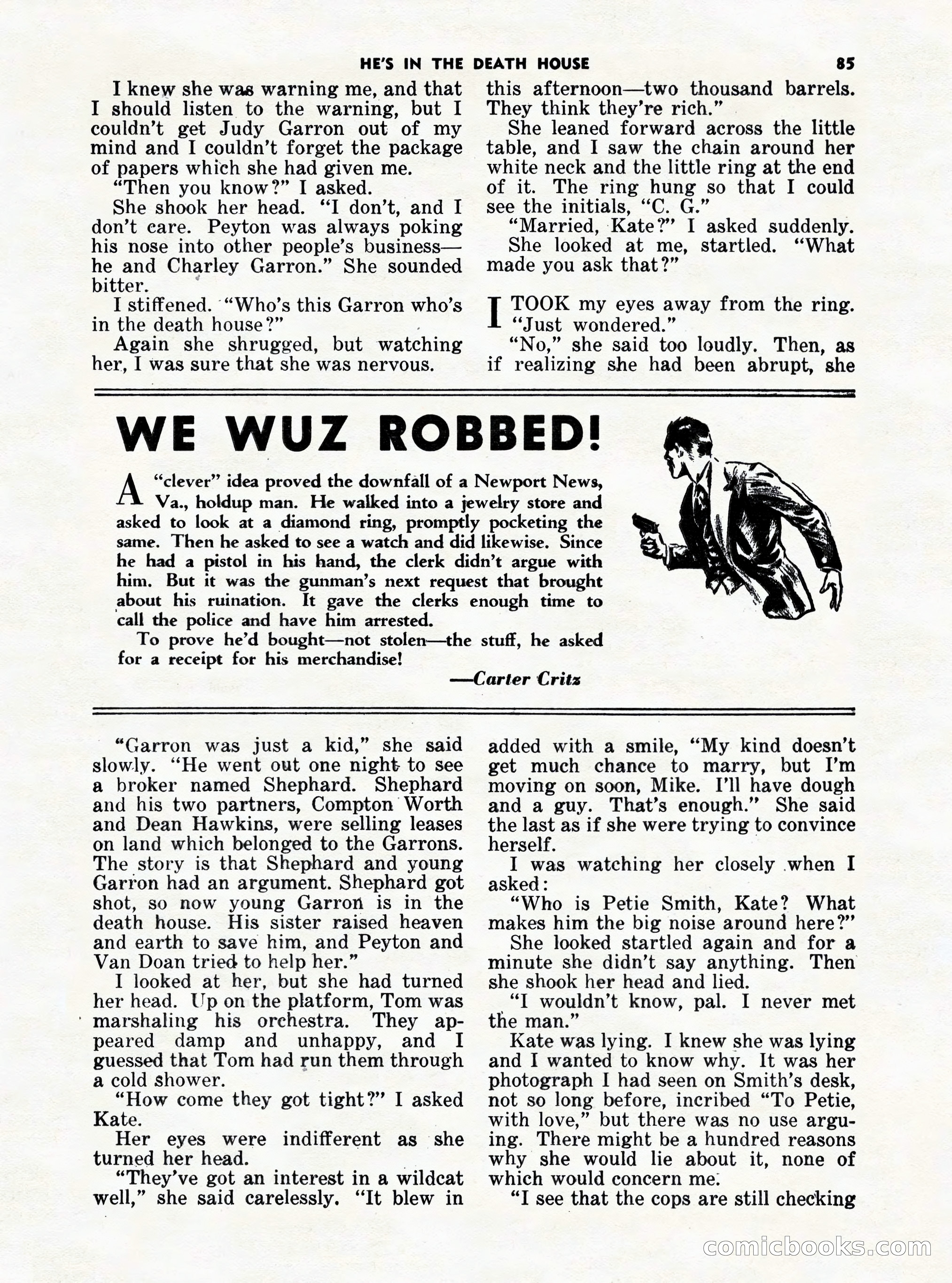
A restored page from Pulp Fiction, 1952. Page through the whole issue in the reader above.
📄 Transcribed text from this page (OCR, searchable)
Machine-transcribed from the original scan — historical spelling and the odd misread are preserved.
HE’S IN THE DEATH HOUSE I knew she was warning me, and that I should listen to the warning, but I couldn’t get Judy Garron out of my mind and I couldn’t forget the package of papers which she had given me. “Then you know?” I asked. She shook her head. “I don’t, and I don’t eare. Peyton was always poking his nose into other people’s business— he and Charley Garron.” She sounded bitter. I stiffened. “Who’s this Garron who’s in the death house?” Again she shrugged, but watching her, I was sure that she was nervous. 85 this afternoon—two thousand barrels. They think they’re rich.” | She leaned forward across the little table, and I saw the chain around her white neck and the little ring at the end of it. The ring hung SO that I could see the initials, “C. G.” “Married, Kate?” I asked suddenly. She looked at me, startled. ‘‘What made you ask that?” | TOOK my eyes away from the ring. “Just wondered.” “No,” she said too loudly. Then, as if realizing she had been abrupt, she A him. call the police and have him arrested. WE WUZ ROBBED! “clever” idea proved the downfall of a Newport News, Va., holdup man. He walked into a jewelry store and asked to look at a diamond ring, promptly pocketing the same. Then he asked to see a watch and did likewise. Since he had a pistol in his hand, the clerk didn’t argue with But it was the gunman’s next request that brought about his ruination. It gave the clerks enough time to To prove he’d bought—not stolen—the stuff, he asked for a receipt for his merchandise! —Carter Critz “Garron was just a kid,” she said slowly. “He went out one night to see a broker named Shephard. Shephard and his two partners, Compton Worth and Dean Hawkins, were selling leases on land which belonged to the Garrons. The story is that Shephard and young Garron had an argument. Shephard got shot, so now young Garron is in the death house. His sister raised heaven and earth to save him, and Peyton and Van Doan tried to help her.” I looked at her, but she had turned her head. Up on the platform, Tom was ‘marshaling his orchestra. They ap- peared damp and unhappy, and I guessed that Tom had run them through a cold shower. “How come they got tight?” I asked Kate. Her eyes were indifferent as she turned her head. 7 “They’ve got an interest in a wildcat well,” she said carelessly. “It blew in added with a smile, “My kind doesn’t get much chance to marry, but I’m moving on soon, Mike. I’ll have dough and a guy. That’s enough.” She said the last as if she were trying to convince herself. I was watching her closely when I asked: “Who is Petie Smith, Kate? What makes him the big noise around here?” She looked startled again and for a minute she didn’t say anything. Then she shook her head and lied. aa | wouldn’t know, pal. I never met the man.’ Kate was lying. I knew she was lying and I wanted to know why. It was her photograph I had seen on Smith’s desk, not so long before, incribed “To Petie, with love,” but there was no uSe argu- ing. There might be a hundred reasons why she would lie about it, none of which would concern me. “T see that the cops are still checking cConniclooo S (C(O) mM