
Pulp Fiction, 1952 · page 84 of 132
5 Detective Novels Magazine Cover — page 84: what you’re looking at
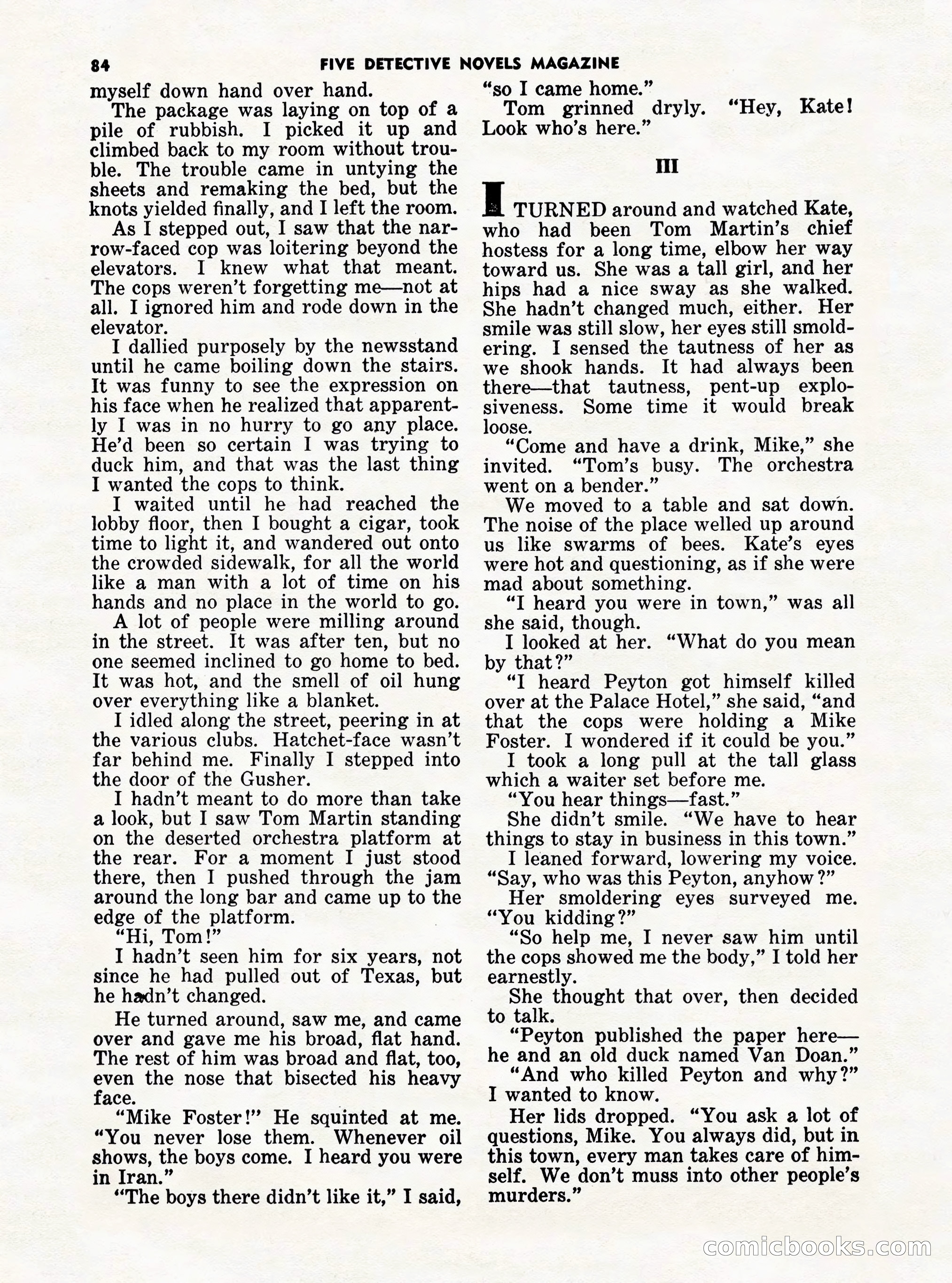
A restored page from Pulp Fiction, 1952. Page through the whole issue in the reader above.
📄 Transcribed text from this page (OCR, searchable)
Machine-transcribed from the original scan — historical spelling and the odd misread are preserved.
84 myself down hand over hand. The package was laying on top of a pile of rubbish. I picked it up and climbed back to my room without trou- ble. The trouble came in untying the sheets and remaking the bed, but the knots yielded finally, and I left the room. As I stepped out, I saw that the nar- row-faced cop was loitering beyond the elevators. I knew what that meant. The cops weren’t forgetting me—not at all. I ignored him and rode down in the elevator. I dallied purposely by the newsstand until he came boiling down the stairs. It was funny to see the expression on his face when he realized that apparent- ly I was in no hurry to go any place. He’d been so certain I was trying to duck him, and that was the last thing I wanted the cops to think. I waited until he had reached the lobby floor, then I bought a cigar, took time to light it, and wandered out onto the crowded sidewalk, for all the world like a man with a lot of time on his hands and no place in the world to go. A lot of people were milling around in the street. It was after ten, but no one seemed inclined to go home to bed. It was hot, and the smell of oil hung over everything like a blanket. I idled along the street, peering in at the various clubs. Hatchet-face wasn’t far behind me. Finally I stepped into the door of the Gusher. I hadn’t meant to do more than take a look, but I saw Tom Martin standing on the deserted orchestra platform at the rear. For a moment I just stood there, then I pushed through the jam around the long bar and came up to the edge of the platform. “Hi, Tom!” I hadn’t seen him for six years, not since he had pulled out of Texas, but he hadn’t changed. He turned around, saw me, and came over and gave me his broad, flat hand. The rest of him was broad and flat, too, om the nose that bisected his heavy ace. “Mike Foster!” He squinted at me. “You never lose them. Whenever oil shows, the boys come. I heard you were in Iran.” “The boys there didn’t like it,” I said, FIVE DETECTIVE NOVELS MAGAZINE “so I came home.” Tom grinned dryly. Look who’s here.” iil “Hey, Kate! | TURNED around and watched Kate, who had been Tom Martin’s chief hostess for a long time, elbow her way toward us. She was a tall girl, and her hips had a nice sway as she walked. She hadn’t changed much, either. Her smile was still slow, her eyes still smold- ering. I sensed the tautness of her as we shook hands. It had always been there—that tautness, pent-up explo- siveness. Some time it would break loose. “Come and have a drink, Mike,” she invited. “Tom’s busy. The orchestra went on a bender.” We moved to a table and sat down. The noise of the place welled up around us like swarms of bees. Kate’s eyes were hot and questioning, as if she were mad about something. “IT heard you were in town,” was all she said, though. I looked at her. “What do you mean by that?” “I heard Peyton got himself killed over at the Palace Hotel,” she said, “and that the cops were holding a Mike Foster. I wondered if it could be you.” I took a long pull at the tall glass which a waiter set before me. “You hear things—fast.” She didn’t smile. “We have to hear things to stay in business in this town.” I leaned forward, lowering my voice. “Say, who was this Peyton, anyhow ?” Her smoldering eyes surveyed me. “You kidding?” “So help me, I never saw him until the cops showed me the body,” I told her earnestly. She thought that over, then decided to talk. “Peyton published the paper here— he and an old duck named Van Doan.” “And who killed Peyton and why?” I wanted to know. Her lids dropped. “You ask a lot of questions, Mike. You always did, but in this town, every man takes care of him- self. We don’t muss into other people’s murders.” COnNIEloO® SJ @ (C(O) im