
Pulp Fiction, 1952 · page 22 of 132
5 Detective Novels Magazine — page 22: what you’re looking at
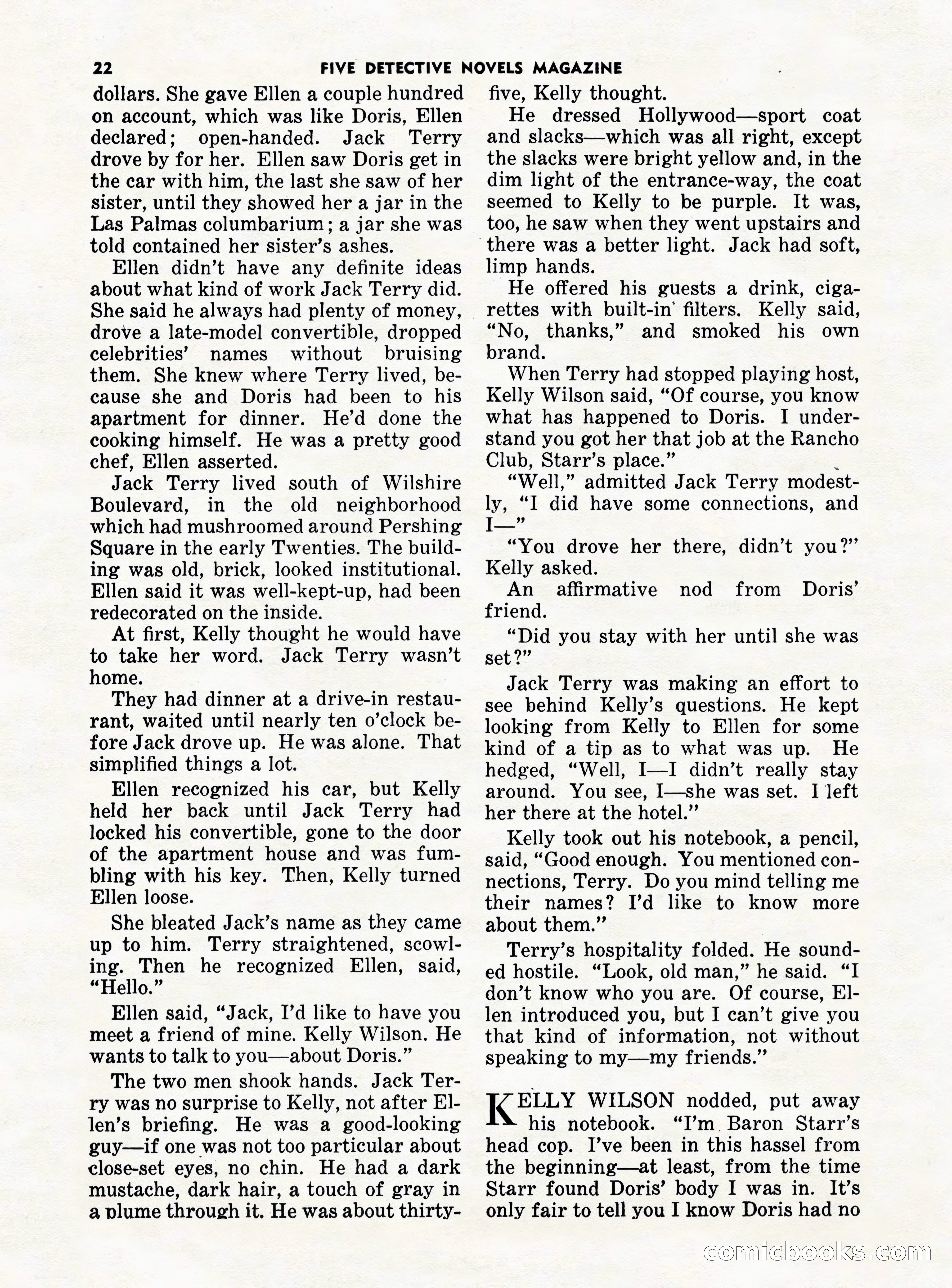
A restored page from Pulp Fiction, 1952. Page through the whole issue in the reader above.
📄 Transcribed text from this page (OCR, searchable)
Machine-transcribed from the original scan — historical spelling and the odd misread are preserved.
22 dollars. She gave Ellen a couple hundred on account, which was like Doris, Ellen declared; open-handed. Jack Terry drove by for her. Ellen saw Doris get in the car with him, the last she saw of her sister, until they showed her a jar in the Las Palmas columbarium; a jar she was told contained her sister’s ashes. Ellen didn’t have any definite ideas about what kind of work Jack Terry did. She said he always had plenty of money, — drove a late-model convertible, dropped celebrities’ names without bruising them. She knew where Terry lived, be- cause she and Doris had been to his apartment for dinner. He’d done the cooking himself. He was a pretty good chef, Ellen asserted. Jack Terry lived south of Wilshire Boulevard, in the old neighborhood which had mushroomed around Pershing Square in the early Twenties. The build- ing was old, brick, looked institutional. Ellen said it was well-kept-up, had been redecorated on the inside. At first, Kelly thought he would have to take her word. Jack Terry wasn’t home. They had dinner at a drive-in restau- rant, waited until nearly ten o’clock be- fore Jack drove up. He was alone. That simplified things a lot. Ellen recognized his car, but Kelly held her back until Jack Terry had locked his convertible, gone to the door of the apartment house and was fum- bling with his key. Then, Kelly turned Ellen loose. She bleated Jack’s name as they came up to him. Terry straightened, scowl- ing. Then he recognized Ellen, said, “Hello.” Ellen said, “Jack, I’d like to have you meet a friend of mine. Kelly Wilson. He wants to talk to you—about Doris.” The two men shook hands. Jack Ter- ry was no surprise to Kelly, not after El- len’s briefing. He was a good-looking guy—if one was not too particular about close-set eyes, no chin. He had a dark mustache, dark hair, a touch of gray in a plume through it. He was about thirty- FIVE DETECTIVE NOVELS MAGAZINE five, Kelly thought. He dressed Hollywood—sport coat and slacks—which was all right, except the slacks were bright yellow and, in the dim light of the entrance-way, the coat seemed to Kelly to be purple. It was, too, he saw when they went upstairs and there was a better light. Jack had soft, limp hands. He offered his guests a drink, ciga- rettes with built-in’ filters. Kelly said, “No, thanks,” and smoked his own brand. When Terry had stopped playing host, Kelly Wilson said, “Of course, you know what has happened to Doris. I under- stand you got her that job at the Rancho Club, Starr’s place.” : “Well,” admitted Jack Terry modest- ly, “I did have some connections, and , “You drove her there, didn’t you?” Kelly asked. An affirmative nod from _ Doris’ friend. “Did you stay with her until she was set ?” Jack Terry was making an effort to see behind Kelly’s questions. He kept looking from Kelly to Ellen for some kind of a tip as to what was up. He hedged, “Well, I—I didn’t really stay around. You see, I—she was set. I left her there at the hotel.” Kelly took out his notebook, a pencil, said, “Good enough. You mentioned con- nections, Terry. Do you mind telling me their names? I’d like to know more about them.” Terry’s hospitality folded. He sound- ed hostile. “Look, old man,” he said. “I don’t know who you are. Of course, El- len introduced you, but I can’t give you that kind of information, not without speaking to my—my friends.” Ko WILSON nodded, put away his notebook. “I’m. Baron Starr’s head cop. I’ve been in this hassel from the beginning—at least, from the time Starr found Doris’ body I was in. It’s only fair to tell you I know Doris had no CoOMmicloooe cS