
Pulp Fiction, 1952 · page 21 of 132
5 Detective Novels Magazine — page 21: what you’re looking at
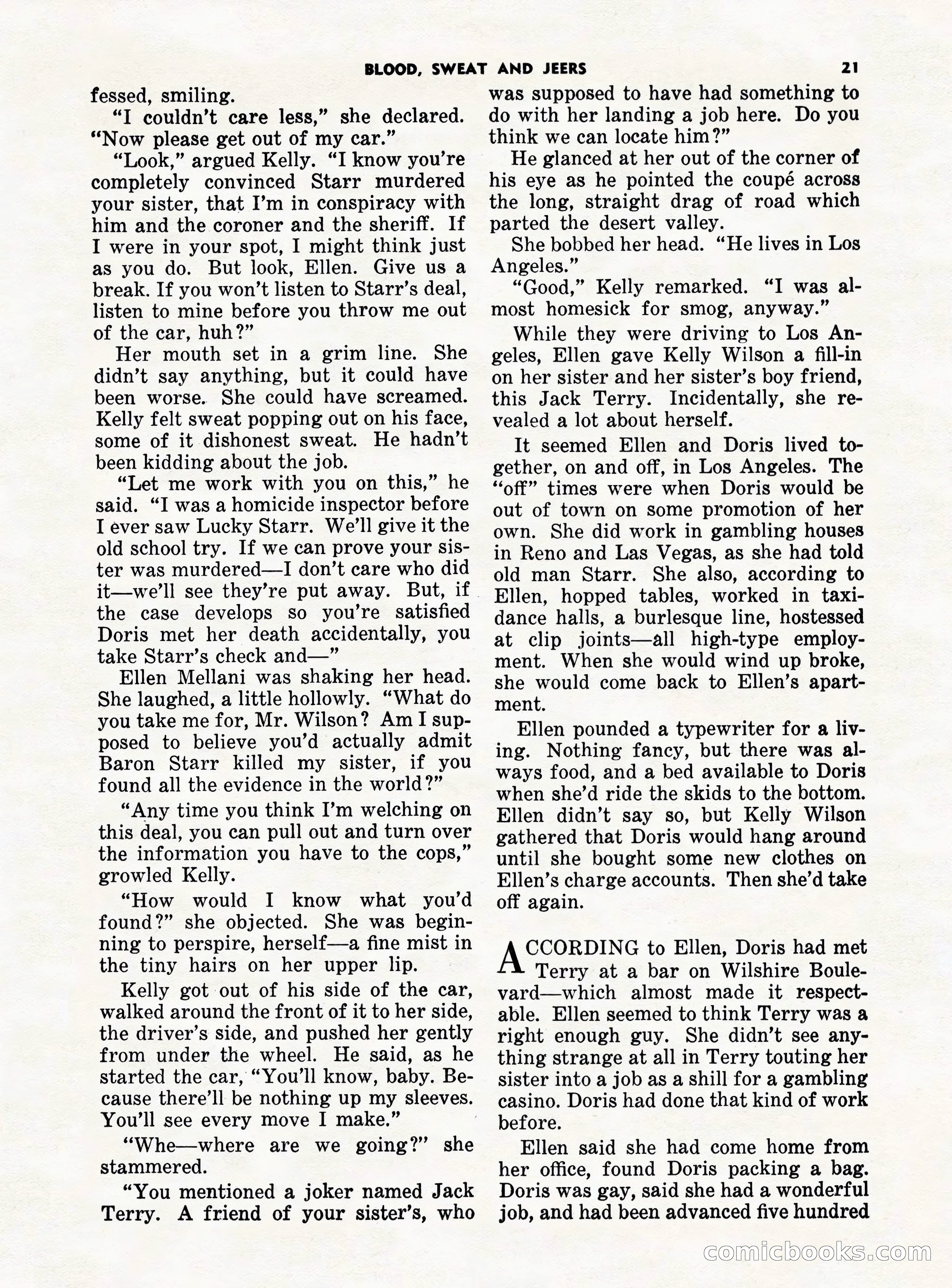
A restored page from Pulp Fiction, 1952. Page through the whole issue in the reader above.
📄 Transcribed text from this page (OCR, searchable)
Machine-transcribed from the original scan — historical spelling and the odd misread are preserved.
BLOOD, SWEAT AND JEERS fessed, smiling. “I couldn’t care less,” she declared. “Now please get out of my car.” “Look,” argued Kelly. “I know you’re completely convinced Starr murdered your sister, that I’m in conspiracy with him and the coroner and the sheriff. If I were in your spot, I might think just as you do. But look, Ellen. Give us a break. If you won’t listen to Starr’s deal, listen to mine before you throw me out of the car, huh?” Her mouth set in a grim line. She didn’t say anything, but it could have been worse. She could have screamed. Kelly felt sweat popping out on his face, some of it dishonest sweat. He hadn’t been kidding about the job. “Let me work with you on this,” he said. “I was a homicide inspector before I ever saw Lucky Starr. We’ll give it the old school try. If we can prove your Sis- ter was murdered—I don’t care who did it—we’ll see they’re put away. But, if. the case develops so you’re satisfied Doris met her death accidentally, you take Starr’s check and—” Ellen Mellani was shaking her head. She laughed, a little hollowly. “What do you take me for, Mr. Wilson? Am I sup- posed to believe you’d actually admit Baron Starr killed my sister, if you found all the evidence in the world?” “Any time you think I’m welching on this deal, you can pull out and turn over the information you have to the cops,” growled Kelly. “How would I know what you'd found?” she objected. She was begin- ning to perspire, herself—a fine mist in the tiny hairs on her upper lip. Kelly got out of his side of the car, walked around the front of it to her side, the driver’s side, and pushed her gently from under the wheel. He said, as he started the car, “You'll know, baby. Be- cause there’ll be nothing up my sleeves. You’ll see every move I make.” “‘Whe—where are we going?” she stammered. “You mentioned a joker named Jack Terry. A friend of your sister’s, who 21 was supposed to have had something to do with her landing a job here. Do you think we can locate him?” He glanced at her out of the corner of his eye as he pointed the coupé across the long, straight drag of road which parted the desert valley. She bobbed her head. “He lives in Los Angeles.” “Good,” Kelly remarked. “I was al- most homesick for smog, anyway.” While they were driving to Los An- geles, Ellen gave Kelly Wilson a fill-in on her sister and her sister’s boy friend, this Jack Terry. Incidentally, she re- vealed a lot about herself. It seemed Ellen and Doris lived to- gether, on and off, in Los Angeles. The “off” times were when Doris would be out of town on some promotion of her own. She did work in gambling houses in Reno and Las Vegas, as she had told old man Starr. She also, according to Ellen, hopped tables, worked in taxi- dance halls, a burlesque line, hostessed at clip joints—all high-type employ- ment. When she would wind up broke, she would come back to Ellen’s apart- ment. Ellen pounded a typewriter for a liv- ing. Nothing fancy, but there was al- ways food, and a bed available to Doris when she’d ride the skids to the bottom. Ellen didn’t say so, but Kelly Wilson gathered that Doris would hang around until she bought some new clothes on Ellen’s charge accounts. Then she’d take off again. AGeeeD G to Ellen, Doris had met Terry at a bar on Wilshire Boule- vard—which almost made it respect- able. Ellen seemed to think Terry was a right enough guy. She didn’t see any- thing strange at all in Terry touting her sister into a job as a shill for a gambling casino. Doris had done that kind of work before. Ellen said she had come home from her office, found Doris packing a bag. Doris was gay, said she had a wonderful job, and had been advanced five hundred MICLOO connie iS