
Pulp Fiction, 1951 · page 12 of 132
5 Detective Novels Magazine Cover — page 12: what you’re looking at
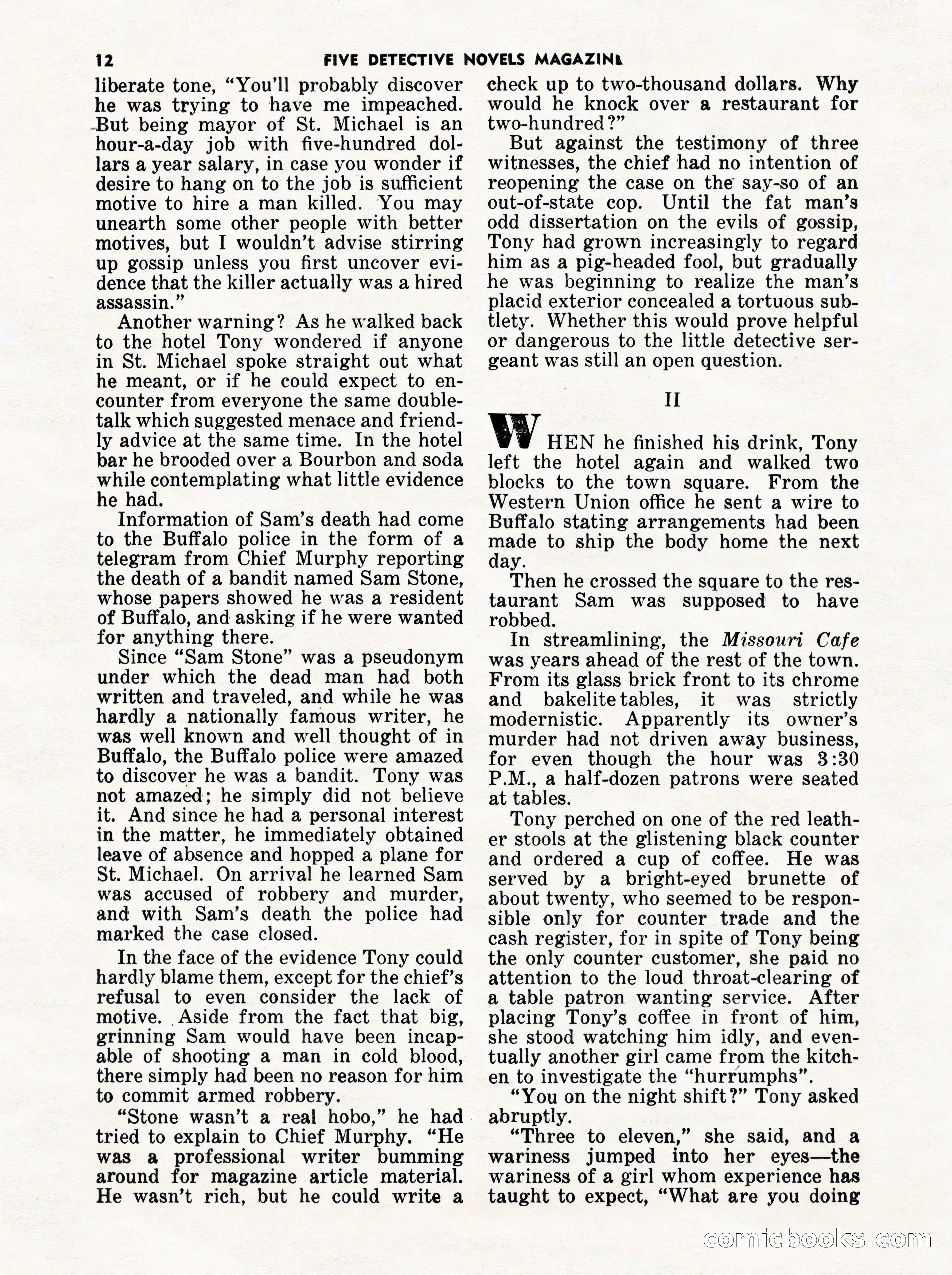
A restored page from Pulp Fiction, 1951. Page through the whole issue in the reader above.
📄 Transcribed text from this page (OCR, searchable)
Machine-transcribed from the original scan — historical spelling and the odd misread are preserved.
12 liberate tone, “You'll probably discover he was trying to have me impeached. -But being mayor of St. Michael is an hour-a-day job with five-hundred dol- lars a year salary, in case you wonder if desire to hang on to the job is sufficient motive to hire a man killed. You may unearth some other people with better motives, but I wouldn’t advise stirring up gossip unless you first uncover evi- dence that the killer actually was a hired assassin.” Another warning? As he walked back to the hotel Tony wondered if anyone in St. Michael spoke straight out what he meant, or if he could expect to en- counter from everyone the same double- talk which suggested menace and friend- ly advice at the same time. In the hotel bar he brooded over a Bourbon and soda while contemplating what little evidence he had. Information of Sam’s death had come to the Buffalo police in the form of a telegram from Chief Murphy reporting the death of a bandit named Sam Stone, whose papers showed he was a resident of Buffalo, and asking if he were wanted for anything there. Since “Sam Stone” was a pseudonym under which the dead man had both written and traveled, and while he was hardly a nationally famous writer, he was well known and well thought of in Buffalo, the Buffalo police were amazed to discover he was a bandit. Tony was not amazed; he simply did not believe it. And since he had a personal interest in the matter, he immediately obtained leave of absence and hopped a plane for St. Michael. On arrival he learned Sam was accused of robbery and murder, and with Sam’s death the police had marked the case closed. In the face of the evidence Tony could hardly blame them, except for the chief’s refusal to even consider the lack of motive. Aside from the fact that big, grinning Sam would have been incap- able of shooting a man in cold blood, there simply had been no reason for him to commit armed robbery. “Stone wasn’t a real hobo,” he had. tried to explain to Chief Murphy. “He was a professional writer bumming around for magazine article material. He wasn’t rich, but he could write a FIVE DETECTIVE NOVELS MAGAZINE check up to two-thousand dollars. Why would he knock over a restaurant for two-hundred ?” But against the testimony of three witnesses, the chief had no intention of reopening the case on the say-so of an out-of-state cop. Until the fat man’s odd dissertation on the evils of gossip, Tony had grown increasingly to regard him as a pig-headed fool, but gradually he was beginning to realize the man’s placid exterior concealed a tortuous sub- tlety. Whether this would prove helpful or dangerous to the little detective ser- geant was still an open question. II W HEN he finished his drink, Tony left the hotel again and walked two blocks to the town square. From the Western Union office he sent a wire to Buffalo stating arrangements had been made to ship the body home the next ay. Then he crossed the square to the res- taurant Sam was supposed to have robbed. In streamlining, the Missouri Cafe was years ahead of the rest of the town. From its glass brick front to its chrome and bakelitetables, it was_ strictly modernistic. Apparently its owner’s murder had not driven away business, for even though the hour was 3:30 P.M., a half-dozen patrons were seated at tables. Tony perched on one of the red leath- er stools at the glistening black counter and ordered a cup of coffee. He was served by a bright-eyed brunette of about twenty, who seemed to be respon- sible only for counter trade and the cash register, for in spite of Tony being the only counter customer, she paid no attention to the loud throat-clearing of a table patron wanting service. After placing Tony’s coffee in front of him, she stood watching him idly, and even- tually another girl came from the kitch- en to investigate the “hurrumphs”, “You on the night shift?” Tony asked abruptly. “Three to eleven,” she said, and a wariness jumped into her eyes—the wariness of a girl whom experience has taught to expect, “What are you doing AMICLOOO SS (C(O) (C(O)