
Pulp Fiction, 1951 · page 11 of 132
5 Detective Novels Magazine Cover — page 11: what you’re looking at
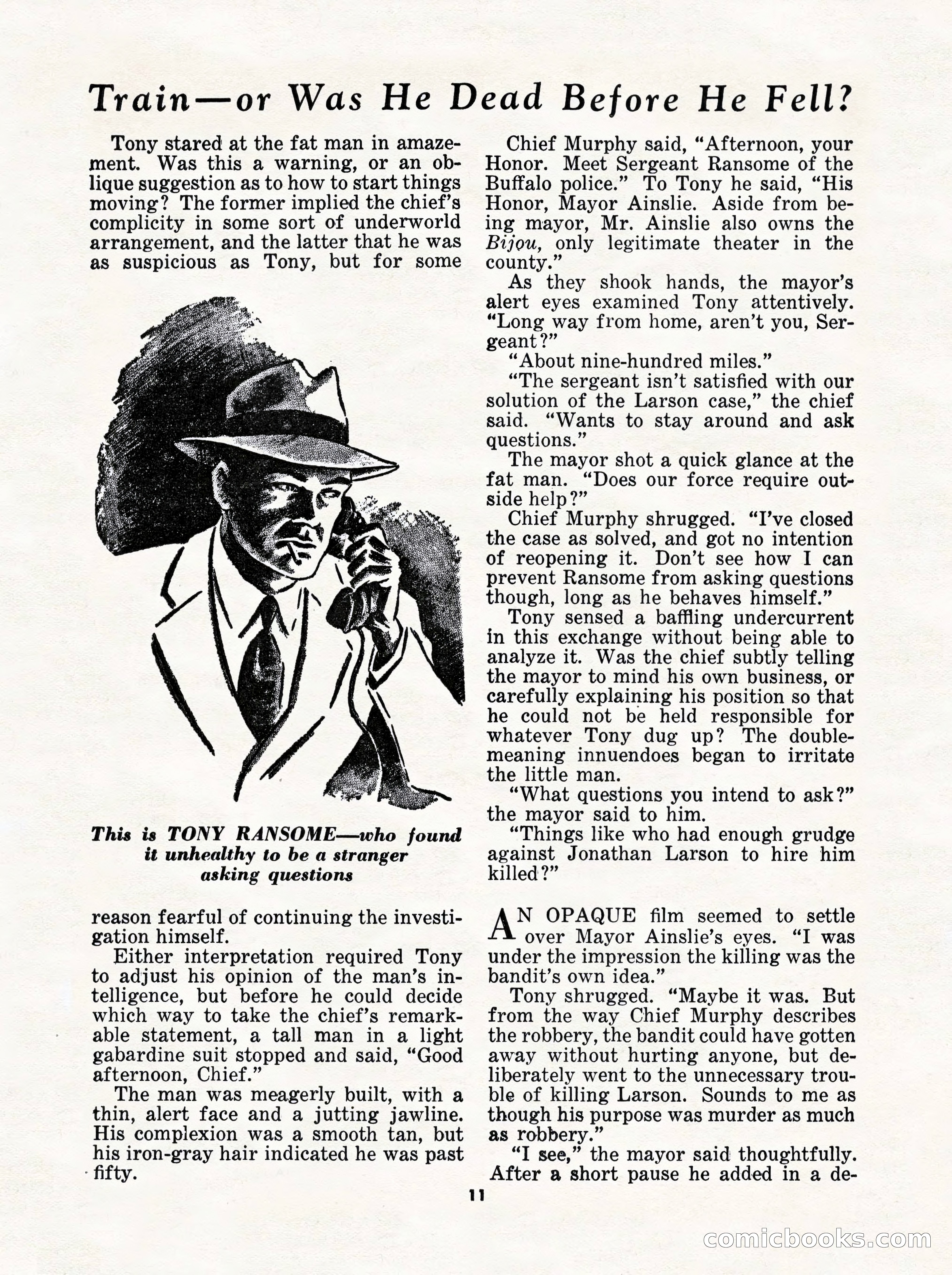
A restored page from Pulp Fiction, 1951. Page through the whole issue in the reader above.
📄 Transcribed text from this page (OCR, searchable)
Machine-transcribed from the original scan — historical spelling and the odd misread are preserved.
Train—or Was He Dead Before He Fell? Tony stared at the fat man in amaze- ment. Was this a warning, or an ob- lique suggestion as to how to start things moving? The former implied the chief’s complicity in some sort of underworld arrangement, and the latter that he was as suspicious as Tony, but for some SSA This is TONY RANSOME—who found it unhealthy to be a stranger asking questions reason fearful of continuing the investi- gation himself. Either interpretation required Tony to adjust his opinion of the man’s in- telligence, but before he could decide which way to take the chief’s remark- able statement, a tall man in a light gabardine suit stopped and said, “Good afternoon, Chief.” The man was meagerly built, with a thin, alert face and a jutting jawline. His compiexion was a smooth tan, but ne iron-gray hair indicated he was past ty. Chief Murphy said, “Afternoon, your Honor. Meet Sergeant Ransome of the Buffalo police.” To Tony he said, “His Honor, Mayor Ainslie. Aside from be- ing mayor, Mr. Ainslie also owns the Bijou, only legitimate theater in the county.” As they shook hands, the mayor’s alert eyes examined Tony attentively. “Long way from home, aren’t you, Ser- geant?” “About nine-hundred miles.” “The sergeant isn’t satisfied with our solution of the Larson case,” the chief said. “Wants to stay around and ask questions.” The mayor shot a quick glance at the fat man. “Does our force require out- side help?” Chief Murphy shrugged. “I’ve closed the case as solved, and got no intention of reopening it. Don’t see how I can prevent Ransome from asking questions though, long as he behaves himself.” Tony sensed a baffling undercurrent in this exchange without being able to analyze it. Was the chief subtly telling the mayor to mind his own business, or carefully explaining his position so that he could not be held responsible for whatever Tony dug up? The double- meaning innuendoes began to irritate the little man. “What questions you intend to ask?” the mayor said to him. “Things like who had enough grudge against Jonathan Larson to hire him killed?” N OPAQUE film seemed to settle over Mayor Ainslie’s eyes. “I was under the impression the killing was the bandit’s own idea.” Tony shrugged. “Maybe it was. But from the way Chief Murphy describes the robbery, the bandit could have gotten away without hurting anyone, but de- liberately went to the unnecessary trou- ble of killing Larson. Sounds to me as though his purpose was murder as much as robbery.” “T see,” the mayor said thoughtfully. After a short pause he added in a de- AMICLOOO (C(O) S (C(O)