
Pulp Fiction, 1957 · page 60 of 101
2 Gun Western, May 1957 — page 60: what you’re looking at
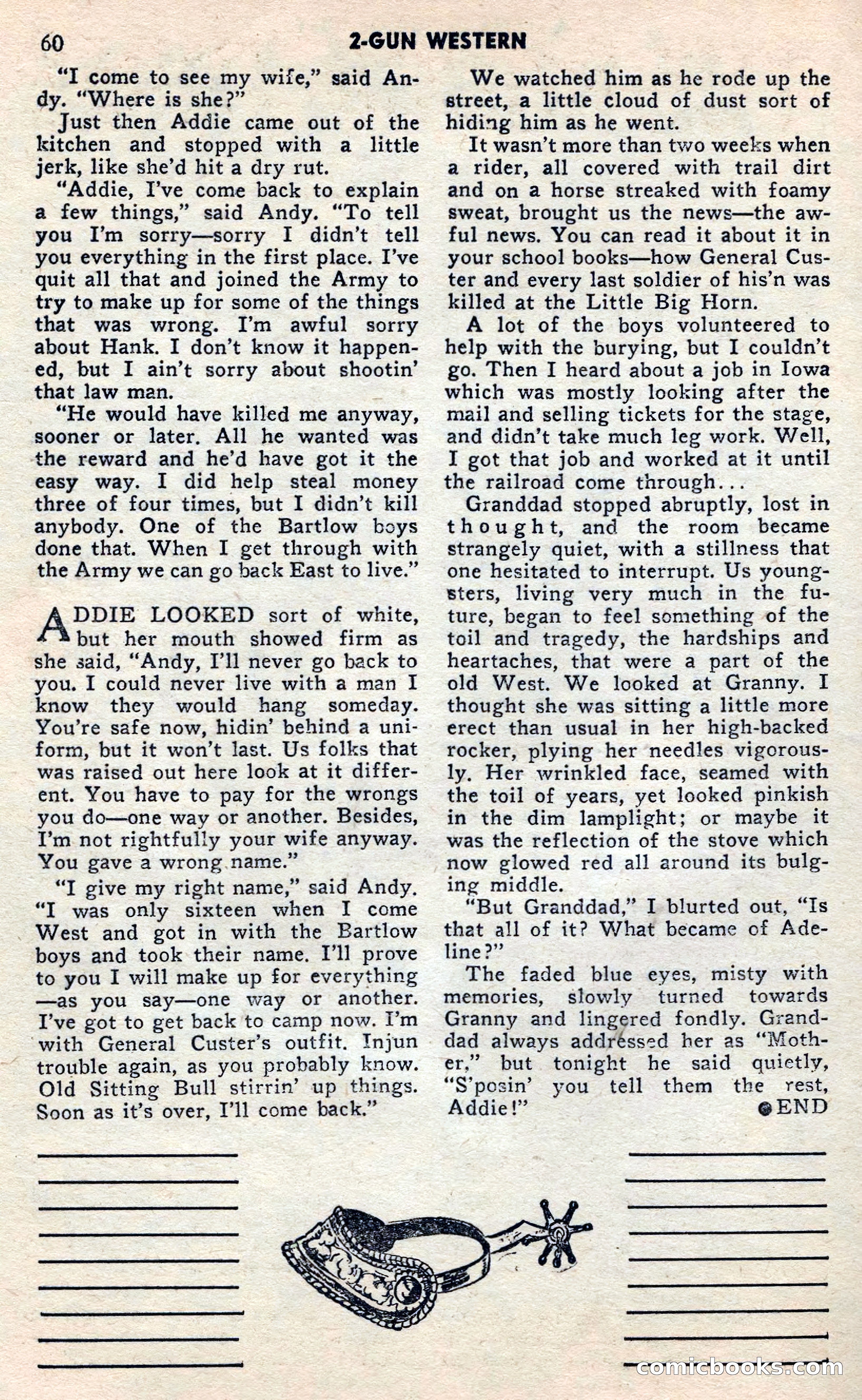
A restored page from Pulp Fiction, 1957. Page through the whole issue in the reader above.
📄 Transcribed text from this page (OCR, searchable)
Machine-transcribed from the original scan — historical spelling and the odd misread are preserved.
60 | 2-GUN WESTERN» “I come to see my wife,” said An- dy. “Where is she?” | Just then Addie came out of the kitchen and stopped with a little jerk, like she’d hit a dry rut. “Addie, I’ve come back to explain a few things,” said Andy. “To tell you I’m sorry—sorry I didn’t tell you everything in the first place. I’ve quit all that and joined the Army to try to make up for some of the things that was wrong. I’m awful sorry about Hank. I don’t know it happen- ed, but I ain’t sorry about shootin’ that law man. “He would have killed me anyway, sooner or later. All he wanted was the reward and he’d have got it the easy way. I did help steal money three of four times, but I didn’t kill anybody. One of the Bartlow boys done that. When I get through with the Army we can go back East to live.” DDIE LOOKED sort of white, but her mouth showed firm as she said, “Andy, Pll never go back to you. I could never live with a man I know they would hang someday. You’re safe now, hidin’ behind a uni- form, but it won’t last. Us folks that was raised out here look at it differ- ent. You have to pay for the wrongs you do—one way or another. Besides, I’m not rightfully your wife anyway. You gave a wrong.name.” “TI give my right name,” said Andy. “I was only sixteen when I come West and got in with the Bartlow boys and took their name. I’ll prove to you I will make up for everything —as you say—one way or another. I’ve got to get back to camp now. I’m ‘with General Custer’s outfit. Injun trouble again, as you probably know. Old Sitting Bull stirrin’ up things. Soon as it’s over, I’ll come back.” | We watched him as he rode up the street, a little cloud of dust sort of hiding him as he went. It wasn’t more than two weeks when a rider, all covered with trail dirt and on a horse streaked with foamy sweat, brought us the news—the aw- ful news. You can read it about it in your school books—how General Cus- ter and every last soldier of his’n was killed at the Little Big Horn. A lot of the boys volunteered to help with the burying, but I couldn't go. Then I heard about a job in Iowa which was mostly looking after the mail and selling tickets for the stage, and didn’t take much leg work. Well, I got that job and worked at it until the railroad come through... Granddad stopped abruptly, lost in thought, and the room became strangely quiet, with a stillness that one hesitated to interrupt. Us young- sters, living very much in the fu- ture, began to feel something of the toil and tragedy, the hardships and heartaches, that were a part of the old West. We looked at Granny. I thought she was sitting a little more erect than usual in her high-backed rocker, plying her needles vigorous- ly. Her wrinkled face, seamed with the toil of years, yet looked pinkish in the dim lamplight; or maybe it was the reflection of the stove which now glowed red all around its bulg- ing middle. “But Granddad,” I blurted out, “Is that all of it? What became of Ade- line ?”’ The faded blue eyes, misty with memories, slowly turned towards Granny and lingered fondly. Grand- dad always addréssed her as “Moth- er,’ but tonight he said quietly, “S’pesin’ Addie!” you tell them the rest, @END aGOMIGOOOKS5;GOIM 2)