
Pulp Fiction, 1957 · page 56 of 101
2 Gun Western, May 1957 — page 56: what you’re looking at
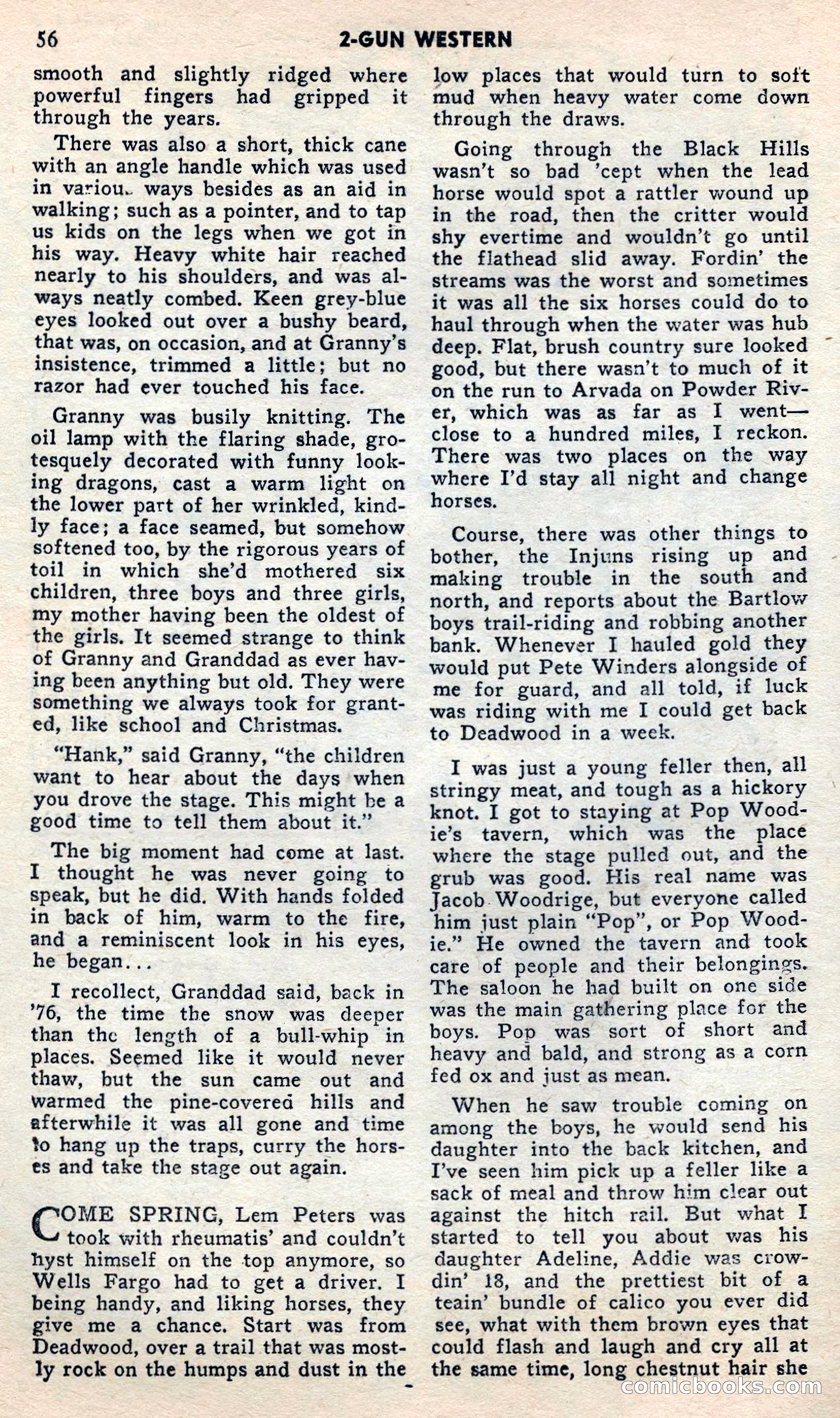
A restored page from Pulp Fiction, 1957. Page through the whole issue in the reader above.
📄 Transcribed text from this page (OCR, searchable)
Machine-transcribed from the original scan — historical spelling and the odd misread are preserved.
56 smooth and slightly ridged where powerful fingers had gripped it through the years. There was also a short, thick cane with an angle handle which was used in variou. ways besides as an aid in walking; such as a pointer, and to tap us kids on the legs when we got in his way. Heavy white hair reached nearly to his shoulders, and was al- ways neatly combed. Keen grey-blue eyes looked out over a bushy beard, that was, on occasion, and at Granny’s insistence, trimmed a little; but no razor had ever touched his face. Granny was busily knitting. The oil lamp with the flaring shade, gro- tesquely decorated with funny look- ing dragons, cast a warm light on the lower part of her wrinkled, kind- ly face; a face seamed, but somehow softened too, by the rigorous years of toil in which she’d mothered six children, three boys and three girls, my mother having been the oldest of the girls. It seemed strange to think of Granny and Granddad as ever hav- ing been anything but old. They were something we always took for grant- ed, like school and Christmas. “Hank,” said Granny, “the children want to hear about the days when you drove the stage. This might be a good time to tell them about it.” The big moment had come at last. I thought he was never going to speak, but he did. With hands folded in back of him, warm to the fire, and a reminiscent look in his eyes, he began... I recollect, Granddad said, back in ‘76, the time the snow was deeper than the length of a bull-whip in places. Seemed like it would never thaw, but the sun came out and warmed the pine-covered hills and afterwhile it was all gone and time to hang up the traps, curry the hors- es and take the stage out again. OME SPRING, Lem Peters was took with rheumatis’ and couldn’t hyst himself on the top anymore, so Wells Fargo had to get a driver. I being handy, and liking horses, they give me a chance. Start was from Deadwood, over a trail that was most- ly rock on the humps and dust in the 2-GUN WESTERN low places that would turn to soft mud when heavy water come down through the draws. : Going through the Black Hills wasn’t so bad ’cept when the lead horse would spot a rattler wound up in the road, then the critter would shy evertime and wouldn’t go until the flathead slid away. Fordin’ the streams was the worst and sometimes it was all the six horses could do to haul through when the water was hub deep. Flat, brush country sure looked good, but there wasn’t to much of it on the run to Arvada on Powder Riv- er, which was as far as I went— close to a hundred miles, I reckon. There was two places on the way where I’d stay all night and change horses. Course, there was other things to bother, the Injuns rising up and making trouble in the south and north, and reports about the Bartlow boys trail-riding and robbing another bank. Whenever I hauled gold they would put Pete Winders alongside of me for guard, and all told, if luck was riding with me I could get back to Deadwood in a week. I was just a young feller then, all stringy meat, and tough as a hickory knot. I got to staying at Pop Wood- ie’s tavern, which was the place where the stage pulled out, and the grub was good. His real name was Jacob. Woodrige, but everyone called him just plain “Pop”, or Pop Wood- ie.’ He owned the tavern and took care of people and their belongings. The saloon he had built on one side was the main gathering place for the boys. Pop was sort of short and heavy and bald, and strong as a corn fed ox and just as mean. When he saw trouble coming on among the boys, he would send his daughter into the back kitchen, and I’ve seen him pick up a feller like a sack of meal and throw him clear out against the hitch rail. But what I started to tell you about was his daughter Adeline, Addie was crow- din’ 18, and the prettiest bit of a teain’ bundle of calico you ever did see, what with them brown eyes that could flash and laugh and cry all at the same time, long chestnut hair she CORMCDOOKS. CO