
Pulp Fiction, 1957 · page 50 of 101
2 Gun Western, May 1957 — page 50: what you’re looking at
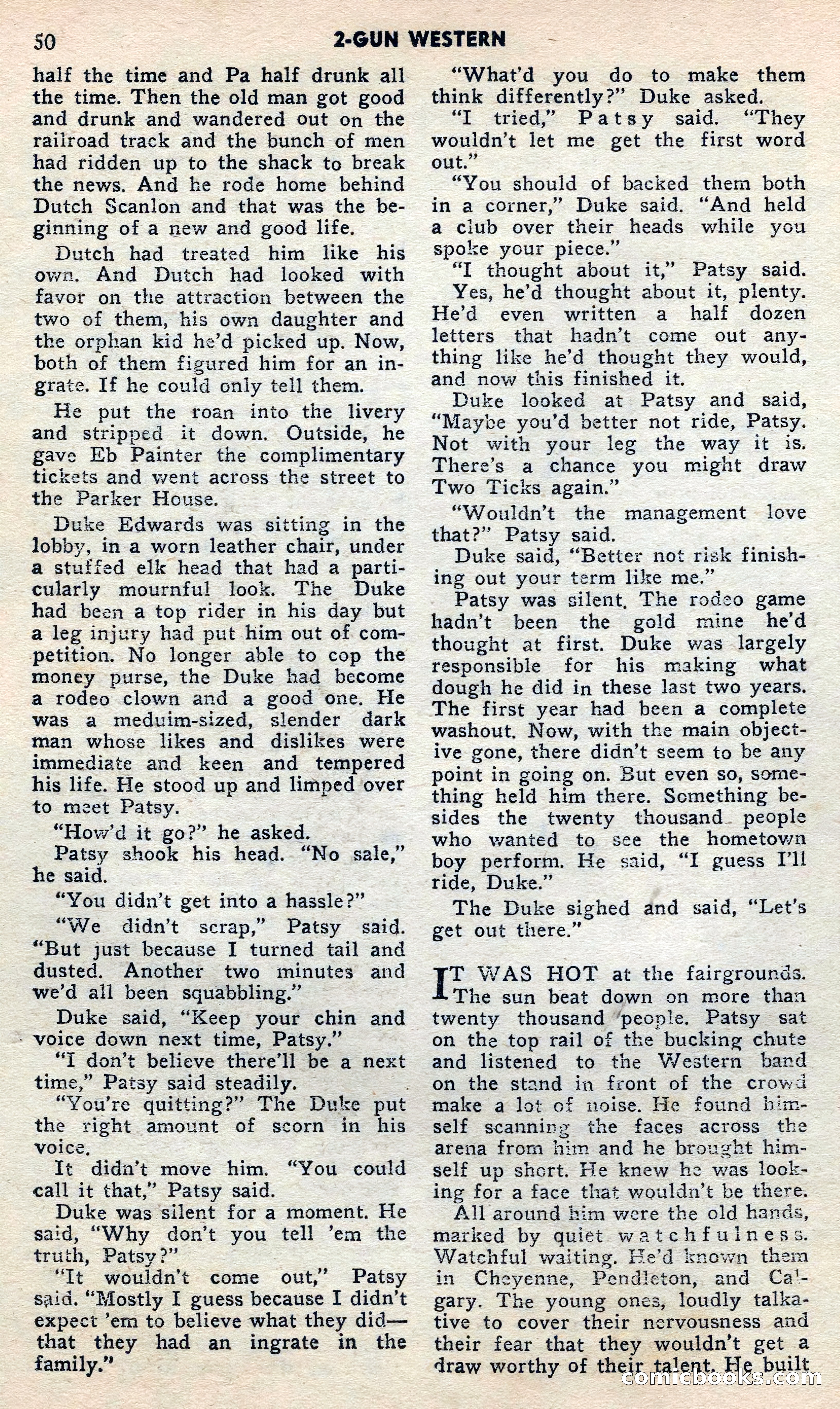
A restored page from Pulp Fiction, 1957. Page through the whole issue in the reader above.
📄 Transcribed text from this page (OCR, searchable)
Machine-transcribed from the original scan — historical spelling and the odd misread are preserved.
50 2-GUN WESTERN - half the time and Pa half drunk all the time. Then the old man got good and drunk and wandered out on the railroad track and the bunch of men had ridden up to the shack to break the news. And he rode home behind Dutch Scanlon and that was the be- ginning of a new and good life. Dutch had treated him like his own. And Dutch had looked with favor on the attraction between the two of them, his own daughter and the orphan kid he’d picked up. Now, both of them figured him for an in- grate. If he could only tell them. He put the roan into the livery and stripped it down. Outside, he gave Eb Painter the complimentary tickets and went across the street to the Parker House. Duke Edwards was sitting in the lobby, in a worn leather chair, under a stuffed elk head that had a parti- cularly mournful look. The Duke had been a top rider in his day but a leg injury had put him out of com- petition. No longer able to cop the money purse, the Duke had become a rodeo clown and a good one. He Was a meduim-sized, slender dark man whose likes and dislikes were immediate and keen and tempered his life. He stood up and limped over to meet Patsy. “How’d it go?” he asked. Patsy shook his head. “No sale,’ he said. “You didn’t get into a hassle?” “We didn’t scrap,” Patsy said. “But just because I turned tail and dusted. Another two minutes and we'd all been squabbling.” Duke said, “Keep your chin and - voice down next time, Patsy.” “I don’t believe there'll be a next time,” Patsy said steadily. “You're quitting?” The Duke put the right amount of scorn in his voice, It didn’t move him. call it that,’ Patsy said. Duke was silent for a moment. He said, “Why don’t you tell ’em the truth, Patsy?” “Tt wouldn’t come out,’ Patsy said. “Mostly I guess because I didn’t expect ’em to believe what they did— that they had an ingrate in the family.” “You could “What'd you do to make them think differently?” Duke asked. “I tried,” Patsy said. “They wouldn’t let me get the first word out.” “You should of backed them both in a corner,” Duke said. “And held a oe over their heads while you spoke your piece.” “IT thought about it,’ Patsy said. Yes, he’d thought about it, plenty. He’d even written a half dozen letters that hadn’t come out any- thing like he’d thought they would, and now this finished it. Duke looked at Patsy aa said, “Maybe you'd better not ride, Patsy. Not with your leg the way it is. There’s a chance you might draw Two Ticks again.” “Wouldn’t the management love that?” Patsy said. Duke said, “Better not risk finish- ing out your term like me.” Patsy was silent, The rodeo game hadn’t been the gold mine hed thought at first. Duke was largely responsible for his making what dough he did in these last two years. The first year had been a complete washout, Now, with the main object- ive gone, there didn’t seem to be any point in going on. But even so, sorme- thing held him there. Something be- sides the twenty thousand. people who wanied to see the hometown boy perform. He said, “I guess I'll ride, Duke.” The Duke sighed and said, get out there.” “Let's Es WAS HOT at the fairgrounds. The sun beat down on more than twenty thousand ‘people. Patsy sat on the top rail of the bucking chute and listened to the Western band on the stand in front of the crows make a lot of noise. He found him- self scanning the faces across the arena from him and he brought him- self up short. He knew he was lock- ing for a face that wouldn’t be there. All around him were the old hands, marked by quiet watchfulness. Watchful waiting. He'd known them in Cheyenne, Pendleton, and Ca'- gary. The young ones, loudly talka- tive to cover their nervousness and their fear that they wouldn't get a draw worthy of aecomich . E e_built