
Pulp Fiction, 1955 · page 65 of 99
2-Gun Western, November 1955 — page 65: what you’re looking at
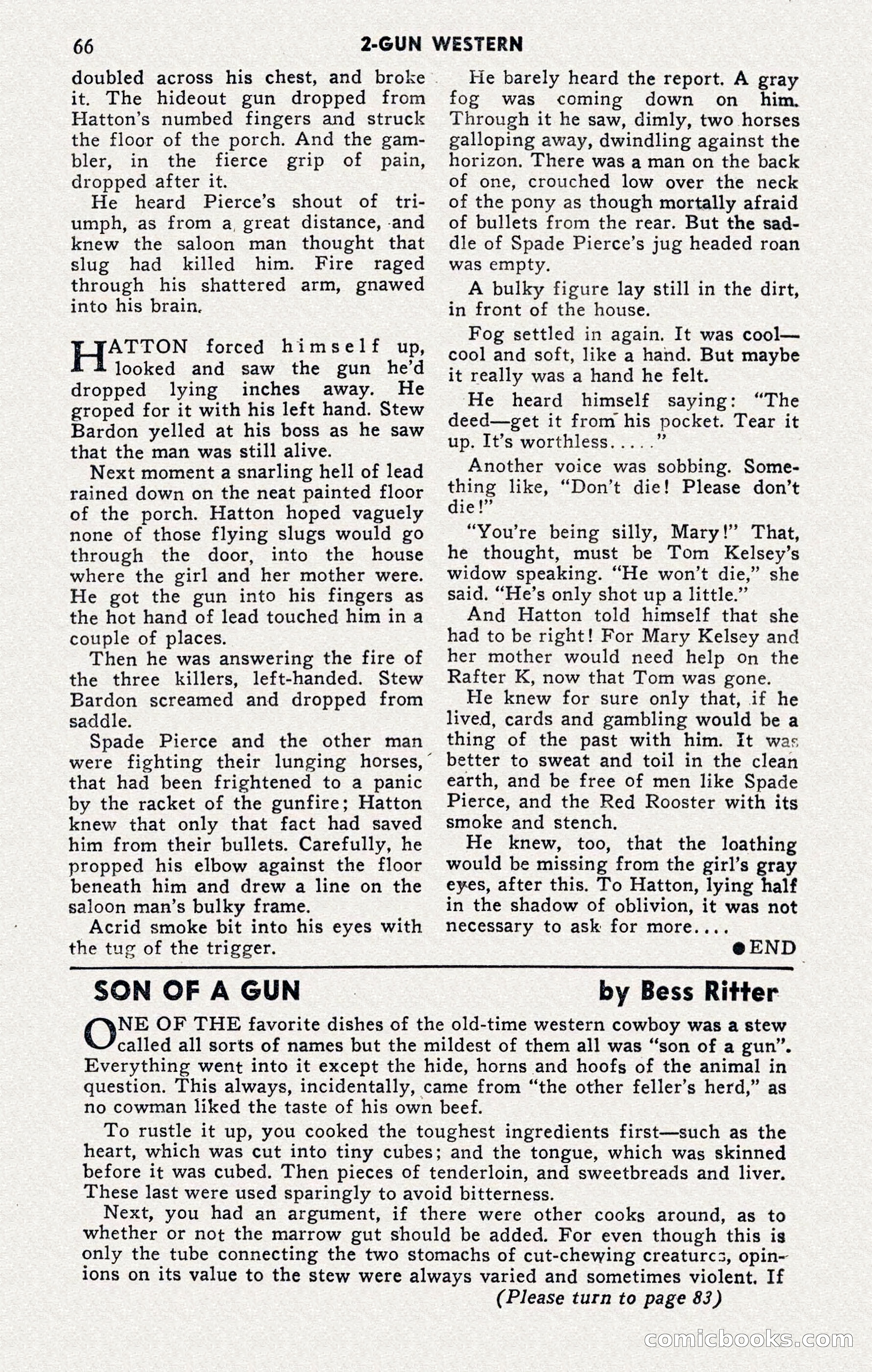
A restored page from Pulp Fiction, 1955. Page through the whole issue in the reader above.
📄 Transcribed text from this page (OCR, searchable)
Machine-transcribed from the original scan — historical spelling and the odd misread are preserved.
66 doubled across his chest, and broke it. The hideout gun dropped from Hatton’s numbed fingers and struck the floor of the porch. And the gam- bler, in the fierce grip of pain, dropped after it. He heard Pierce’s shout of tri- umph, as from a, great distance, and knew the saloon man thought that slug had killed him. Fire raged through his shattered arm, gnawed into his brain. Het forced himself up, looked and saw the gun he’d dropped lying inches away. He groped for it with his left hand. Stew Bardon yelled at his boss as he saw that the man was still alive. Next moment a snarling hell of lead rained down on the neat painted floor of the porch. Hatton hoped vaguely none of those flying slugs would go through the door, into the house where the girl and her mother were. He got the gun into his fingers as the hot hand of lead touched him in a couple of places. Then he was answering the fire of the three killers, left-handed. Stew Bardon screamed and dropped from saddle. Spade Pierce and the other man were fighting their lunging horses,” that had been frightened to a panic by the racket of the gunfire; Hatton knew that only that fact had saved him from their bullets. Carefully, he propped his elbow against the floor beneath him and drew a line on the saloon man’s bulky frame. Acrid smoke bit into his eyes with the tug of the trigger. 2-GUN WESTERN He barely heard the report. A gray fog was coming down on _ him, Through it he saw, dimly, two horses galloping away, dwindling against the horizon. There was a man on the back of one, crouched low over the neck of the pony as though mortally afraid of bullets from the rear. But the sad- die of Spade Pierce’s jug headed roan was empty. A bulky figure lay still in the dirt, in front of the house. Fog settled in again. It was cool— cool and soft, like a hand. But maybe it really was a hand he felt. He heard himself saying: “The deed—get it from his pocket. Tear it up. It’s worthless..... 2 Another voice was sobbing. Some- thing like, “Don’t die! Please don’t die!” “You're being silly, Mary!” That, he thought, must be Tom Kelsey’s widow speaking. “He won’t die,” she said. “He’s only shot up a little.” And Hatton told himself that she had to be right! For Mary Kelsey and her mother would need help on the Rafter K, now that Tom was gone. He knew for sure only that, if he lived, cards and gambling would be a thing of the past with him. It was better to sweat and toil in the clean earth, and be free of men like Spade Pierce, and the Red Rooster with its smoke and stench. He knew, too, that the loathing would be missing from the girl’s gray eyes, after this. To Hatton, lying half in the shadow of oblivion, it was not necessary to ask for more.... @END SON OF A GUN by Bess Ritter Oe OF THE favorite dishes of the old-time western cowboy was a stew called all sorts of names but the mildest of them all was “son of a gun”. Everything went into it except the hide, horns and hoofs of the animal in question. This always, incidentally, came from “the other feller’s herd,” as no cowman liked the taste of his own beef. To rustle it up, you cooked the toughest ingredients first—such as the heart, which was cut into tiny cubes; and the tongue, which was skinned before it was cubed. Then pieces of tenderloin, and sweetbreads and liver. These last were used sparingly to avoid bitterness. Next, you had an argument, if there were other cooks around, as to whether or not the marrow gut should be added. For even though this is only the tube connecting the two stomachs of cut-chewing creaturcs, opin- ions on its value to the stew were always varied and sometimes violent. If (Please turn to page 83) GIOOKS conn CO