
Pulp Fiction, 1955 · page 64 of 99
2-Gun Western, November 1955 — page 64: what you’re looking at
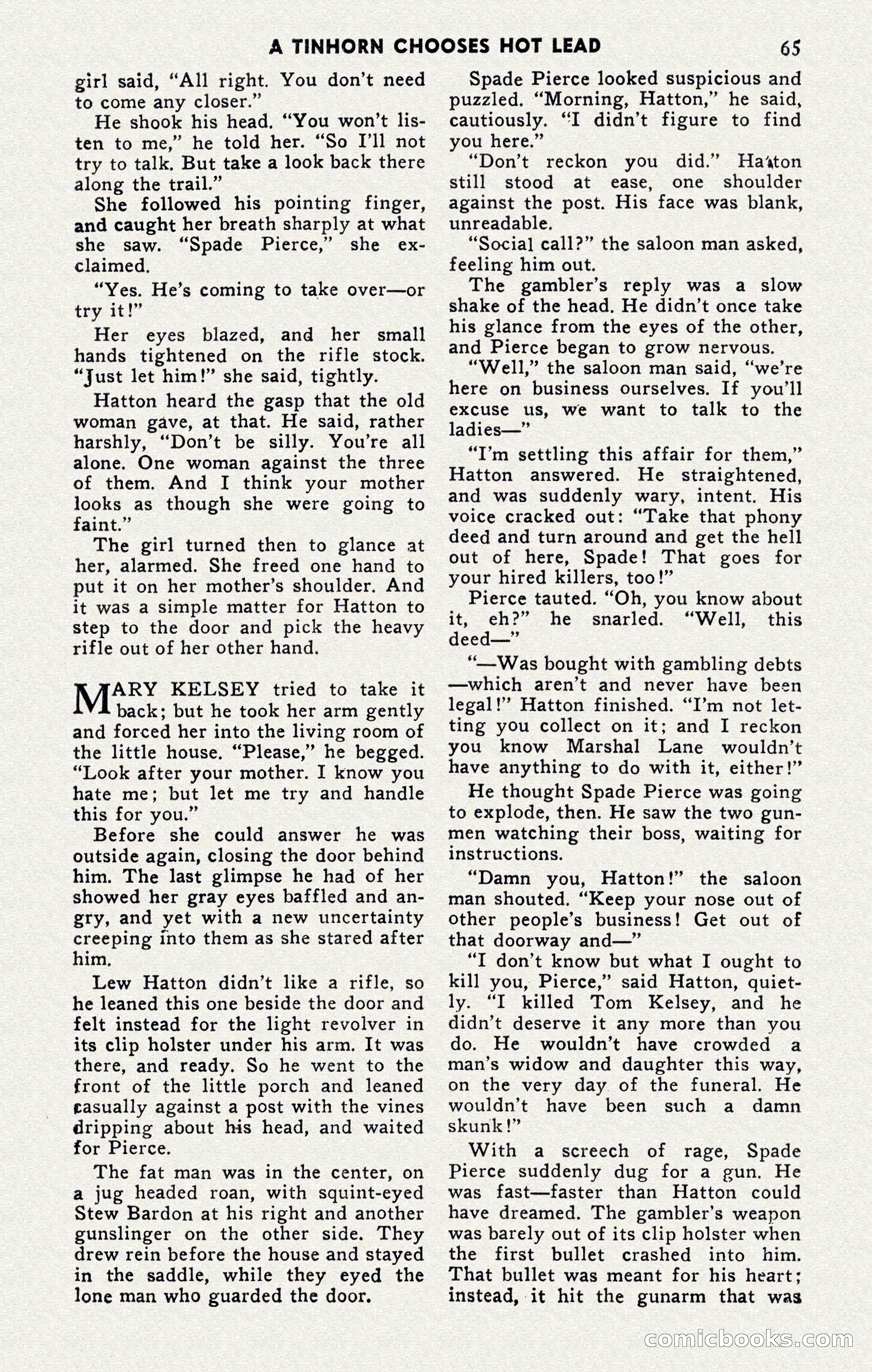
A restored page from Pulp Fiction, 1955. Page through the whole issue in the reader above.
📄 Transcribed text from this page (OCR, searchable)
Machine-transcribed from the original scan — historical spelling and the odd misread are preserved.
A TINHORN CHOOSES HOT LEAD girl said, “All right. You don’t need to come any closer.” He shook his head. “You won’t lis- ten to me,” he told her. “So I'll not try to talk, But take a look back there along the trail.” She followed his pointing finger, and caught her breath sharply at what she saw. “Spade Pierce,” she ex- claimed. “Yes. He’s coming to take over—or try it!” Her eyes blazed, and her small hands tightened on the rifle stock. “Just let him!” she said, tightly. Hatton heard the gasp that the old woman gave, at that. He said, rather harshly, “Don’t be silly. You're all alone. One woman against the three of them. And I think your mother looks as though she were going to faint.” The girl turned then to glance at her, alarmed. She freed one hand to put it on her mother’s shoulder. And it was a simple matter for Hatton to step to the door and pick the heavy rifle out of her other hand. ARY KELSEY ttried to take it back; but he took her arm gently and forced her into the living room of the little house. “Please,” he begged. “Look after your mother. I know you hate me; but let me try and handle this for you.” Before she could answer he was outside again, closing the door behind him. The last glimpse he had of her showed her gray eyes baffled and an- gry, and yet with a new uncertainty creeping into them as she stared after him, Lew Hatton didn’t like a rifle, so he leaned this one beside the door and felt instead for the light revolver in its clip holster under his arm. It was there, and ready. So he went to the front of the little porch and leaned casually against a post with the vines dripping about his head, and waited for: Pierce. The fat man was in the center, on a jug headed roan, with squint-eyed Stew Bardon at his right and another gunslinger on the other side. They drew rein before the house and stayed in the saddle, while they eyed the lone man who guarded the door. 65 Spade Pierce looked suspicious and puzzled. “Morning, Hatton,” he said, cautiously. “I didn’t figure to find you here.” “Don’t reckon you did.” Ha‘ton still stood at ease, one shoulder against the post. His face was blank, unreadable. “Social call?” the saloon man asked, feeling him out. The gambler’s reply was a slow shake of the head. He didn’t once take his glance from the eyes of the other, and Pierce began to grow nervous. “Well,” the saloon man said, “‘we’re here on business ourselves. If you'll excuse us, we want to talk to the ladies—” “T’m settling this affair for them,” Hatton answered. He straightened, and was suddenly wary, intent. His voice cracked out: “Take that phony deed and turn around and get the hell out of here, Spade! That goes for your hired killers, too!” Pierce tauted. “Oh, you know about it, eh?” he snarled. “Well, this deed—” “Was bought with gambling debts —which aren’t and never have been legal!” Hatton finished. “I’m not let- ting you collect on it; and I reckon you know Marshal Lane wouldn’t have anything to do with it, either!” He thought Spade Pierce was going to explode, then. He saw the two gun- men watching their boss, waiting for instructions. “Damn you, Hatton!” the saloon man shouted. “Keep your nose out of Other people’s business! Get out of that doorway and—” “I don’t know but what I ought to kill you, Pierce,” said Hatton, quiet- ly. “I killed Tom Kelsey, and he didn’t deserve it any more than you do. He wouldn’t have crowded a man’s widow and daughter this way, on the very day of the funeral. He wouldn’t have been such a damn skunk!” With a screech of rage, Spade Pierce suddenly dug for a gun. He was fast—faster than Hatton could have dreamed. The gambler’s weapon was barely out of its clip holster when the first bullet crashed into him. That bullet was meant for his heart; instead, it hit the gunarm that was MIGIIOO CO S CO