
Pulp Fiction, 1955 · page 54 of 100
2-Gun Western, November 1955 — page 54: what you’re looking at
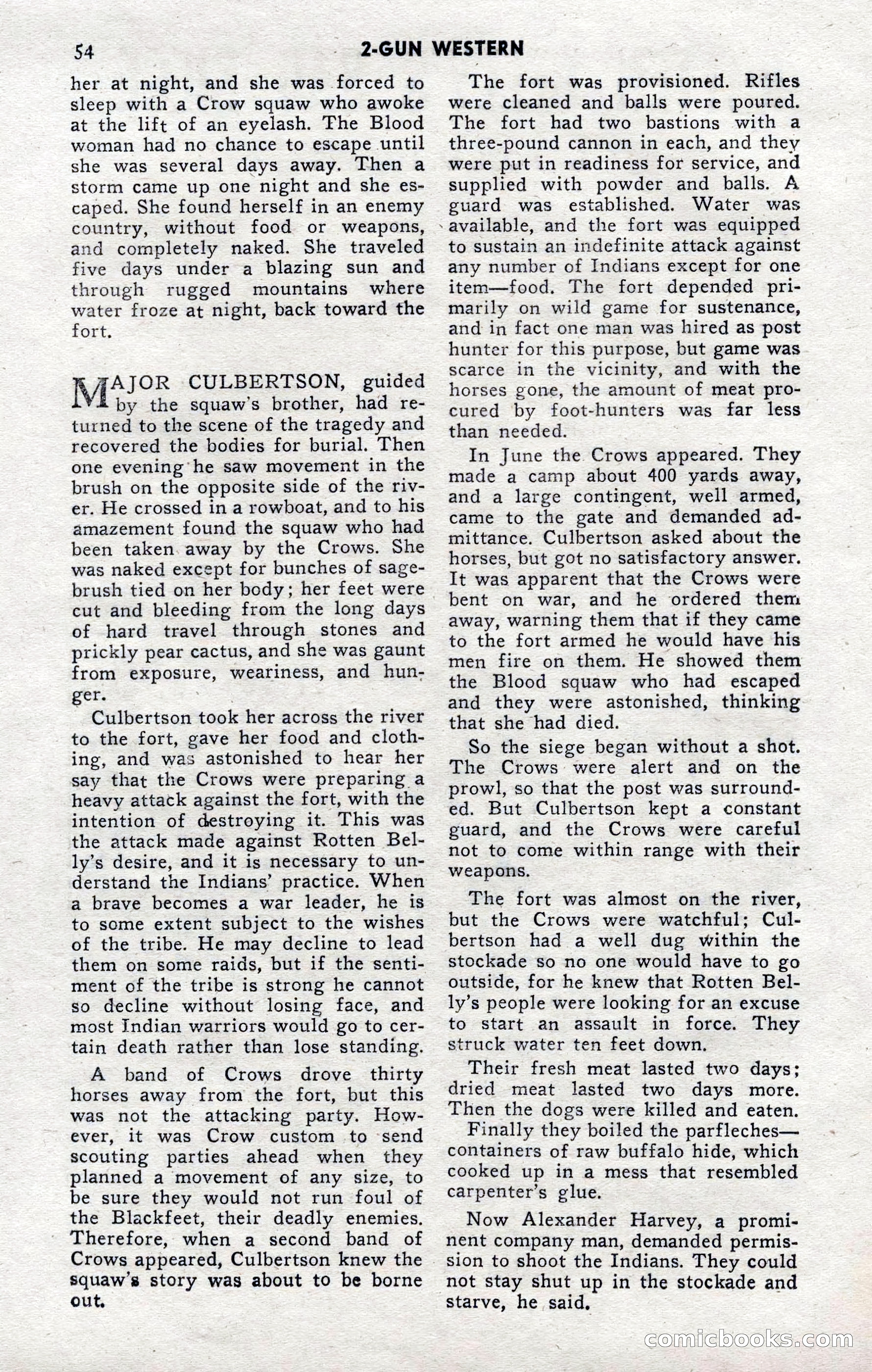
A restored page from Pulp Fiction, 1955. Page through the whole issue in the reader above.
📄 Transcribed text from this page (OCR, searchable)
Machine-transcribed from the original scan — historical spelling and the odd misread are preserved.
54 her at night, and she was forced to sleep with a Crow squaw who awoke at the lift of an eyelash. The Blood woman had no chance to escape until she was several days away. Then a storm came up one night and she es- caped. She found herself in an enemy country, without food or weapons, and completely naked. She traveled five days under a blazing sun and through rugged mountains where water froze at night, back toward the fort. MiasoR CULBERTSON, guided by the squaw’s brother, had re- turned to the scene of the tragedy and recovered the bodies for burial. Then one evening’ he saw movement in the brush on the opposite side of the riv- er. He crossed in a rowboat, and to his amazement found the squaw who had been taken. away by the Crows. She was naked except for bunches of sage- brush tied on her body; her feet were cut and bleeding from the long days of hard travel through stones and prickly pear cactus, and she was gaunt from exposure, weariness, and hun- ger. 3 Culbertson took her across the river to the fort, gave her food and cloth- ing, and was astonished to hear her say that the Crows were preparing a heavy attack against the fort, with the intention of destroying it. This was the attack made against Rotten Bel- ly’s desire, and it is necessary to un- derstand the Indians’ practice. When a brave becomes a war leader, he is to some extent subject to the wishes of the tribe. He may decline to lead them on some raids, but if the senti- ment of the tribe is strong he cannot so decline without losing face, and most Indian warriors would go to cer- tain death rather than lose standing. A band of Crows drove thirty horses away from the fort, but this was not the attacking party. How- ever, it was Crow custom to ‘send scouting parties ahead when they planned a movement of any size, to be sure they would not run foul of the Blackfeet, their deadly enemies. Therefore, when a second band of Crows appeared, Culbertson knew the squaw’s story was about to be borne out, 2-GUN WESTERN The fort was provisioned. Rifles were cleaned and balls were poured. The fort had two bastions with a three-pound cannon in each, and they were put in readiness for service, and supplied with powder and balls. A guard was established. Water was -available, and the fort was equipped to sustain an indefinite attack against any number of Indians except for one item—food. The fort depended pri- marily on wild game for sustenance, and in fact one man was hired as post hunter for this purpose, but game was scarce in the vicinity, and with the horses gone, the amount of meat pro- cured by foot-hunters was far less than needed. In June the Crows appeared. They made a camp about 400 yards away, and a large contingent, well armed, came to the gate and demanded ad- mittance. Culbertson asked about the horses, but got no satisfactory answer. It was apparent that the Crows were bent on war, and he ordered them away, warning them that if they came to the fort armed he would have his men fire on them. He showed them the Blood squaw who had escaped and they were astonished, thinking that she had died. So the siege began without a shot. The Crows were alert and on the prowl, so that the post was surround- ed. But Culbertson kept a constant guard, and the Crows were careful not to come within range with their weapons. : The fort was almost on the river, but the Crows were watchful; Cul- bertson had a well dug within the stockade so no one would have to go outside, for he knew that Rotten Bel- ly’s people were looking for an excuse to start an assault in force. They struck water ten feet down. Their fresh meat lasted two days; dried meat lasted two days more. Then the dogs were killed and eaten. Finally they boiled the parfleches— containers of raw buffalo hide, which cooked up in a mess that resembled carpenter’s glue. Now Alexander Harvey, a promi- nent company man, demanded permis- sion to shoot the Indians. They could not stay shut up in the stockade and starve, he said, Oo GCOMIIGboOolks (©)