
Pulp Fiction, 1955 · page 53 of 100
2-Gun Western, November 1955 — page 53: what you’re looking at
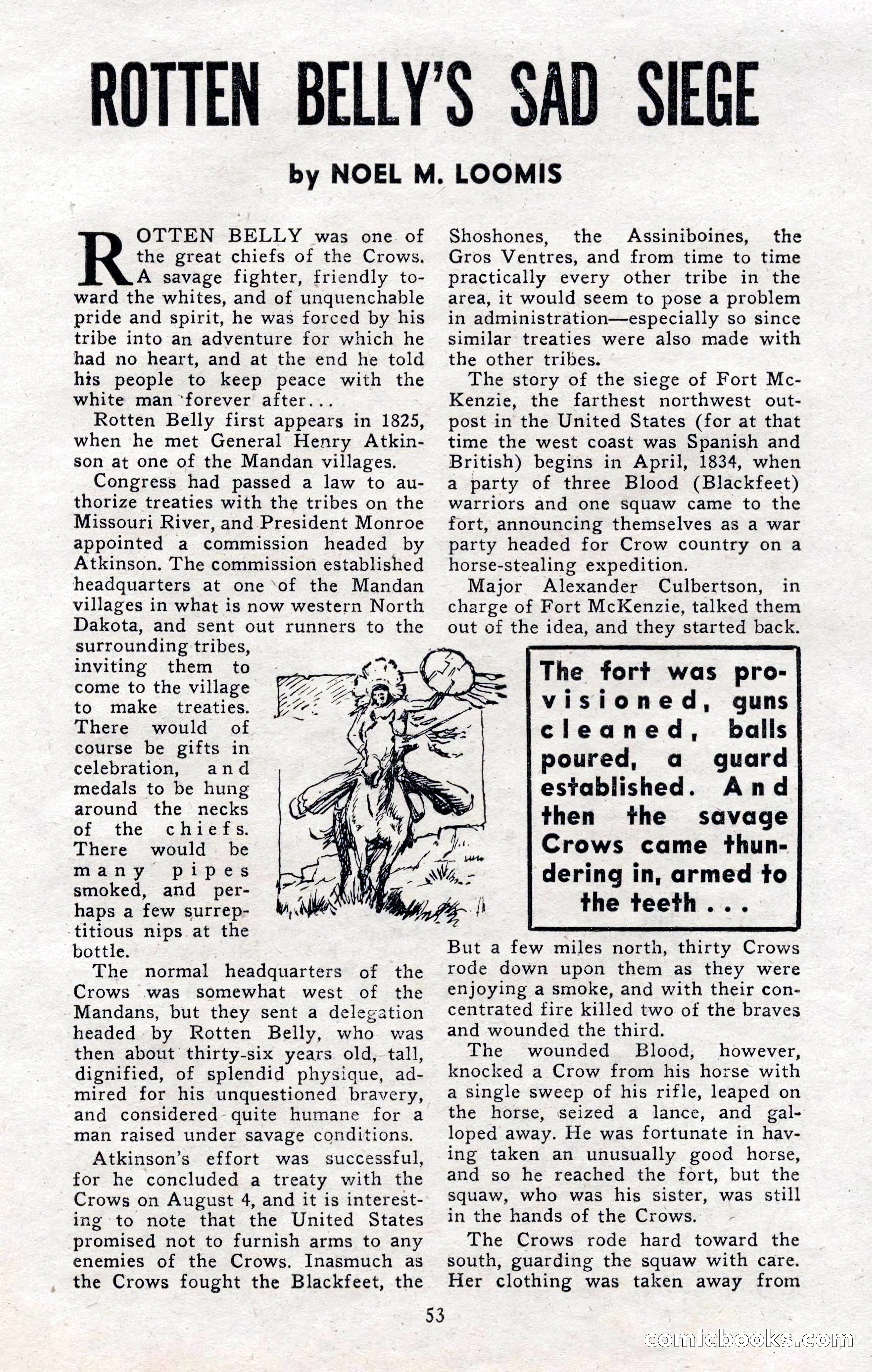
A restored page from Pulp Fiction, 1955. Page through the whole issue in the reader above.
📄 Transcribed text from this page (OCR, searchable)
Machine-transcribed from the original scan — historical spelling and the odd misread are preserved.
ROTTEN BELLY’S SAD SIEGE. by NOEL M. LOOMIS OTTEN BELLY was one of Re great chiefs of the Crows. A savage fighter, friendly to- ward the whites, and of unquenchable pride and spirit, he was forced by his tribe into an adventure for which he had no heart, and at the end he told hts people to keep peace with the white man ‘forever after... Rotten Belly first appears in 1825, when he met General Henry Atkin- son at one of the Mandan villages. Congress had passed a law to au- thorize treaties with the tribes on the Missouri River, and President Monroe appointed a commission headed by Atkinson. The commission established headquarters at one ‘of the Mandan villages in what is now western North Dakota, and sent out runners to the surrounding tribes, inviting them to come to the village to make treaties. There would of course be gifts in celebration, and medals to be hung around the necks of the. chTeers, There would be many pipes smoked, and per- haps a few surrep- -titious nips at the bottle. The normal headquarters of the Crows was somewhat west of the Mandans, but they sent a delegation headed by Rotten Belly, who was then about thirty-six years old, tall, dignified, of splendid physique, ad- mired for his unquestioned bravery, and considered- quite humane for a man raised under savage conditions. Atkinson’s effort was successful, for he concluded a treaty with the Crows on August 4, and it is interest- ing to note that the United States promised not to furnish arms to any enemies of the Crows. Inasmuch as the Crows fought the Blackfeet, the 53 Shoshones, the Assiniboines, the Gros Ventres, and from time to time practically every other tribe in the area, it would seem to pose a problem in administration—especially so since similar treaties were also made with the other tribes. The story of the siege of Fort Mc- Kenzie, the farthest northwest out- post in the United States (for at that time the west coast was Spanish and British) begins in April, 1834, when a party of three Blood (Blackfeet) warriors and one squaw came to the fort, announcing themselves as a war party headed for Crow country ona horse-stealing expedition. Major Alexander Culbertson, in charge of Fort McKenzie, talked them out of the idea, and they started back. The fort was pro- | ivisioned, guns cleaned, balls} | poured, 'established. And then the savage Crows came thun- dering in, armed to the teeth... But a few miles north, thirty Crows rode down upon them as they were enjoying a smoke, and with their con- centrated fire killed two of the braves and wounded the third. The wounded Blood, however, knocked a Crow from his horse with a single sweep of his rifle, leaped on the horse, seized a lance, and gal- loped away. He was fortunate in hav- ing taken an unusually good horse, and so he reached the fort, but the squaw, who was his sister, was still in the hands of the Crows. The Crows rode hard toward the south, guarding the squaw with care. Her clothing was taken away from oO connicloo € S a guard | CO